

What design options are available with powder coated aluminium products?
Powder coated aluminium products can be designed with a broad choice of colours, gloss levels, textures and specialist finishes. The selected coating can be matched to the product’s intended appearance and performance requirements, from smooth architectural finishes to textured or protective surfaces for demanding industrial applications.
Design options for powder coated aluminium products include the arrangement of coated and uncoated areas, single or multiple colour zones, surface reflectivity, tactile character, edge treatment and the way the finish accommodates the product’s geometry. The best choice is determined not only by appearance, but also by the component’s use, exposure conditions, cleaning requirements and the need for consistency across a production batch.
Colour layout and contrast
A product does not have to use one uniform appearance across every face. Separate areas can be specified for visual contrast, identification or assembly purposes, subject to the design allowing suitable masking during preparation and application. For example, a visible frame may use a different coating from an infill panel, while internal faces can be treated to complement the external surface without drawing attention to them.
Multiple colours require a clear coating schedule. The specification should identify which faces, edges, apertures and fixing areas receive each finish. This is particularly important for folded aluminium, assembled parts and profiles, where a coating boundary may be visible from more than one angle. Masking requirements should also be considered because protected areas may be left bare or require a defined transition between finishes.
Visual consistency across components
Where several aluminium parts form one product, the design should account for differences in section size, orientation and surface area. These factors can affect how the finished surface appears, even when the same coating specification is used. A coordinated brief should therefore identify the required relationship between panels, profiles, brackets, covers and other associated parts rather than specifying each item in isolation.
Sample approval can help establish the intended appearance before a larger batch is processed. A sample should be assessed under relevant lighting and viewed at the distances from which the finished product will normally be seen. This is useful when components are assembled together, when adjacent parts have different shapes, or when a consistent appearance is more important than an exact visual match between unrelated coating systems.
Designing around aluminium profiles and formed parts
Profiles offer opportunities to use the coating as part of the product’s visual structure. Recesses, grooves, flanges and raised details may be emphasised or visually blended depending on the selected specification. On folded or machined parts, the design should allow for access to the surfaces that need coating and should avoid creating concealed areas where preparation or coverage is difficult.
Sharp corners, narrow channels and closely spaced features can influence the final result. Suitable edge radii and sensible spacing make it easier to prepare the aluminium and achieve a more uniform finish. The design should also allow for coating thickness at mating faces, slots and threaded areas, since these may affect assembly tolerances if they are not protected or allowed for.
Perforations, apertures and edges
Perforated sheets and components with repeated apertures create a distinctive visual pattern, but the specification should cover both the front and reverse faces. The appearance of hole edges can be important where the product is viewed from different angles. Designers should consider whether the inside of apertures must be coated, whether the open area needs to remain unobstructed, and how the chosen finish will work with the spacing and shape of the perforations.
Edges also form part of the design. A visible coated edge can provide continuity around a panel, whereas a masked edge may be required for a joint, electrical contact, mechanical fit or later assembly operation. These requirements need to be identified before processing rather than treated as a finishing detail after the coating has been applied.
Combining appearance with practical use
The coating specification should reflect the conditions in which the aluminium product will be handled and used. A decorative appearance may need to be balanced against contact with moisture, dirt, cleaning products, abrasion, impact or repeated handling. Products installed in demanding industrial settings may require a design that disguises minor marking more effectively than a highly reflective surface, while components intended for visible architectural or equipment applications may prioritise uniformity and clean detailing.
Cleaning access is another design consideration. Deep recesses, narrow gaps and heavily textured areas can retain contamination more readily than simpler surfaces. If the product will be cleaned frequently, the geometry and selected surface character should work together so that dirt can be removed without excessive scrubbing or harsh treatment.
Information to include in a design brief
- Which faces and components are to be coated.
- The required colour reference and whether adjoining parts need to coordinate.
- Areas that must remain free from coating for assembly, electrical contact or dimensional reasons.
- Masking lines, permitted overspray and the treatment of edges, holes and recesses.
- Required appearance when parts are viewed together rather than individually.
- Expected exposure to handling, abrasion, moisture, chemicals and cleaning.
- Any critical dimensions or mating surfaces that must be protected during coating.
A complete drawing, finish schedule and sample approval process reduce ambiguity between design intent and production requirements. Powder coated aluminium can therefore be designed as more than a colour choice: the coating can define visual zones, support product identification, accommodate the component’s geometry and provide a surface appropriate to its working environment.
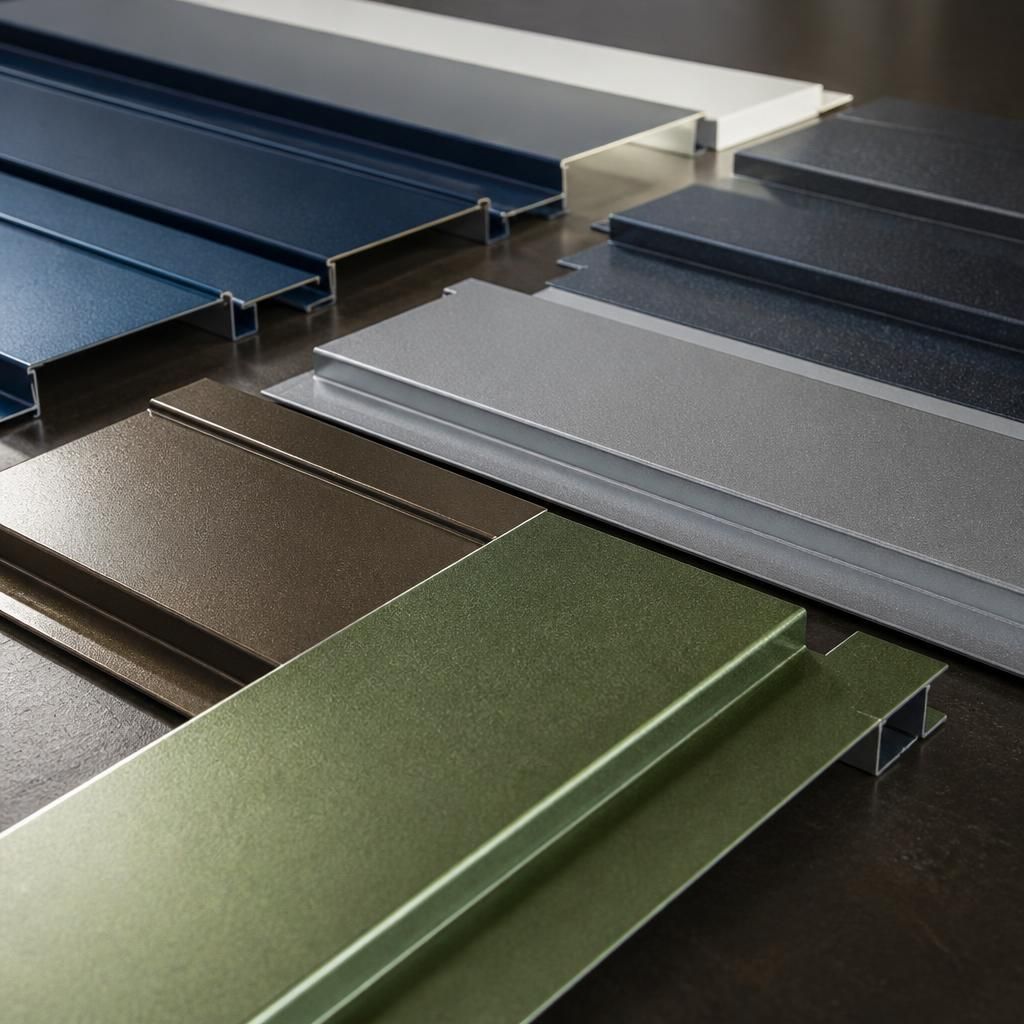
Metallic, mica and other effect powder coatings add visual depth beyond a standard solid colour, but their appearance depends more closely on application consistency. The orientation of profiles, panels and assembled parts should be considered during specification, as changes in viewing angle can alter how the effect is perceived across the finished product.
These finishes are best suited to designs where the visual character of the coating is part of the product’s identity. A clear finish schedule should state whether the effect is required on every visible face, which components must appear visually consistent, and whether adjacent parts can be assessed as a coordinated group rather than as isolated items. This helps distinguish a deliberate variation in appearance from an unwanted mismatch.
Discuss design options for powder coated aluminium products
If you are developing an aluminium component and need to confirm how its geometry, finish specification or masking requirements will affect the final appearance, discuss the design with a powder coating specialist. Providing drawings, finish references and details of critical areas will help establish a suitable coating approach.