

What is the powder coating process for enhancing perforated aluminium?
The powder coating process enhances perforated aluminium by cleaning and pre-treating the metal, applying electrostatically charged powder to its surface, then curing it in an oven to form a continuous protective finish. This produces an even coating across the sheet and perforations, adding durable colour and helping protect the aluminium from wear and environmental exposure.
The powder coating process for perforated aluminium is a controlled finishing procedure adapted to the sheet’s open area, hole pattern, thickness and intended use. In practice, the result depends not only on the powder and colour, but also on how the panel is prepared, supported, coated and inspected. Perforations create internal edges and recesses that require particular attention during handling and application.
1. Assessing the component before coating
The coater first reviews the aluminium’s dimensions, gauge, perforation size, open-area ratio and any formed edges or returns. These details influence how the sheet can be hung, how it drains during preparation and how air and powder move around the component. The specification should also identify the required colour, gloss level, texture, durability and service environment. Outdoor architectural panels, machine guards and internal equipment covers may require different coating systems.
Any areas that must remain uncoated, such as fixing faces, electrical contact points, threaded holes or close-fitting joints, are identified at this stage. Masking plugs, caps or high-temperature tape can then be selected to suit the geometry. Clear instructions about tolerances are especially useful where the finished panel must fit into a frame or connect to another coated component.
2. Preparing perforated aluminium
Preparation is more demanding than it is for a plain, uninterrupted sheet. The surface must be free from oil, handling residue, dirt and loose material, while the edges of each perforation need to be clean enough to accept the finish. The condition of the aluminium is checked for burrs, scratches, corrosion or embedded contaminants that could remain visible after coating.
Rinse and drainage are also important. Liquid used during preparation can collect around hole edges, in folded sections or against temporary supports. Components therefore need suitable orientation and thorough drying before powder is applied. Poor drainage can contribute to surface defects, adhesion problems or marks that only become apparent after curing.
3. Positioning, masking and earthing
Perforated sheets are normally supported so that they remain stable without excessive contact marks or distortion. The racking arrangement must provide a reliable earth connection to the aluminium; without this, electrostatic application becomes less consistent. Contact points are positioned where any small uncoated marks can be hidden, trimmed or accommodated in the final installation.
Parts are spaced to allow access to both faces and to reduce the risk of powder transfer between adjacent panels. Masking is fitted securely because loose material can obstruct perforations, leave unwanted uncoated areas or become difficult to remove after curing.
4. Applying powder to the hole pattern
Perforations can affect powder deposition because the edges and recesses alter the electric field. A heavy build-up on the front face may reduce penetration into the sides of holes, while excessive powder around an edge can soften the definition of the pattern. The operator adjusts gun distance, angle, movement and application settings to suit the component rather than treating it like a solid flat sheet.
Both faces may require separate attention, particularly where the hole walls are visible in the finished installation. The aim is a controlled film build that provides the specified appearance and protection without blocking openings, closing fine perforations or creating runs at the edges. The chosen powder must be compatible with aluminium and appropriate for the exposure conditions; a decorative interior grade is not automatically suitable for a demanding external or industrial environment.
5. Curing the finish
Once coated, the sheet is transferred carefully to the curing oven. The relevant cure schedule is determined by the powder system and the component itself, including its mass and thickness. The important consideration is the metal temperature achieved by the part, rather than simply the temperature displayed in the oven. Correct curing allows the powder to flow and cross-link into its intended finish.
Thin perforated aluminium can heat differently from heavier brackets or frames, so loading and oven conditions need to be controlled consistently. Excessive handling before the finish has fully cured can mark the surface or damage perforation edges.
6. Inspection and finishing checks
Inspection normally covers colour, gloss, texture, film continuity, coverage of hole edges, masking lines, contamination and visible blemishes. Dimensions and fit may also be checked where the coating affects an assembly or fixing location. The perforations are examined for obstruction, particularly when the design relies on airflow, acoustic performance, screening or accurate visual alignment.
After approval, components should be separated with suitable protective material and packed so that perforation edges do not rub against neighbouring panels. For B2B projects, supplying drawings or samples with the required finish specification helps maintain consistency across repeat batches.
For manufacturers, fabricators and construction-related businesses in the Midlands and surrounding areas, this process can be arranged as a batch service with collection and delivery options. Sharing the panel drawings, aluminium grade, intended environment and masking requirements before production allows the coating method to be matched to the finished application.
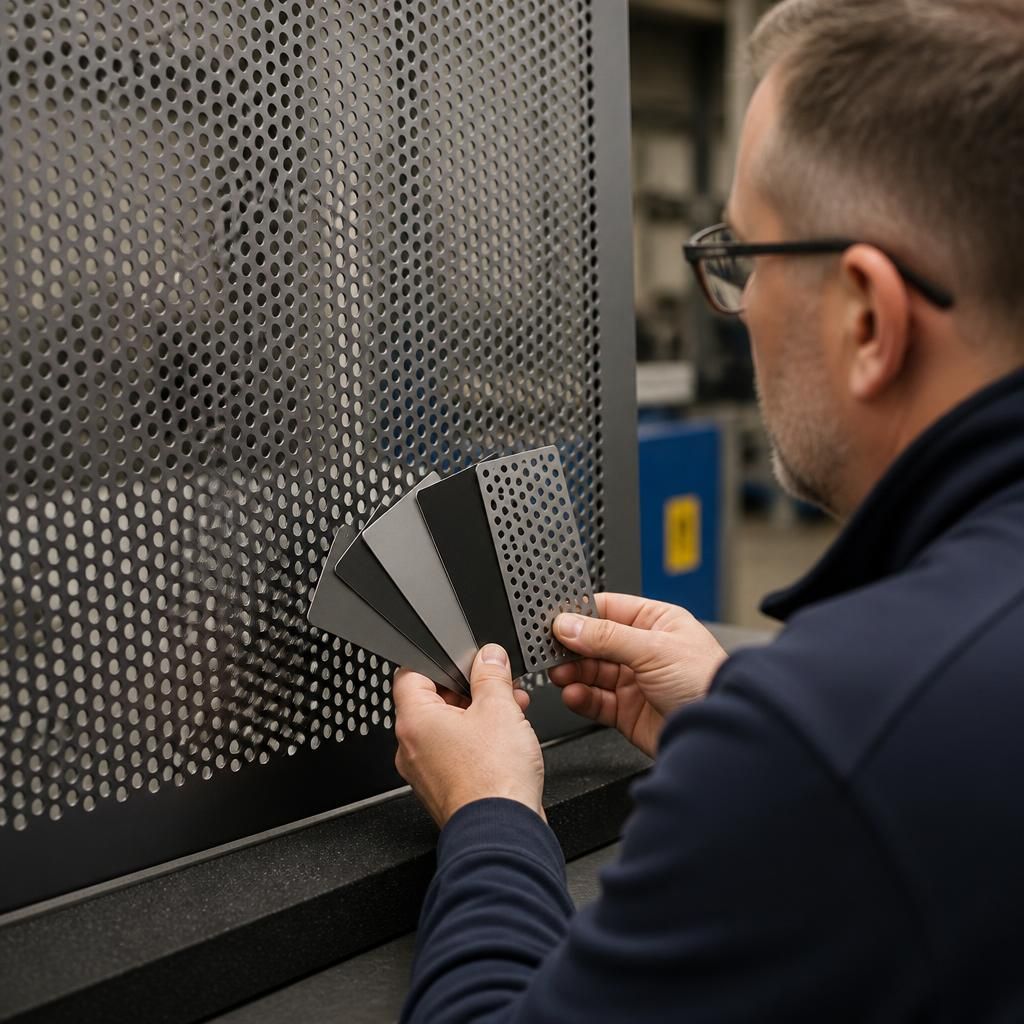
For perforated aluminium, the finished appearance depends on more than the powder colour. The open areas reveal the background behind the panel, so the perceived shade, contrast and gloss can change with the backing material, viewing angle and lighting. A representative sample should therefore be assessed in an orientation and setting similar to the final installation.
This check can also confirm that the selected film build preserves the visual definition of the perforation pattern and that the coating is compatible with adjacent components. Agreeing the sample and finish specification before the main batch gives the coater a clear reference for colour, texture, masking and overall appearance.