

What are the optimal applications for powder coated perforated aluminium in industrial settings?
Powder coated perforated aluminium is best suited to industrial applications requiring lightweight ventilation, airflow control, light transmission or visual screening with a durable, designed finish. Typical uses include machine guards, equipment enclosures, acoustic and environmental screening, building façades, ceiling and ventilation panels, and protective covers for industrial systems.
Powder coated perforated aluminium is most effective where an industrial component needs controlled air movement, reduced weight and a durable, specified surface finish in the same design. Its strongest applications are ventilated plant and equipment, screened service areas, architectural industrial fabrications and protective panels where the perforations must perform a defined practical function rather than serve only as decoration.
Ventilation and air-handling equipment
Perforated aluminium is well suited to air intake and exhaust panels, louvre assemblies, plant-room screens and ventilation covers. The perforated sheet allows air to pass while limiting direct access to internal equipment and giving the installation a more uniform appearance. Powder coating adds a consistent finish that can be coordinated with surrounding plant, frames or building elements.
The correct open area and hole pattern depend on the required airflow, pressure drop, noise considerations and the need to prevent the entry of larger debris. These factors should be established before the material is specified. A visually open pattern is not necessarily suitable for an application with precise ventilation requirements.
Generator, compressor and mechanical plant enclosures
Industrial machinery often requires protection without being enclosed in a solid panel that restricts cooling or access. Perforated aluminium can form sections of generator housings, compressor guards and mechanical plant enclosures, allowing ventilation while helping separate moving or hot equipment from nearby work areas.
It is important to consider vibration, heat, access for servicing and the strength of the supporting frame. The sheet itself may provide screening, but it should not be treated as a structural guard unless its thickness, fixing method and support arrangement have been engineered for that purpose.
Electrical and utility installations
Substations, control equipment, cable-management areas and other utility installations can use powder coated perforated aluminium for access panels and ventilated barriers. The material can help prevent accidental contact with equipment while retaining airflow around heat-producing components. It is also useful where a service area needs to remain visually accessible for inspection without leaving the equipment completely exposed.
Designers should assess electrical clearances, earthing requirements, security and the possibility of galvanic corrosion where aluminium is fixed directly to other metals. Isolation washers, suitable fixings and a correctly prepared interface may be necessary, depending on the surrounding construction.
Industrial building envelopes and internal partitions
On factories, warehouses and process buildings, perforated aluminium panels can be used for entrance features, plant-room façades, service-zone separation and internal screens. The perforations provide visual permeability, which can make equipment areas easier to monitor while avoiding the closed appearance of a solid wall. Powder coating allows the finish to be matched to a project colour scheme and applied consistently across panels, trims and associated fabricated parts.
For external use, the specification should account for exposure, drainage, movement and the method of attachment. Panel edges and cut-outs need particular attention because they are more vulnerable to damage during fabrication, handling and installation than the central face of the sheet.
Safety guarding and access-control panels
Where operators need to see machinery or processes while remaining separated from moving components, perforated aluminium may be suitable for secondary guarding and inspection screens. The open pattern can support visibility and ventilation, while the coating provides a cleanable surface. However, the application must comply with the relevant machinery-safety requirements. Mesh or a specifically engineered guard may be more appropriate where finger, hand or tool access must be controlled to a defined level.
Acoustic and environmental screening
Perforated aluminium can form part of a designed screening system around plant, loading areas and service compounds. It can soften the visual impact of mechanical equipment and provide a degree of separation without creating a completely solid barrier. Acoustic performance, however, depends on the complete system, including the panel, backing material, cavity and support structure. Perforated sheet alone should not be specified as a guaranteed noise-control solution.
Process and manufacturing environments
In manufacturing areas, powder coated perforated aluminium can be used for equipment covers, production-line screens, access doors and non-structural guards. It is particularly useful where panels need to be light enough for removal or handling but still require a finished, professional appearance. The design should account for contact with oils, cleaning chemicals, abrasive dust, elevated temperatures and repeated handling.
Standard architectural powder coatings may not be suitable for every process environment. Where chemical exposure, impact or unusual operating conditions are expected, the coating system should be selected with the substrate, pretreatment and service conditions considered together. Specialist protective or nylon coating requirements may need a separate technical review rather than being assumed from the colour or appearance alone.
How to decide whether it is the right application
- Airflow: establish the required open area and whether the perforation pattern will affect ventilation or pressure performance.
- Strength: match sheet thickness, panel size, folds and support spacing to wind, impact, vibration and handling loads.
- Exposure: assess moisture, pollutants, salt, process chemicals, heat and cleaning methods before choosing the coating specification.
- Safety: check aperture size, edge condition, access control and applicable guarding or building requirements.
- Appearance: define colour, gloss, texture and whether all visible faces, edges and folded sections require coating.
- Fabrication: confirm whether drilling, cutting, folding and welding will take place before coating, since post-coating work can expose unprotected aluminium.
- Installation: specify compatible fixings and allow for thermal movement, drainage and replacement of removable panels.
The optimal use of powder coated perforated aluminium is therefore determined by the balance between ventilation, visibility, protection, weight and environmental exposure. It is a strong choice for engineered panels and enclosures, but the perforation pattern, aluminium grade, fabrication method and coating system must be selected for the actual duty. A powder-coating specialist can review the component design and process requirements before production, including projects involving batch quantities, larger fabricated parts or protective coating specifications.
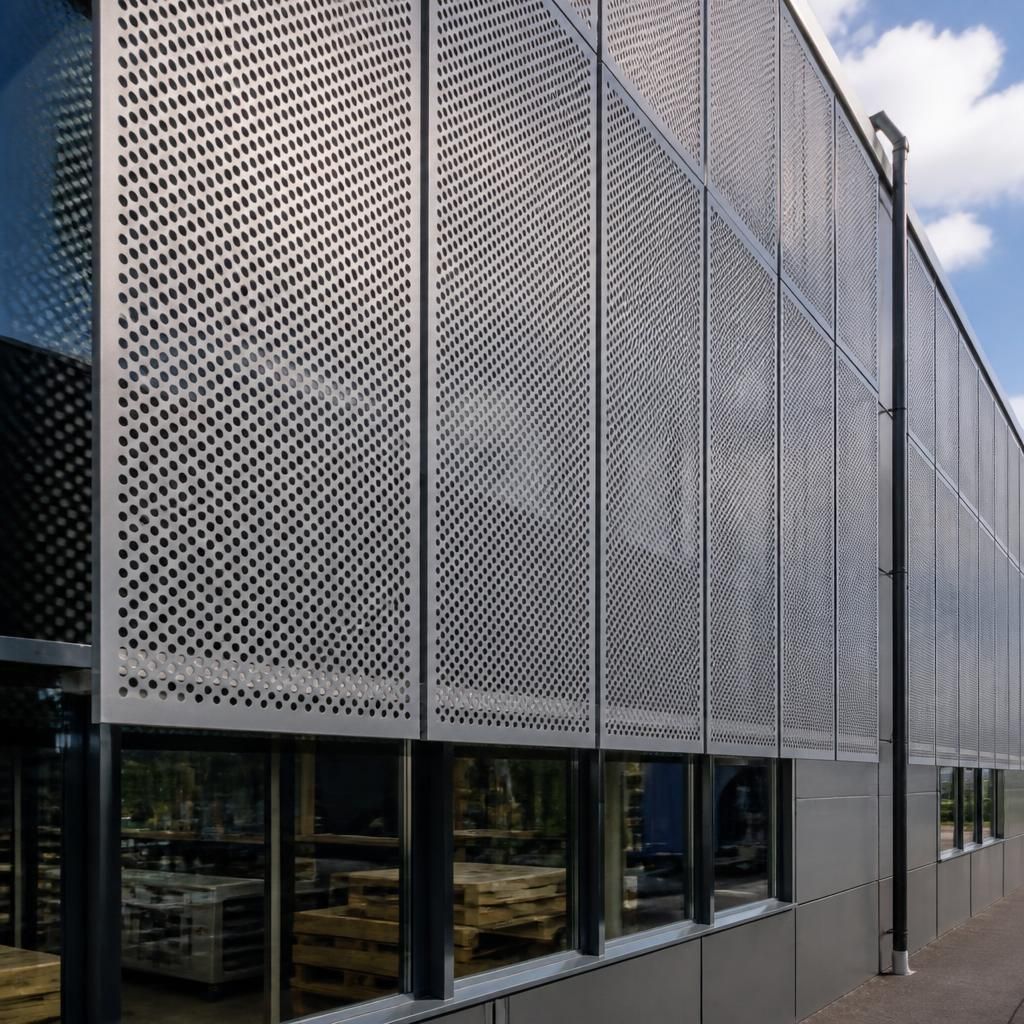
Solar-control screens are a further application for powder coated perforated aluminium on industrial buildings. Positioned over glazing or in front of exposed elevations, the panels can filter direct sunlight while retaining daylight, outward visibility and air movement. This makes them suitable for offices within factories, glazed workshops, entrance areas and service buildings where solid shading would be too restrictive.
The design should be based on the building’s orientation, sun path, panel angle, perforation pattern, stand-off distance and the performance of the glazing. These variables determine how much light and solar radiation reach the internal space. The screen must also be supported against wind loads and detailed to allow drainage, cleaning and access to the façade. Powder coating provides the specified colour and surface finish across the screening system, but the aluminium grade, pretreatment and coating specification should reflect the external exposure.