

What environmental factors should be considered when selecting powder coated aluminium sheets and coils for outdoor projects?
When selecting powder coated aluminium sheets and coils for outdoor projects, assess exposure to UV radiation, rain, humidity, temperature changes, airborne pollutants and coastal salt. These conditions influence the required coating formulation, colour stability, corrosion protection and surface durability, so the specification should match the installation environment.
The correct powder coated aluminium sheets or coils for an outdoor project should be selected according to the complete exposure conditions at the installation site, not simply the intended colour or finish. The assessment should cover the building’s orientation, local atmosphere, moisture behaviour, temperature movement, physical exposure, contact with other materials and the expected service life. These factors determine the coating system, finish, pretreatment and level of protection required.
Consider the position and orientation of the installation. A south-facing or highly exposed elevation may receive substantially more direct sunlight than a shaded or north-facing surface. Uneven exposure can lead to differences in colour retention, gloss and surface temperature across the same installation. Projections, overhangs and adjacent structures may provide some shelter, while open façades, roofs and elevated panels are more exposed to wind-driven moisture and airborne debris.
Design details also affect how environmental exposure is managed. Water should be able to drain away rather than remain in folds, laps, channels or horizontal areas. Persistent wetting can place greater demand on the coating and may allow corrosion to develop at cut edges, fixing points or damaged areas. The design should therefore avoid water traps and allow inspection and cleaning where necessary.
Assess condensation as well as rainfall. Aluminium sheets used on façades, roofs, canopies and enclosures may experience repeated cycles of condensation, particularly where warm internal air meets a cooler external surface. Insulation, ventilation and vapour control can influence this risk. Where the sheet forms part of a composite or enclosed construction, the specification should account for moisture that may become trapped between layers rather than relying solely on the external coating.
Allow for thermal movement. Aluminium expands and contracts as its temperature changes. Large sheets, long coils formed into panels and assemblies with rigid fixings may experience movement that places stress on joints, fasteners and the coating. The supporting structure, fixing method, joint design and tolerances should be compatible with this movement. This is especially important where aluminium is installed alongside materials that expand at a different rate.
Review contact with adjacent materials. Aluminium can be affected by prolonged contact with incompatible metals, treated timber, concrete residues, sealants or building chemicals. Moisture between dissimilar materials can create galvanic or chemical corrosion at interfaces. Isolating layers, suitable fixings and compatible sealants may be needed, while cement, mortar and alkaline residues should not be allowed to remain on the coated surface. Run-off from copper or other metals should also be considered because it can stain or affect the aluminium below.
Match the coating to the atmospheric severity. A clean inland setting generally presents a different risk profile from a heavily industrial or marine location. However, site assessment should consider the actual surroundings rather than relying only on broad geographic labels. Nearby roads, factories, chemical processes, agricultural activity, wastewater facilities and construction works can introduce contaminants that settle on the coating. In a marine setting, salt-laden moisture may reach sheltered recesses as well as exposed faces, so drainage, edge protection and maintenance access become particularly important.
Consider mechanical exposure from the environment. Windborne sand, grit and construction dust can gradually affect the appearance of a coating, while hail, maintenance equipment, falling debris and repeated contact can cause local impact damage. A smooth, high-gloss finish may make marks more visible than a textured or lower-gloss finish. Areas likely to be handled, walked near or exposed to abrasion may require a coating and design that prioritise surface durability over appearance alone.
Specify colour and gloss with exposure in mind. Dark colours can reach higher surface temperatures in direct sunlight, which may increase thermal movement and make dirt, fading or local damage more noticeable. Bright or highly saturated colours may also require closer attention to long-term colour stability. Where different batches or replacement panels may be needed, the project specification should record the coating colour, gloss level and system so that future work can be matched as closely as possible.
Check edges, formed areas and fabricated details. Bending, cutting, drilling and punching can expose areas that have not received the same protection as the main face of the sheet. Tight bends may also stress the coating if the material and forming process are not compatible. Selection should therefore include the intended fabrication method, edge treatment, hole protection and the condition of the coating after forming. Coils destined for profiling or panel manufacture need a system suitable for those processes, not just one that performs well on a flat surface.
Environmental selection should also include the project’s maintenance arrangements and expected replacement cycle. A finish that is difficult to access or clean may need greater resistance to soiling and a design that limits dirt retention. Where the installation is expected to remain in service for a long period, it is sensible to document the coating specification, fabrication requirements, compatible cleaning approach and inspection points before production begins.
In practice, the specification should identify the exposure category, likely contaminants, moisture and drainage conditions, solar orientation, thermal movement, contact materials, mechanical risks and fabrication method. This site-specific review provides a sound basis for choosing the powder coating formulation, colour, gloss, pretreatment and edge treatment for the aluminium sheets or coils.
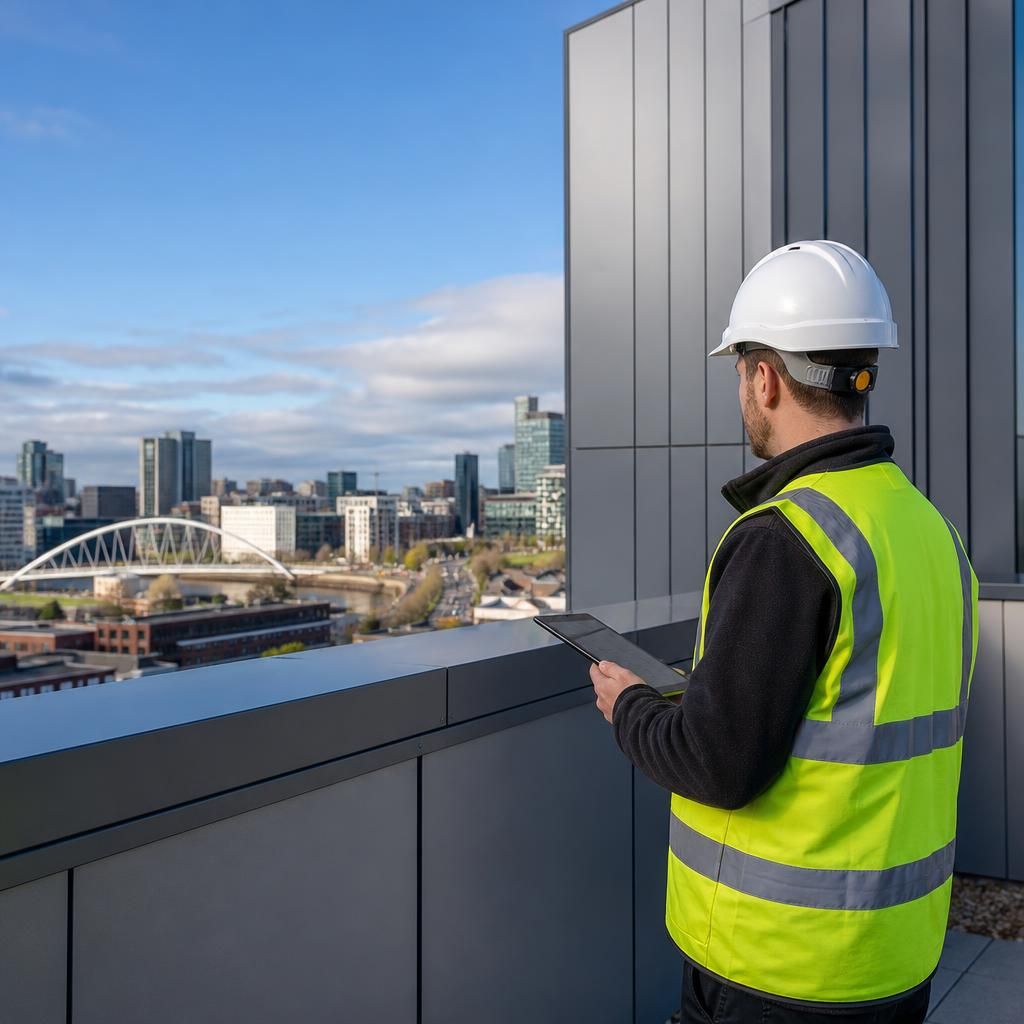
Environmental selection should also consider the aluminium sheet or coil’s whole-life impact, not only its resistance to outdoor exposure. For projects with sustainability requirements, review the aluminium’s recycled content, the coating system’s environmental documentation, and whether bonded or composite elements can be separated at the end of the installation’s service life.
Repairability is another relevant consideration. A finish that can be inspected, cleaned and locally managed without replacing large sections may reduce material use over time. Request the relevant technical and environmental information before final specification, including the coating system, substrate details and any limitations affecting future maintenance or recycling.
Discuss your outdoor aluminium coating requirements
Share your project drawings, installation environment and fabrication requirements with powder-coatings.co.uk for an informed discussion about suitable powder-coated aluminium sheets or coils. The team can help identify the relevant coating considerations before the specification is finalised.