

What are the available customisation options for powder coated aluminium sheets and coils to meet specific project demands?
Powder coated aluminium sheets and coils can be customised by selecting the coating colour, gloss or texture, material thickness and required sheet or coil dimensions. Project requirements may also determine the coating specification, edge treatment, cutting format and protective packaging needed for fabrication, transport or installation.
Customisation of powder coated aluminium sheets and coils involves specifying the aluminium grade, temper, coating arrangement, fabrication sequence and quality requirements around the finished application. These decisions are important because a sheet intended for folding, profiling, external cladding or industrial fabrication may need a different preparation and production route from a flat decorative panel.
Aluminium grade and temper are often the starting points. The alloy affects formability, strength, corrosion behaviour and compatibility with the intended fabrication process, while the temper indicates how the material has been treated mechanically. A more formable grade may be appropriate where the coated material will be bent or pressed, whereas a stronger option may be preferred for structural or heavily handled components. The selected material should be confirmed against the design loads, forming method and applicable project specification.
The coating sequence can also be adapted to the way the aluminium will be used. Powder may be applied to flat sheet before later profiling, or the aluminium may be fabricated first and coated as a completed component. Pre-coating can provide an efficient, consistent finish across a coil or repeated profile, but subsequent cutting, drilling and forming must be assessed carefully. Coating after fabrication can protect more of the finished part, although areas that are difficult to access may require particular attention during preparation and application.
Forming requirements should be discussed before production. Tight folds, deep pressing, roll forming and repeated manipulation can place stress on the coating. The design may therefore need an agreed bend radius, forming direction, corner detail or test piece. Where holes, slots or penetrations are required, their position and edge condition should be considered in relation to coating coverage and the risk of exposing bare aluminium during later fabrication.
Projects can specify masked or deliberately uncoated areas where electrical contact, welding, bonding, earthing or assembly tolerances make a coating unsuitable. Masking may be required on fixing faces, threaded features, folded joints or areas that must remain dimensionally precise. These requirements should be shown clearly on drawings, since masking locations and removal methods can affect production planning and the final appearance.
It is also possible to define the coating arrangement on each face. For example, the visible face may require a different performance requirement from the reverse side, or the back may need protection suitable for contact with another material. Where a panel will be enclosed, laminated, bonded or installed against insulation, compatibility between the reverse coating, adhesive and adjacent materials should be checked rather than assumed.
Surface preparation is another customisable part of the specification. Aluminium normally requires cleaning and a suitable conversion or pre-treatment process before powder application. The preparation method should reflect the service environment and the level of adhesion required. Any existing oxide, oil, handling residue or fabrication contamination needs to be removed, while sharp burrs and damaged edges should be addressed before coating.
For repeat production, the specification can include controls for batch consistency. Useful information may include:
- the approved material grade and temper;
- the coating system and application sequence;
- the faces or areas to be coated, masked or left untreated;
- the forming and fabrication operations to be completed after coating;
- the agreed appearance standard and acceptable surface variation; and
- the inspection, adhesion and curing checks required for the project.
A representative sample or trial piece can help confirm that the proposed material and process are suitable before a larger batch is released. This is particularly useful where the aluminium will be formed after coating, where several components must match, or where the finished surface will be viewed at close range. Drawings should identify critical edges, masking zones, inspection faces and assembly interfaces, rather than relying only on a general coating description.
For businesses preparing a specification, powder-coating specialists can review the material grade, fabrication sequence and coating requirements together. Powder-coatings.co.uk serves manufacturers, fabricators, construction firms and automotive businesses across the Midlands and surrounding areas, with collection and delivery options for suitable projects.
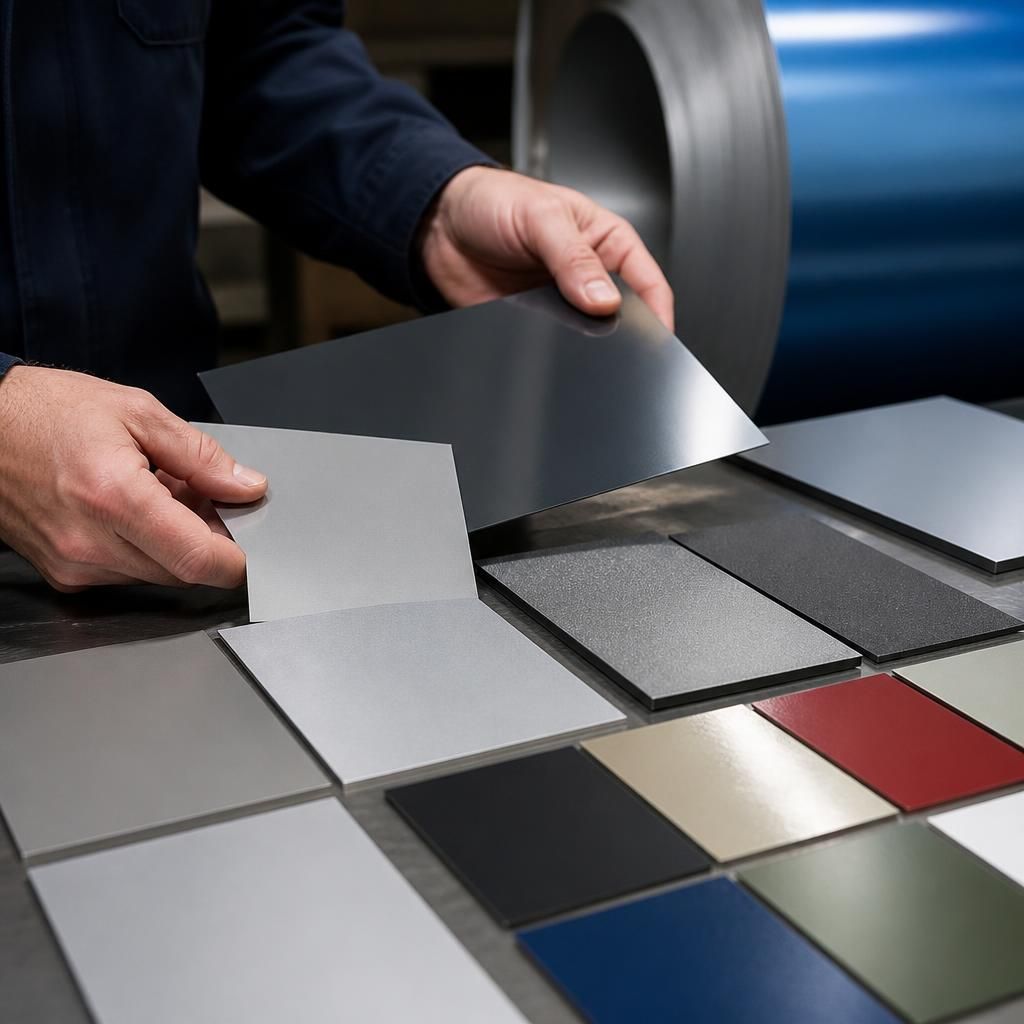
The visible appearance of powder coated aluminium sheets and coils can be tailored through colour, gloss level and surface texture. A smooth finish gives a consistent, easy-to-clean surface, while textured finishes can alter how light is reflected and may make minor handling marks less noticeable. Gloss selection should be considered alongside the viewing distance, lighting conditions and surrounding materials.
Colour approval is best based on a representative coated sample rather than a digital image alone. Metallic, textured and low-gloss finishes can appear different depending on light direction and panel orientation, so the required viewing conditions should be agreed before production. Where sheets or coils will be installed together, the specification should also identify whether colour and finish matching is required across separate batches.