

How does the thickness of powder coating impact the longevity and performance of aluminium sheets and coils in industrial applications?
Powder coating thickness affects how effectively aluminium sheets and coils resist abrasion, corrosion, weathering and handling damage. A coating that is too thin may provide inadequate protection, while excessive thickness can affect surface uniformity, edge coverage and the fit of finished components, so the specification should match the application and exposure conditions.
Powder coating thickness is the depth of the cured dry film covering the aluminium, and it directly influences how the finished sheet or coil behaves in service. The suitable thickness is not necessarily the greatest possible one: it is the level that provides continuous coverage while retaining the flexibility, dimensional accuracy, appearance and adhesion required by the component’s design and operating conditions.
Thickness and protective continuity
A consistent film helps seal the prepared aluminium surface and prevents isolated thin spots from becoming weak points in the coating system. If the film is below the coating system’s specified range, it may not fully conceal minor surface variation or provide a continuous barrier at every part of the profile. Increasing thickness can improve coverage only up to the limits of the powder formulation and application process; it cannot compensate for contamination, inadequate pre-treatment or poor curing.
For aluminium sheets and coils, consistency across the full width is particularly important. Variations can arise from changes in electrostatic attraction, powder flow, gun settings, line speed or part geometry. A specification should therefore state an acceptable dry-film range rather than relying on a nominal setting alone. Measurements taken at representative locations can identify whether the coating is being applied evenly and whether the process is suitable for the component.
Effect on forming and fabrication
Aluminium sheet and coil may be folded, pressed, roll-formed, punched or cut after coating, depending on the product and manufacturing sequence. A thicker film can have less tolerance for severe forming than a correctly specified thinner system, particularly over tight radii or at formed features. Excess film may craze, fracture or detach when the coating is forced beyond its flexibility. The powder type, cure condition, substrate preparation and forming radius are all important, so thickness should be selected with the intended fabrication method rather than considered in isolation.
Where a coated coil will be slit, profiled or formed, the supplier and fabricator should establish whether coating takes place before or after the operation. This determines where the film must withstand deformation and whether cut edges will subsequently need treatment. Holes, folds, joints and contact points should also be reviewed because they can impose greater stress on the coating than a flat panel.
Effect on finish and appearance
Film build affects how the cured powder flows and how the finished colour, gloss and texture are perceived. An insufficient build may produce weak visual coverage, whereas excessive build can contribute to an uneven texture, pronounced orange peel or differences between flat and formed areas. This is especially relevant where adjacent panels must match or where a smooth architectural appearance is required.
Metallic, textured and special-effect powders can be more sensitive to application conditions than straightforward solid colours. The agreed coating range should be checked against the powder manufacturer’s technical data, and sample panels may be appropriate where colour matching or appearance across a large batch is important. Visual assessment should be combined with measured film thickness rather than used as the only quality check.
Effect on adhesion and curing
Thickness does not determine adhesion by itself. Aluminium needs suitable cleaning and pre-treatment so the powder can bond to a stable surface. The coating must then reach the required cure condition throughout the film. If the layer is too heavy for the specified oven cycle, the outer surface may appear cured while the full film has not achieved the intended properties. Conversely, an under-applied or inadequately cured film may have reduced cohesion even if its measured thickness appears acceptable.
For this reason, coating approval should consider the complete system: aluminium grade and condition, surface preparation, powder chemistry, application method, dry-film thickness and cure schedule. A change in one of these factors may require the thickness range or process settings to be reviewed.
Thermal and electrical considerations
Powder coating is electrically insulating, so film thickness can matter where aluminium forms part of an earthing path, electrical enclosure or component requiring controlled surface resistance. Contact areas may need to remain uncoated or be masked according to the design. Masking should be defined before production because removing cured powder later can damage surrounding areas.
The coating also adds a layer between the aluminium and its surroundings. For ordinary panels this is rarely the controlling design factor, but heat-transfer components, heat sinks and enclosures with specified thermal performance require separate consideration. In these applications, the coating thickness, colour, exposed surface area and operating temperature should be assessed together with the aluminium’s heat-dissipation role.
How to select and verify the thickness
- Define the service environment, expected loading and fabrication route before choosing the coating range.
- Use the powder system’s technical data and the project specification to set a minimum, target and maximum dry-film thickness.
- Identify areas that must remain free from coating, including electrical contacts, threaded features, sliding fits and precision interfaces.
- Confirm that the selected build is compatible with bending, roll forming, punching or other post-coating operations.
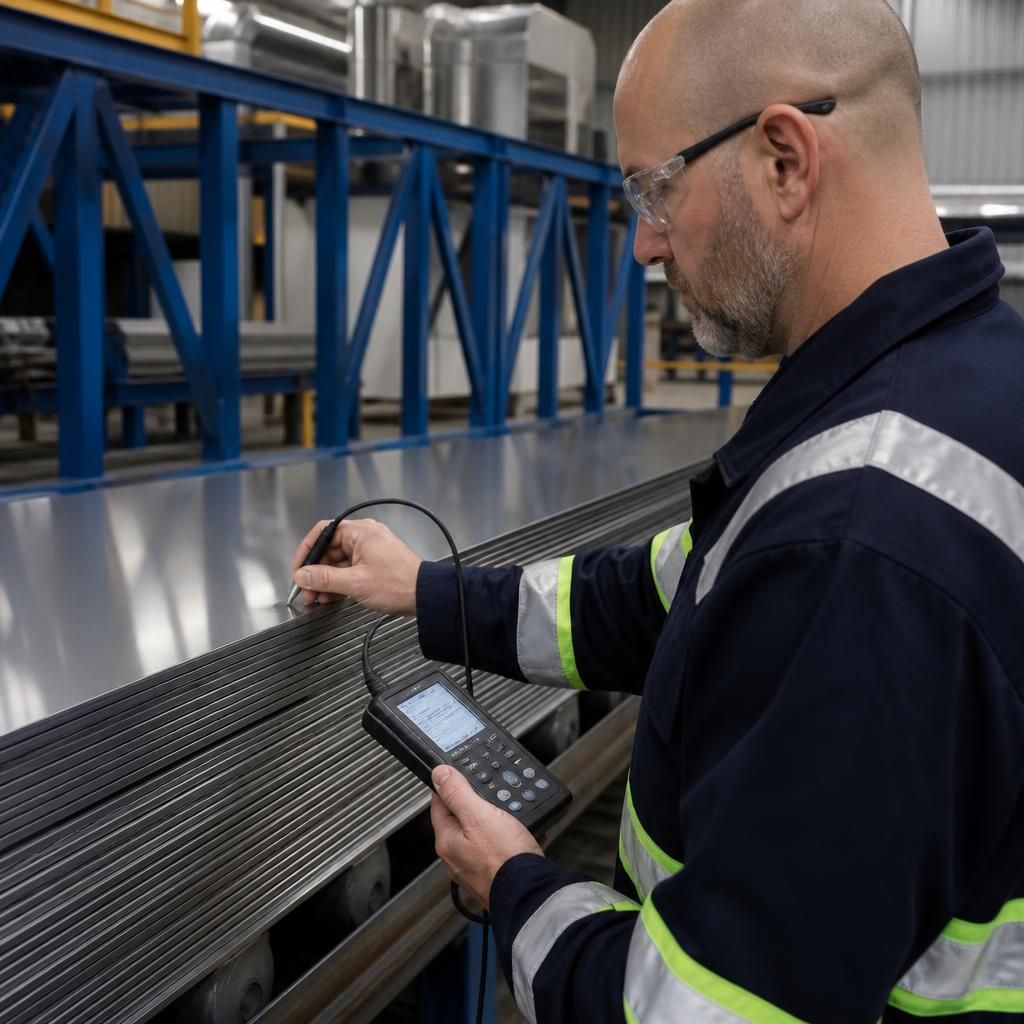
- Measure cured film thickness using a suitable non-destructive gauge on representative areas, with the gauge checked for calibration and correct use on aluminium.
- Investigate readings outside the agreed range rather than simply adding another coat, since recoating can affect adhesion, appearance and dimensional fit.
For continuous coil coating, the line’s application and curing controls should be assessed across the coil width and through the production run. For individual sheets or fabricated parts, attention should be given to geometry, recesses and areas that influence powder deposition. In both cases, the best result comes from matching the dry-film specification to the finished component’s function, manufacturing sequence and required appearance—not from treating thickness as a standalone measure of quality.
Powder coating thickness is only one factor in the service life of aluminium sheets and coils. A thicker film does not automatically provide better resistance to ultraviolet exposure, chemicals, moisture or temperature changes; the powder chemistry, surface preparation and curing process must also be suitable for the environment.
For industrial applications, specify the coating by considering the actual exposure and type of damage expected. An exterior panel may need a system selected for weathering, while a fabricated component exposed to friction or cleaning chemicals may require different performance characteristics. Matching the coating formulation and verified film range to these conditions gives a more reliable result than increasing thickness alone.