

How do I choose the right thickness for powder coated aluminium sheets and coils?
Choose the aluminium gauge based on the sheet or coil’s structural requirements, including span, loads, forming, handling and installation conditions, rather than using coating thickness as a substitute for material strength. Specify the powder coating separately according to the required durability, appearance and exposure conditions, and confirm both choices against the finished component’s design and application.
The correct specification uses two separate thicknesses: the aluminium substrate thickness and the cured powder coating film thickness. The substrate determines the component’s section, stiffness, forming behaviour and resistance to handling damage, while the coating thickness relates to coverage, protection, appearance and dimensional fit. They should be selected together as part of the finished component specification, not treated as interchangeable measurements.
Start with the design information rather than choosing a familiar gauge. Review the component’s shape, unsupported areas, edge details, fixing arrangement and how it will be handled before installation. A flat sheet, folded panel, profiled strip and deep-formed part can require different aluminium thicknesses even when they have similar overall dimensions. Drawings should identify unsupported spans, holes, cut-outs, returns and folded edges, since these features affect rigidity and the way the part can be manufactured.
For sheets used as panels or covers, consider how much deflection is acceptable under the expected service loads. A thinner sheet may be suitable where the design includes stiffening folds, closely spaced supports or a formed profile. A thicker sheet may be more appropriate where the surface is broad, lightly supported or likely to experience repeated handling. The choice should be verified against the design loads and fixing method rather than inferred from the panel’s appearance.
For coils, the required thickness is also influenced by the downstream process. Confirm whether the material will be slit, blanked, roll-formed, pressed or folded, and whether the finished profile needs a particular bend radius. The selected thickness must work with the tooling and forming sequence without producing unacceptable distortion, cracking at bends or damage to the coated surface. If forming takes place after coating, the coating system and bend geometry need to be assessed together; if the aluminium is coated after fabrication, access to all required surfaces becomes an additional consideration.
Do not specify only a nominal thickness. Ask for the applicable material grade, thickness tolerance and flatness requirements, particularly where parts must fit together, pass through guides or align with pre-drilled holes. Small differences between nominal and supplied dimensions can affect folded dimensions, joint gaps, clips, seals and clearances. The drawing or purchase specification should state whether the stated dimension refers to the bare aluminium or the completed coated part.
The coating specification should then define the required cured film thickness as a controlled range suitable for the selected powder system and exposure. Applying more powder is not automatically a better solution. An excessive film can alter edge definition, affect assembly clearances, soften fine detail and contribute to defects such as runs, orange peel or poor curing. Too little coating can leave inadequate coverage, particularly around edges, corners and formed features. The appropriate range should therefore be confirmed against the coating manufacturer’s technical requirements and the component’s service conditions.
Allow for the coating when checking interfaces and tolerances. This is important where coated aluminium sheets or coils are used with sliding parts, threaded fixings, press-fit components, seals, folded returns or interlocking profiles. Identify functional surfaces that must remain within a tighter dimensional limit and distinguish them from purely cosmetic surfaces. Where a close fit is unavoidable, agree how the coating will be applied, measured and protected during subsequent handling.
A practical selection review should cover:
- the required aluminium grade and nominal substrate thickness;
- permitted thickness, flatness and dimensional tolerances;
- the finished shape, unsupported span, stiffening features and fixing pattern;
- the forming method, minimum bend requirements and risk of coating damage;
- the coating route, including whether coating occurs before or after fabrication;
- the specified cured coating thickness and how it will be checked;
- the exposure, appearance and edge-coverage requirements; and
- any assembly clearances, masking areas or surfaces that must remain uncoated.
Samples or a representative first-off component can be useful where the part combines tight tolerances, formed details and a visible finish. Inspect the substrate dimensions before coating and the finished dimensions afterwards, rather than relying on a visual assessment alone. Check bends, corners, holes, edges and mating faces because these areas are more likely to reveal problems than a broad, flat surface.
For a production order, provide the coater with the latest drawing, material specification, coating requirements, critical dimensions and handling instructions. Powder coating specialists can use this information to identify where the selected aluminium thickness, forming method and film-build requirement may conflict. This approach produces a specification that is suitable for manufacture and installation, rather than selecting a thickness in isolation from the finished application.
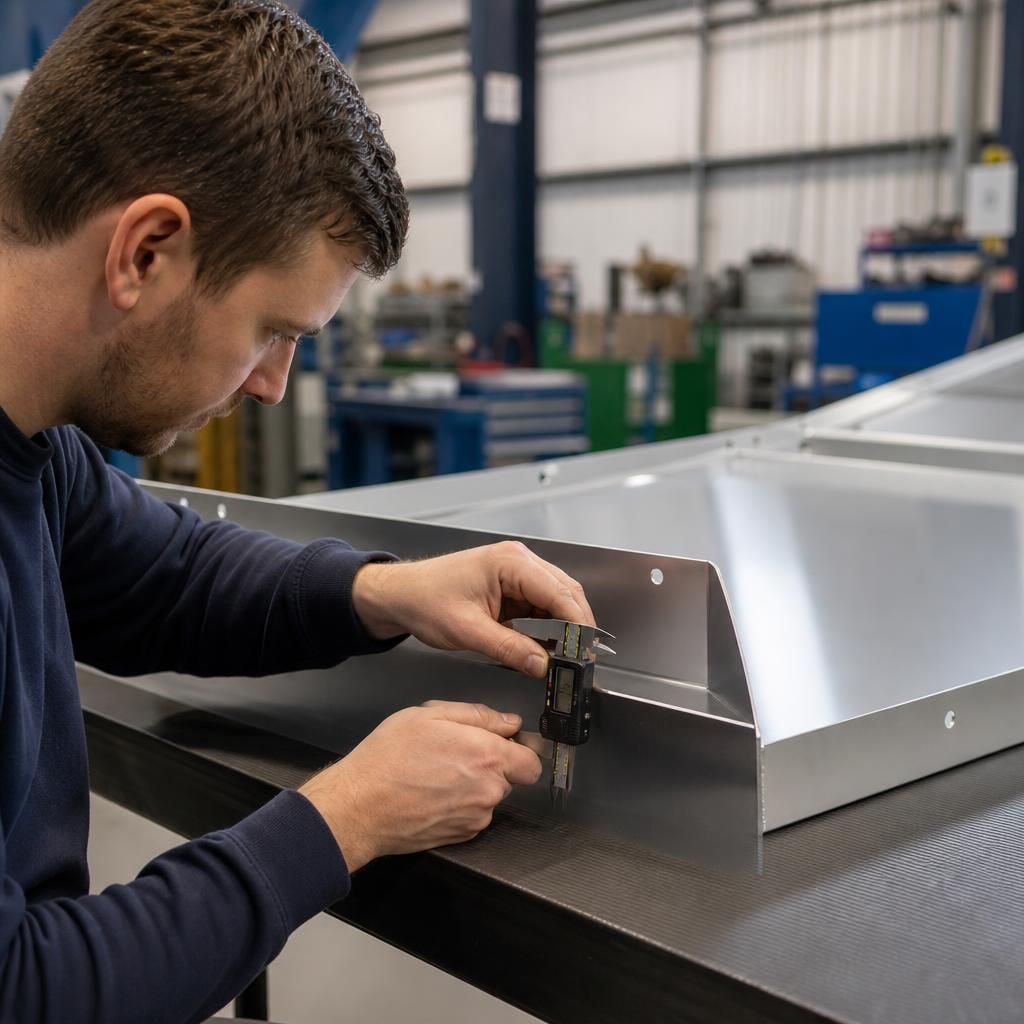
Thickness selection should also account for local stability, not just overall span. A broad aluminium panel may have adequate material strength yet still show oil-canning, vibration or local buckling between fixings if its unsupported areas are too flexible. Stiffening ribs, returns, folded edges and closer support spacing can improve stability without simply increasing the gauge across the entire component.
Review these details on the fabrication drawing, particularly around large flat faces, access openings, corners and fixing points. The preferred solution may be a different combination of substrate thickness and formed geometry, provided it remains compatible with the required bend radii, coating process and installation tolerances.
Discuss your aluminium thickness requirements
Discuss your aluminium thickness requirements with a powder coating specialist, providing the drawing, forming details, tolerances and intended exposure conditions. This allows the substrate and coating specifications to be reviewed together before production.