

What specifications and certifications should be verified when selecting powder coated aluminium profiles for compliance in industrial projects?
Verify the aluminium profile’s coating system, specified film thickness, colour and gloss tolerance, pretreatment, curing requirements, adhesion and corrosion-resistance performance against the project specification and relevant standards. Check that the coater can provide current certification, test reports, batch traceability and declarations covering the required environmental, fire or sector-specific compliance obligations.
Compliance verification for powder coated aluminium profiles should cover three linked areas: the profile itself, the coating specification and the evidence supplied by the processor. A suitable certificate is not sufficient on its own; its scope, date, issuing body, covered site, test method and relationship to the exact profile and end use must all be checked against the project’s contractual requirements.
Start with the project and profile requirements. Confirm the aluminium alloy, temper, extrusion dimensions, wall thickness, permitted dimensional tolerances and any requirements for mechanical performance. These details can affect coating coverage, heat transfer during curing and the behaviour of the finished component. Drawings should identify faces that will be visible, areas requiring masking, joint interfaces, drainage paths, fixing points and surfaces that must remain uncoated for electrical bonding or assembly.
Also establish whether the profile is part of a wider tested or certified product. A coated extrusion used in a façade, window, balustrade, machine enclosure or transport component may need to meet requirements as part of the complete assembly. The coating certificate cannot automatically demonstrate that the finished construction meets requirements for structural performance, weather resistance, fire behaviour or safety.
Check the standard’s precise scope. Standards and schemes are not interchangeable. Verify that the stated document applies to:
- aluminium rather than another substrate, such as galvanised steel;
- the coating type and intended exposure category;
- the profile geometry and proposed application method;
- the required colour range, finish and appearance class;
- the environment in which the component will be installed; and
- the current edition or contractually specified edition of the standard.
For architectural aluminium, a recognised quality scheme such as QUALICOAT may be relevant, while GSB approval can be relevant to certain coating applications. Their requirements can cover the approved coating materials, preparation, production controls and testing. The project team should confirm whether the scheme is mandatory, preferred or simply being used as a benchmark. It should also check that the certificate covers the actual coating plant and process, rather than relying on a powder manufacturer’s approval that does not certify the applicator’s work.
Separate product certification from management-system certification. A quality-management certificate, such as ISO 9001, indicates that an organisation operates a documented management system; it does not prove that every coated profile complies with the project specification. Similarly, laboratory accreditation demonstrates competence for specified test methods, but it does not certify the performance of an individual production batch. Ask what each document proves and what it does not prove.
Where independent testing is required, examine the laboratory’s scope of accreditation and confirm that it includes the relevant method. Test reports should identify the sample, substrate, coating system, preparation process, conditioning, test procedure, results and acceptance criteria. A generic report for a similar product should not be treated as batch-specific evidence unless the contract permits that approach.
Verify the evidence trail from raw profile to finished batch. The documentation should allow the finished parts to be linked to the supplied aluminium, the coating material and the production records. Useful records may include:
- profile drawings, material certificates and delivery documentation;
- coating product identification, technical data and batch references;
- pre-treatment and production records;
- equipment calibration records for inspection instruments;
- inspection results linked to a defined production batch; and
- non-conformance reports and agreed corrective actions, where applicable.
Traceability is particularly important where profiles are delivered in multiple batches or where components are assembled by different contractors. Agree in advance how batches will be marked, what records will accompany delivery and how retained samples or reference panels will be identified.
Clarify declarations and regulatory documentation. A declaration of performance, declaration of conformity or UKCA or CE marking may be relevant to a complete regulated product, but the requirement depends on the product category and the applicable legislation. Powder coating alone does not automatically make an aluminium profile a marked construction product. The manufacturer, fabricator, designer or system supplier may hold the relevant responsibility, so the compliance route should be confirmed by the project’s appointed technical authority.
For projects with material-restriction requirements, request the relevant substance declarations, such as information relating to REACH or RoHS where applicable. Environmental claims should also be supported by appropriate evidence rather than general statements. Depending on the procurement criteria, this could include an environmental product declaration, recycled-content evidence or information about the coating material’s environmental profile. Check that the document covers the specified product and not merely a product family or an unrelated raw material.
Treat fire compliance as an assembly issue. A powder-coated aluminium profile should not be assumed to have a particular fire classification solely because the coating material has been tested. Fire performance can depend on the profile design, substrate, coating build, backing materials, fixings and complete installation. Where fire classification is required, request evidence for the finished system or a technically justified application of the test result. Confirm the classification standard, test direction, substrate and installation conditions before accepting it.
Agree inspection and acceptance criteria before production. The specification should state how appearance and workmanship will be judged, including the viewing distance, lighting conditions, acceptable variation between components, treatment of minor marks and the procedure for approving a sample. A master sample or control panel can help establish an agreed visual reference, but it should not replace documented technical requirements.
For larger or safety-critical work, define who will inspect, when inspection will take place and what happens if a result falls outside the agreed limit. Inspection records should identify the equipment used and show that measuring instruments were suitably calibrated. Any repair, rework or replacement should be recorded and assessed for its effect on the original compliance evidence.
Before placing an order, issue the coater with the full specification, drawings, exposure conditions, required declarations and acceptance criteria. Ask the coater to return a compliance schedule showing each requirement, the document that supports it, its validity and any exclusions. This makes gaps visible before production and provides a clearer basis for technical approval, delivery checks and future audit queries.
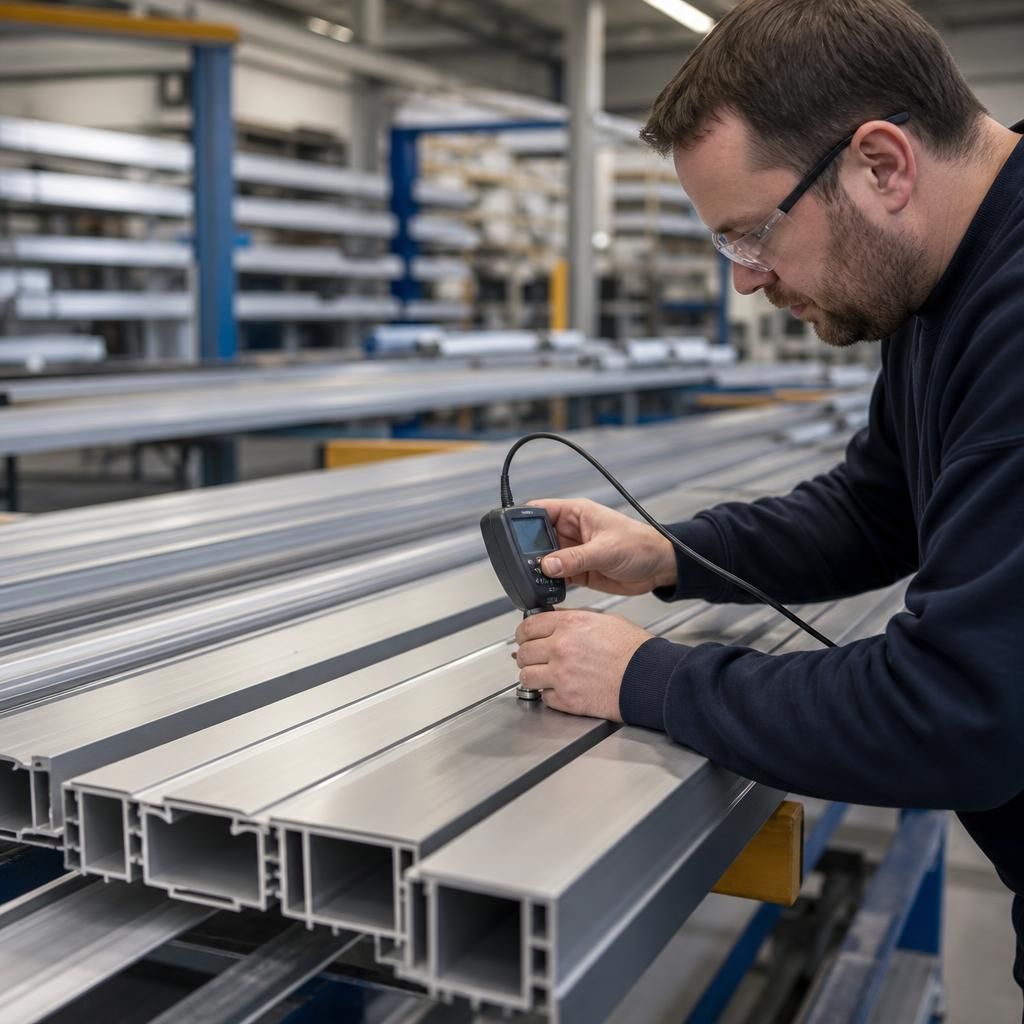
Film thickness should be verified using an agreed measurement method and sampling plan, rather than judged from appearance alone. Profile geometry can produce different coating build on broad faces, edges, recesses and areas close to masked sections, so the specification should identify the surfaces to be measured and the acceptance limits for each relevant area.
Before production, confirm whether readings are required on every profile, a defined sample from each batch or selected reference pieces. The record should identify the part, measurement locations, instrument and results, while any inaccessible or unsuitable areas should be dealt with through an agreed inspection method. This creates a clear link between the specified coating build and the actual finished aluminium profiles.
Discuss your powder coated aluminium profile compliance requirements
Discuss your powder coated aluminium profile requirements with our technical team and provide your drawings, exposure conditions and compliance criteria for review. We can help identify the documentation and inspection evidence needed before production.