

What are the key benefits of choosing powder coated aluminium profiles over other finishing methods?
Powder coated aluminium profiles provide a tough, consistent finish with strong resistance to wear, corrosion and weathering when the coating is correctly specified. Compared with many liquid paint systems, powder coating also offers broad colour and texture choice, reliable coverage and straightforward maintenance, while avoiding the drying and solvent-handling requirements associated with some alternative finishes.
Powder coated aluminium profiles offer a combination of design freedom, process consistency and functional protection that can be difficult to achieve with anodising or liquid paint alone. The main advantages are the ability to specify a controlled, opaque finish across complex sections, apply a wide range of decorative effects, and produce repeatable results suitable for manufactured components and architectural or industrial assemblies.
More control over appearance
Aluminium profiles are often used where visible surfaces, joins and long runs must form a coherent finish. Powder coating provides control over colour, gloss level and surface effect, allowing profiles to be matched with other coated metalwork or incorporated into a wider design scheme. The coating is opaque, so it can also provide a more uniform visual result than finishes that depend on the underlying appearance of the aluminium.
This is particularly useful where the profile contains extrusion lines, minor variations in the substrate or different faces that need to appear visually consistent. Textured and fine-effect finishes can also alter the perceived surface character without changing the profile itself. The selected finish should still be approved against a physical sample, as lighting, viewing distance and profile geometry can affect how a colour or texture appears.
Coverage of complex profile shapes
Aluminium extrusions may include grooves, recesses, returns, flanges and other details that are difficult to finish evenly by hand. Powder application uses electrically charged particles attracted to the grounded metal, helping the coating reach a broad range of profile surfaces. Application remains dependent on part orientation, recess geometry, masking and the chosen powder, but the process is well suited to repeatable treatment of engineered sections.
Compared with brushing or spraying liquid paint, this can reduce visible application marks and variation between faces. It also allows the coating specification to be considered alongside the profile design, so areas that must remain uncoated, accept fasteners or fit into another component can be masked or otherwise protected during processing.
Repeatability for production work
For batches of aluminium profiles, powder coating supports a defined process specification covering preparation, powder selection, application and curing. Once the requirements have been established, the same control points can be applied to subsequent batches. This is valuable where profiles are installed across one project or used as recurring parts in manufactured products.
Repeatability does not mean that every powder is interchangeable. Substrate preparation, coating chemistry, film thickness, curing conditions and handling all influence the final result. Profiles should therefore be assessed as a complete system rather than choosing a colour in isolation. Long sections may also need suitable racking and handling arrangements to prevent contact damage before installation.
Protection without changing the profile design
Powder coating adds a protective film to the aluminium while retaining the underlying extrusion shape and its intended dimensions. This can be preferable to processes that alter the surface through chemical conversion or require a particular substrate appearance. A correctly selected system can help protect exposed faces during manufacture, transport and service, while the profile remains suitable for cutting, assembly and integration into a larger component where the design allows.
Dimensional requirements still need careful consideration. Coating adds film thickness, and close-fitting interfaces, slots, threads, sliding areas and connection points may require masking or allowance in the design. The benefit is greatest when these requirements are identified before coating rather than treated as a correction after processing.
Efficient use of material
Powder coating is a dry application process. Unattached powder can, where the equipment and specification permit, be collected for controlled reuse, which may reduce material wastage compared with processes in which liquid coating is lost through overspray or evaporation. The exact environmental performance depends on the powder type, pretreatment, curing energy, recovery arrangements and how the finished profiles are handled.
The absence of liquid solvents in the powder itself can also simplify certain handling and workplace considerations. This does not remove the need for suitable extraction, preparation controls, personal protection and responsible management of cleaning materials or pretreatment chemicals.
How it compares with anodising and liquid paint
- Compared with anodising: powder coating generally provides an opaque decorative layer and a wider choice of visual effects, whereas anodising preserves more of the aluminium’s metallic character. Powder coating may therefore be more suitable when a strong colour match or a non-metallic appearance is required.
- Compared with liquid paint: powder coating is well suited to controlled factory application and repeat production, with no wet drying stage between application and handling. Liquid systems can still be appropriate for certain site-applied, heat-sensitive or repair requirements, so the operating conditions and part size must be considered.
- Compared with untreated aluminium: a coating provides a deliberate finish and an additional barrier between the substrate and its surroundings. Untreated areas, cut ends, drilled holes and damaged sections may still require separate consideration because the coating does not automatically protect surfaces that were never coated.
Overall, the strongest case for powder coated aluminium profiles is not simply that they are coloured or protected. It is that the finish can be specified as part of the profile’s design and production process, balancing appearance, coverage, dimensional requirements, batch repeatability and the conditions the component will face. The right result depends on pretreatment, powder chemistry, cure requirements, profile geometry and the intended environment, so these factors should be agreed before production rather than selected solely on the basis of colour.
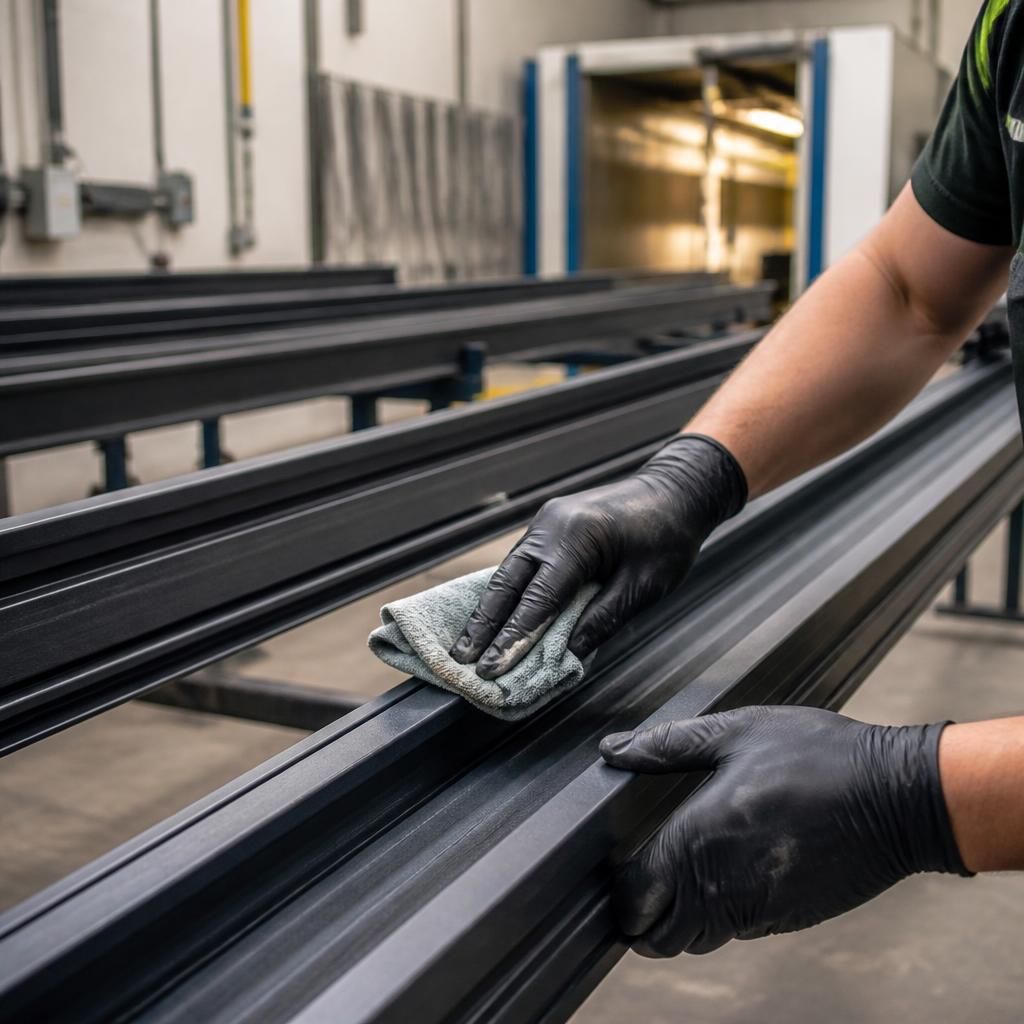
A key benefit of powder coated aluminium profiles is reduced routine maintenance compared with finishes that require frequent repainting or more involved surface treatment. The cured coating forms a continuous finish that can usually be kept presentable through suitable cleaning, provided the powder type and cleaning method are appropriate for the service environment.
For industrial profiles, this can simplify ongoing care across exposed frames, guards, trims and other assembled sections. Dirt, dust and deposits should be removed using compatible, non-abrasive materials, while harsh chemicals, aggressive tools and practices that could scratch the coating should be avoided. Regular inspection remains important because impact damage, cut edges and uncoated interfaces can require separate attention.
This maintenance advantage is greatest when the coating specification reflects the conditions the aluminium will face. Atmospheric exposure, contact with chemicals, cleaning requirements and the likelihood of abrasion should be considered before selecting the powder system, rather than treating maintenance as an issue only after installation.