

What are the cost implications and potential return on investment when choosing powder coated aluminium profiles for large-scale industrial projects?
Powder coated aluminium profiles involve upfront costs for the profiles, preparation, coating specification, colour, batch size, handling and logistics, but their potential return on investment comes from durable performance, reduced maintenance and a lower likelihood of premature recoating or replacement. For a large-scale industrial project, the most meaningful comparison is therefore the total lifecycle cost rather than the initial purchase price alone, assessed against the required service environment, finish specification and expected operating life.
The financial case for powder coated aluminium profiles should be assessed through a project-specific total-cost model that compares the complete installed solution with credible alternatives over the intended service period. The investment may be justified not only by coating performance, but also by reduced intervention, more predictable maintenance planning, lower disruption and the preservation of the profile’s functional and visual specification.
Separate the cost categories before comparing options. A useful assessment distinguishes between the cost of acquiring and finishing the profiles, the cost of incorporating them into the project, and the costs that arise during operation. This prevents a low purchase quotation from appearing more economical when it creates additional work elsewhere in the supply chain.
- Acquisition and finishing: include the aluminium profile, coating system, colour and gloss requirement, pretreatment, masking, inspection and any project-specific preparation.
- Design and production: consider profile geometry, cut lengths, tolerances, batch planning, handling requirements and whether the specification creates additional fabrication or assembly work.
- Installation: assess protection during transport and installation, site handling, access, fitting interfaces and the possibility of damage that requires repair or replacement.
- Ownership: allow for inspection, cleaning, local repairs, access equipment, planned recoating and the consequences of removing components if a finish eventually needs renewal.
Large-scale projects can also incur indirect costs when profiles arrive in unsuitable batches, require additional sorting, or cannot be installed in the planned sequence. Clear drawings, agreed acceptance criteria and a defined inspection process help identify these risks before production. The costing exercise should therefore use the actual profile schedule and installation method rather than a generic cost per metre.
Volume affects the commercial structure. Repeated profile sizes, consistent colours and well-planned production batches can simplify processing and reduce avoidable handling. Conversely, numerous short runs, mixed specifications, frequent colour changes and unusually shaped components can increase preparation and production complexity. These effects should be discussed during specification and scheduling, as they may influence the delivered cost even where the total coated area is similar.
Design can have a comparable effect. Profiles that allow efficient racking, drainage and access for pretreatment and coating are generally easier to process consistently than designs with concealed recesses, tight contact points or difficult-to-mask areas. The design should also account for contact with fixings, adjacent materials, sealants and drainage paths. A finish that performs well on an exposed face may not deliver the intended result if interfaces trap moisture, cause abrasion or make future inspection impractical.
Define the performance requirement before selecting the lowest-priced specification. The appropriate coating system depends on exposure, expected handling, appearance requirements, substrate condition and the consequences of failure. A higher specification may be financially sensible where access is difficult, replacement would interrupt production, or the profiles form part of a critical enclosure, façade, platform or equipment assembly. It is not automatically the best choice in every application; the additional cost should be linked to a specific risk that the project needs to control.
Return on investment can be modelled by comparing the chosen solution with a suitable alternative across the same scope and assessment period. The comparison should include:
- initial supply, finishing and installation costs;
- planned cleaning, inspection and repair requirements;
- the expected timing and extent of recoating or replacement;
- access, isolation, dismantling and reinstatement costs;
- production loss, restricted use or programme disruption during remedial work;
- the cost of rejected, damaged or non-conforming components; and
- residual value or continuing serviceability at the end of the assessment period.
Where costs occur at different points in the project, a discounted cash-flow or net-present-value approach gives a more realistic result than simply adding nominal amounts. The discount rate, service period, maintenance assumptions and replacement timing should be recorded so that the calculation can be reviewed. If the project does not use formal financial modelling, a year-by-year cost schedule still provides a clearer comparison than an initial-price assessment.
Use sensitivity analysis rather than relying on one forecast. The result may change if the operating environment is more aggressive than expected, access becomes more expensive, the project programme changes, or a component requires earlier intervention. Test the model against alternative assumptions for maintenance frequency, service life, damage rates, labour costs and replacement timing. A solution that remains competitive under reasonable variations is less dependent on optimistic assumptions.
Not every benefit appears as a direct cash saving. Consistent colour and surface appearance may reduce the need to replace visually mismatched components, while a durable finish can support standardised procurement and simplify asset identification. Reduced remedial work may also make maintenance easier to plan. These benefits should be described separately from measurable savings so that the financial case remains transparent rather than presenting qualitative advantages as guaranteed returns.
Procurement documents should make the cost model auditable. Specify the profile alloy and condition, coating type, colour, gloss, pretreatment, required appearance, inspection method, packaging expectations and responsibilities for handling. Request itemised pricing for non-standard operations and identify assumptions about quantities, batch sizes, tolerances and rejected work. The project team can then distinguish a genuine price difference from a difference in scope.
Before approval, compare at least two technically suitable finishing strategies on a like-for-like basis and confirm that each meets the project’s exposure and performance requirements. The preferred option is the one that provides an acceptable balance between capital cost, operational risk, maintenance burden and expected service life. Powder coated aluminium profiles can offer a strong return where their finish reduces future intervention and protects the usefulness of the profile, but that conclusion should come from documented project assumptions rather than from the coating price alone.
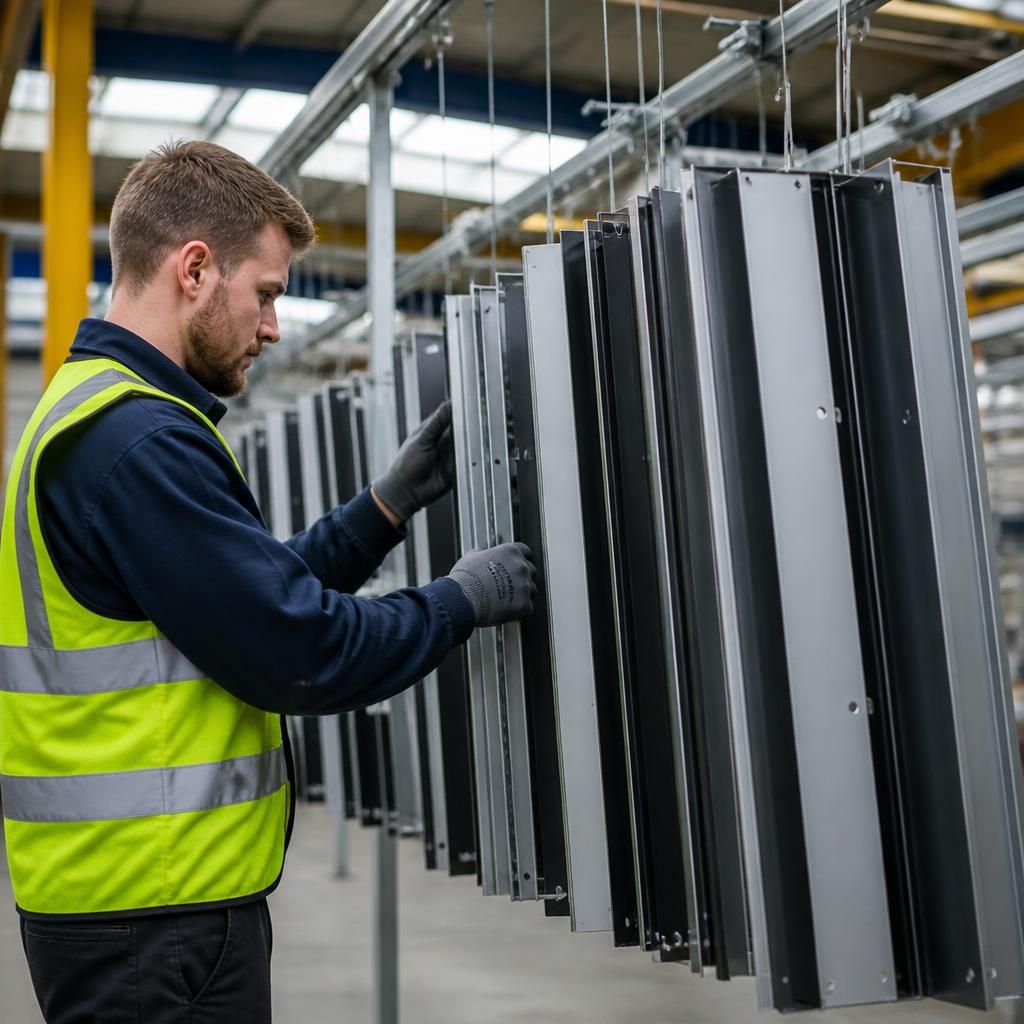
Standardising the finish across a large project can influence return on investment beyond the original coating quotation. Using a consistent colour, gloss level and coating specification may simplify future replacement orders, reduce the number of finish variants held in project records and make it easier to identify compatible components when sections are repaired or extended.
This benefit should be assessed against the project’s expected maintenance and alteration requirements. If replacement profiles are likely to be sourced in small quantities, a documented finish specification can help prevent unsuitable substitutions, visual inconsistency or additional remedial work. The potential value lies in preserving compatibility over the asset’s service life, rather than treating finish standardisation as an automatic financial saving.
Discuss your powder coated aluminium profiles project costs
Share your profile schedule, exposure conditions and finish requirements with the powder coating team to assess the specification and cost assumptions for your project. A tailored discussion can help you compare suitable options on a whole-life basis before procurement.