

What factors should I consider when selecting a powder coating finish for aluminium?
When selecting a powder coating finish for aluminium, consider the component’s environment, required durability, exposure to chemicals or weather, desired colour and gloss level, surface texture, and any functional requirements such as electrical insulation or abrasion resistance. The coating should also be compatible with the aluminium grade, component design and preparation process so the chosen finish delivers the required appearance and performance.
The right powder coating finish for aluminium is selected by balancing the coating chemistry, visual specification, production requirements and the way the finished component will be used. A suitable choice must work as part of the complete coating system, not simply match a colour chart. The specification should therefore cover the powder type, colour, gloss, texture, application method, curing requirements, acceptable tolerances and inspection criteria.
Start with the coating chemistry. Different powder technologies are intended for different service conditions. Polyester-based powders are commonly considered for components that need an exterior decorative finish, while epoxy and epoxy-polyester systems may be more appropriate where internal use, chemical resistance or adhesion is the priority. An epoxy finish can be a poor choice where prolonged ultraviolet exposure is expected, because colour and gloss retention may not meet the requirement. The coating supplier or applicator should confirm that the proposed chemistry is suitable for the component’s intended use rather than selecting a system solely on appearance.
Define the appearance in measurable terms. “Black”, “white” or “silver” may not be precise enough for a production coating specification. Record the required colour reference, gloss category, surface texture and whether the finish is solid, metallic, clear or translucent. A smooth finish gives a different visual effect from a fine-textured or heavily textured finish, even when the colour is nominally identical. Metallic powders can also show directional or batch-related variation, so the specification should state how colour matching and visual approval will be handled.
- Specify the colour reference and any approved visual sample.
- State the required gloss level rather than relying on terms such as “satin” alone.
- Identify whether the surface should be smooth, fine-textured, textured or wrinkle-finished.
- Confirm whether adjacent parts must match, including parts coated at different times.
- Agree which visible areas, edges and concealed faces are subject to inspection.
Consider colour and finish consistency across the order. The same nominal powder reference can appear different when applied over different substrates, at different film builds or with different curing conditions. Component geometry can also affect the visual result. For this reason, a representative sample or first-off approval is useful for important architectural, automotive or visible fabricated parts. Where future additions are likely, retain the agreed reference sample and record the powder specification, application conditions and approved tolerances.
Check how the finish affects dimensions and assembly. Powder coating adds a film to the aluminium surface. This can matter where components fit into slots, use threaded holes, locate against machined faces or require close sliding tolerances. Masking may be required around earth points, bearing seats, weld areas, mating faces or holes. The drawing should identify surfaces that must remain uncoated and any areas where coating build must be controlled. Small design details, sharp transitions and enclosed sections should be discussed before production because they can influence coverage and the final appearance.
Review the curing window and component construction. Powder requires a controlled curing cycle, and the relevant temperature is the metal temperature rather than simply the oven air temperature. Thick and thin sections may heat at different rates, while assemblies containing seals, adhesives, plastics or heat-sensitive inserts may restrict the available process. The selected finish must therefore be compatible with the complete component, including any materials that remain attached during coating. If the part cannot be heated uniformly, the applicator may need to assess the design, masking plan or coating system before confirming suitability.
Specify performance tests and acceptance criteria. For a business-to-business project, a finish specification should explain how quality will be assessed. Depending on the application, this may include checks for colour, gloss, film coverage, adhesion, visual defects, cure and resistance to handling or abrasion. Acceptance criteria should distinguish between a defect on a prominent visible face and one in a concealed area. It should also define how small variations, pinholes, inclusions, orange peel or edge coverage are treated, since vague criteria can create disagreement after coating.
Allow for handling, transport and installation. The most suitable finish is not necessarily the one that looks best immediately after application if the parts will be stacked, bolted together or handled repeatedly. Consider contact points, protective packaging, lifting methods and whether installation could mark the coating. Components with exposed edges or frequent mechanical contact may need a finish and design that tolerate the intended handling conditions. Protection during storage and fitting should form part of the specification rather than being left until after coating.
Use a written coating schedule. A practical schedule should identify the aluminium component or drawing reference, coating chemistry, colour, gloss, texture, approved sample, coating areas, masked areas, inspection method and any special dimensional requirements. It should also record whether different parts need to be visually matched. This gives the powder coater clear instructions and makes repeat orders more consistent.
For complex or high-value aluminium components, the finish should be agreed with the powder coater before the design is released for manufacture. A Midlands powder coating specialist can review the component, proposed specification and production quantities, then advise whether the selected finish is practical for the part and its intended use. That early review is particularly useful where appearance, close tolerances or repeat batch matching are important.
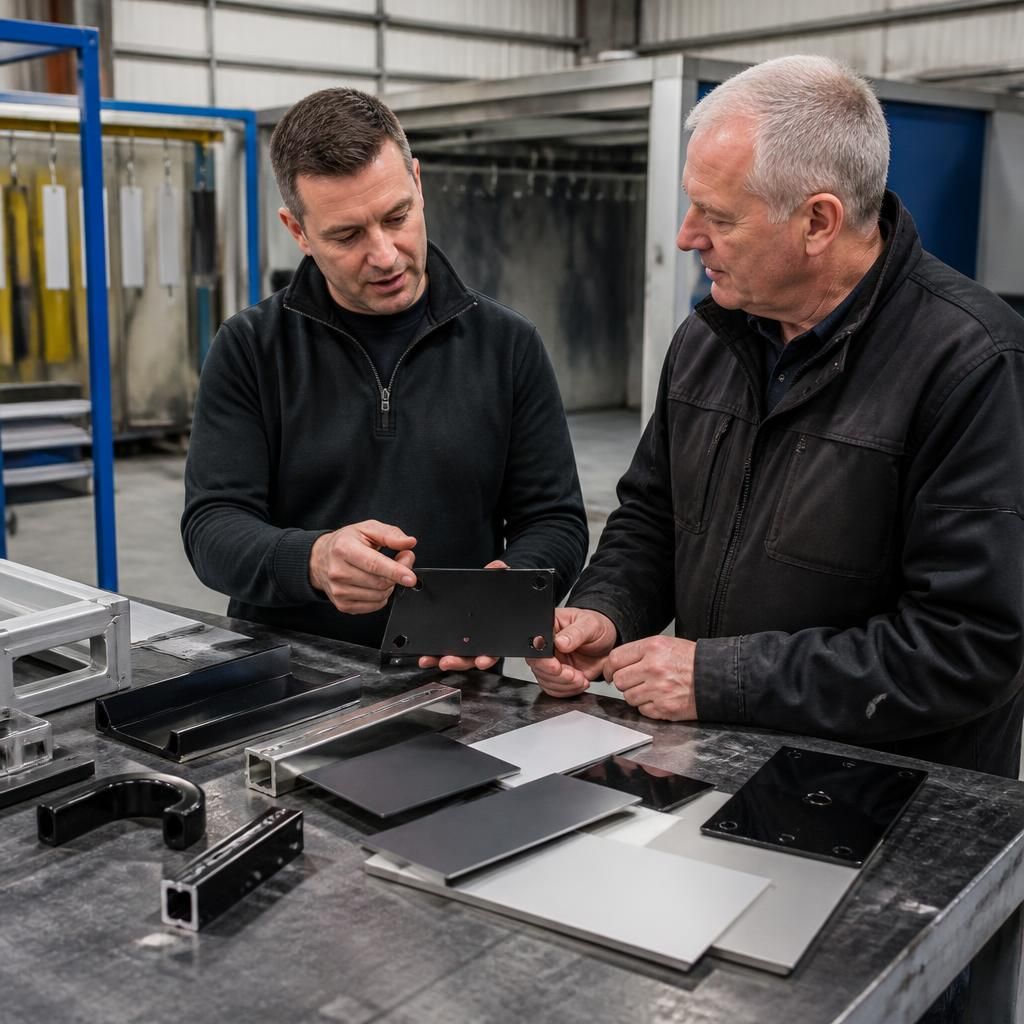
A powder coating finish for aluminium should be chosen according to the component’s function as well as its appearance. Where parts are regularly handled, inserted, moved or exposed to contact, abrasion resistance may be more important than colour or gloss. A specialist protective coating, such as nylon, may be appropriate where a tougher surface is required for demanding service conditions.
- For components requiring electrical isolation, specify an insulating coating system and identify any areas that must remain conductive or uncoated.
- For parts exposed to cleaning agents, oils or process chemicals, check resistance against the actual substances and concentrations involved.
- For components subject to repeated contact or impact, assess surface toughness, edge protection and the risk of coating damage during use.
- For visible parts, confirm that the functional coating can still provide the required colour, texture and gloss.
These requirements can affect the choice of powder chemistry, film build and pretreatment. Recording them before production helps the applicator recommend a finish that performs correctly in service rather than one selected only from a colour chart.
Discuss your aluminium powder coating finish requirements
Discuss your aluminium component drawings, service conditions and finish specification with the powder coating team before production begins. They can help assess whether the proposed coating system is suitable for the part and its intended use.