

What are the advantages of using powder coated aluminium frames over traditional painting methods?
Powder coated aluminium frames generally provide a tougher, more uniform and longer-lasting finish than traditional liquid paint. The cured coating offers improved resistance to chipping, weathering and corrosion, while the controlled application produces consistent coverage across batches and complex profiles.
Powder coated aluminium frames offer several practical advantages over traditional liquid painting: a more controlled application, fewer wet-coating stages, cleaner handling, repeatable appearance and a finish that is well suited to manufactured metal components. These benefits apply particularly where frames are produced in batches, must meet a defined specification or need a consistent finish across profiles and associated parts.
More controlled film application
Powder is applied as a dry, electrically charged material that is attracted to the prepared aluminium surface before being cured in an oven. This process allows the coater to control the coating specification more precisely than application by brush, roller or spray gun. Liquid paint can be affected by runs, sags, brush marks, overspray and variations in viscosity. Powder application reduces these variables when the part is correctly prepared and the equipment is properly set up.
The resulting film can also be specified within a controlled thickness range. This matters where the frame must retain accurate clearances, accommodate moving components or fit with seals, fixings and adjacent parts. Masking may still be needed on threads, contact faces and other areas that must remain uncoated, but the coating process itself is designed for repeatable coverage.
Fewer wet-coating stages
Traditional painting may involve primer, one or more colour coats and a separate protective layer, with drying or flash-off between applications. Powder coating can, depending on the product specification and required performance, provide the main finish in a single cured coating. This can simplify the production route and reduce the number of wet-film handling stages.
There is no liquid paint film to remain tacky during ordinary handling after the specified cure has been achieved. The component must still be allowed to cool and should be inspected before packing or assembly, but the dry finish is generally more practical for a production environment than handling parts between successive liquid-coating stages.
Consistent appearance across manufactured parts
Powder coating is well suited to aluminium frames manufactured to common drawings or supplied as repeat batches. A defined powder specification, application setting and curing schedule help maintain the selected appearance from one component to the next. This is useful where frames are installed together and visible differences in sheen, texture or colour would be noticeable.
Uniformity depends on more than the powder itself. Aluminium sections must be cleaned and suitably pre-treated, contamination must be controlled, and the cure must match the powder manufacturer’s requirements. Differences in alloy, profile geometry, masking or oven exposure can affect the final result. A written coating specification is therefore preferable to relying on a colour description alone.
Cleaner production and handling characteristics
Powder is supplied as a dry material rather than as a liquid mixture containing solvent. Powder-coating operations therefore avoid the same solvent evaporation associated with conventional solvent-based paint systems. Unattached powder can also be collected within suitable equipment and, subject to the coating system and contamination controls, managed as process material rather than becoming routine liquid overspray.
This does not mean that powder coating has no environmental or operational controls. Pretreatment chemicals, oven energy, extraction, housekeeping and waste handling still need to be managed correctly. The relevant advantage is that the application stage does not depend on a wet solvent carrier in the same way as conventional liquid painting.
Suitable finish for formed aluminium profiles
Powder can be applied to many aluminium profiles and fabricated frames in a range of colours, gloss levels and surface effects. This allows a technical coating requirement and an appearance requirement to be addressed within the same finishing process. Textured finishes can also help disguise minor visual variation in the substrate, although they do not remove the need for sound preparation.
Powder coating is generally most effective when the aluminium frame can be placed in an oven and exposed to the required curing conditions. Very large assemblies, heat-sensitive components, bonded sections, rubber seals or pre-installed glazing may require a different approach, partial disassembly or an alternative coating system. These constraints should be assessed before manufacture rather than after the frame has been assembled.
Important limitations compared with liquid paint
Powder coating is not automatically the best choice for every aluminium frame. Liquid paint can be more practical for components that cannot tolerate curing heat, cannot fit the available equipment or need to be coated in situ. It may also be simpler to carry out local repairs without transporting the whole component. Powder-coated parts can be repaired, but a touch-up may not reproduce the original finish exactly, particularly where the surface has a texture or special sheen.
For new or removable aluminium frames, powder coating is often preferred because the parts can be thoroughly prepared, coated under controlled conditions and inspected before delivery. The final choice should consider the frame dimensions, alloy, use environment, required appearance, masking requirements, assembly sequence and whether any seals or fittings are already installed.
In practical terms, the main advantage is process control rather than simply the presence of a coloured surface. When the aluminium is properly pre-treated and the powder is correctly applied and cured, the method provides a clean, repeatable and production-friendly finish with fewer variables than many traditional painting methods.
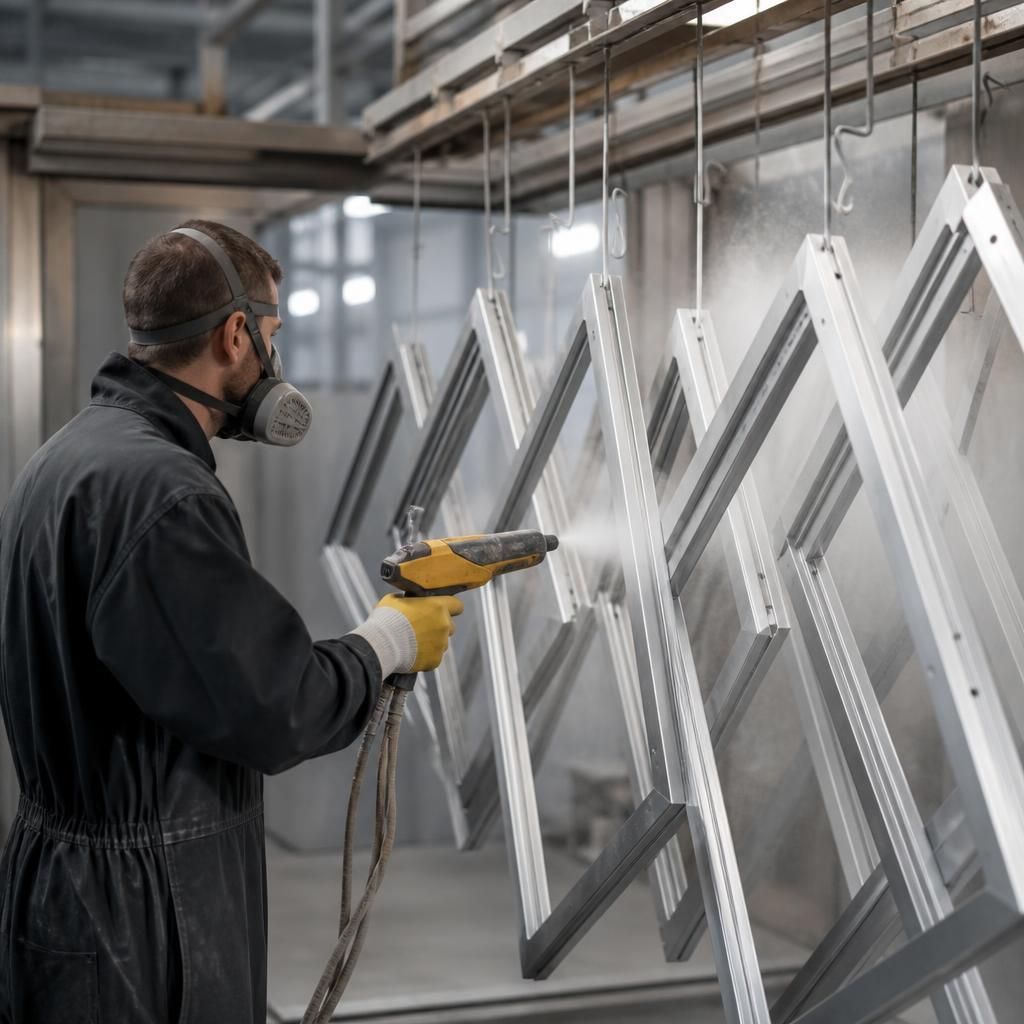
A further advantage of powder coated aluminium frames is that the coating can be selected for a defined functional requirement, not just for colour or appearance. Depending on the formulation, a powder system may be specified to provide resistance to abrasion, chemicals, ultraviolet exposure or other conditions associated with the frame’s operating environment.
This allows the finish to form part of the component specification. For example, an industrial frame exposed to handling, cleaning agents or outdoor light may require a different coating system from an internal, lightly used frame. The selected powder should therefore be matched to the substrate, exposure conditions and performance requirements rather than chosen from colour alone. Technical data and the coater’s preparation and curing controls remain essential to achieving the stated properties.