

Can powder coated aluminium frames be customised for specific industrial applications?
Yes. Aluminium frames can be customised for specific industrial applications through the selection of suitable powder type, colour, texture and protective or specialist finish, including nylon coatings where the component’s operating conditions require particular resistance.
Yes. Powder coated aluminium frames can be specified for particular industrial applications by matching the coating system and application method to the frame’s alloy, geometry, environment, performance requirements and end use. The most suitable specification is determined by the conditions the frame will face rather than by appearance alone.
Customisation starts with the component itself. The coater should understand the aluminium alloy, whether the frame is extruded, folded, fabricated or assembled, and which surfaces need protection. Hollow sections, recesses, sharp edges, joints and fixing points can affect cleaning, powder coverage and curing. Drawings or representative samples help identify areas that may need masking, special racking or separate treatment.
Functional areas can also be defined before coating. Threads, bearing faces, electrical contact points, hinge locations and accurately mating surfaces may need to remain free from powder. Masking and suitable fixturing are therefore important where the finished frame must assemble with other components. The required masking points should be shown clearly on drawings or agreed against a sample, particularly when several parts form one assembly.
The operating environment determines the level of protection required. A frame used indoors in a relatively controlled setting may have different requirements from one exposed to moisture, industrial contaminants, abrasion, cleaning chemicals or frequent handling. The specification should identify potential exposure to:
- water, condensation and outdoor weather;
- oils, solvents, detergents or process chemicals;
- impact, rubbing and repeated mechanical contact;
- heat generated by nearby equipment; and
- corrosive conditions affecting the aluminium or adjoining materials.
This information allows the coating system, preparation stages and finish requirements to be considered together. Powder coating does not compensate for poor joint design, trapped moisture or incompatible contact between metals, so the frame’s construction and drainage arrangements remain relevant to long-term performance.
Appearance can be customised to support identification, product consistency or integration with surrounding equipment. A specification may define a colour reference, gloss level, surface texture and which faces require the finish. Where parts are produced in batches, the same requirements should be applied consistently across drawings, purchase orders and approved samples. Colour and texture should also be considered alongside cleaning needs: heavily textured surfaces can behave differently from smooth finishes when dirt or process residue has to be removed.
Dimensional requirements need particular attention. Powder adds a layer to the prepared aluminium, so close-fitting interfaces, slots and holes should be reviewed before production. The coater needs to know which dimensions are critical and which areas are non-functional. This helps distinguish between surfaces requiring full coverage and areas where masking or post-coating finishing may be appropriate.
Batch and handling requirements form part of the custom specification as well. Frames may need to be presented in a defined orientation, separated to prevent contact damage, or processed with associated brackets and parts in a controlled sequence. Large or unusually shaped sections may require an assessment of the available coating equipment and racking arrangement before the order is confirmed. Providing complete component information at quotation and production stages reduces the risk of unsuitable masking, incomplete coverage or assembly problems.
A useful industrial coating specification should therefore include:
- aluminium grade and component drawings;
- the intended operating environment;
- critical dimensions and surfaces to remain uncoated;
- required colour, gloss and texture;
- any chemical, abrasion or weathering considerations;
- packing, identification and batch-control requirements; and
- an agreed inspection standard or representative approval sample.
In practice, customisation is most effective when the coating requirements are considered during frame design rather than after manufacture. Powder-coating specialists can review the supplied parts, identify process constraints and recommend how preparation, masking, racking and finishing should be handled for the intended industrial application. The final specification should balance protection, appearance, dimensional fit and repeatability across the complete batch.
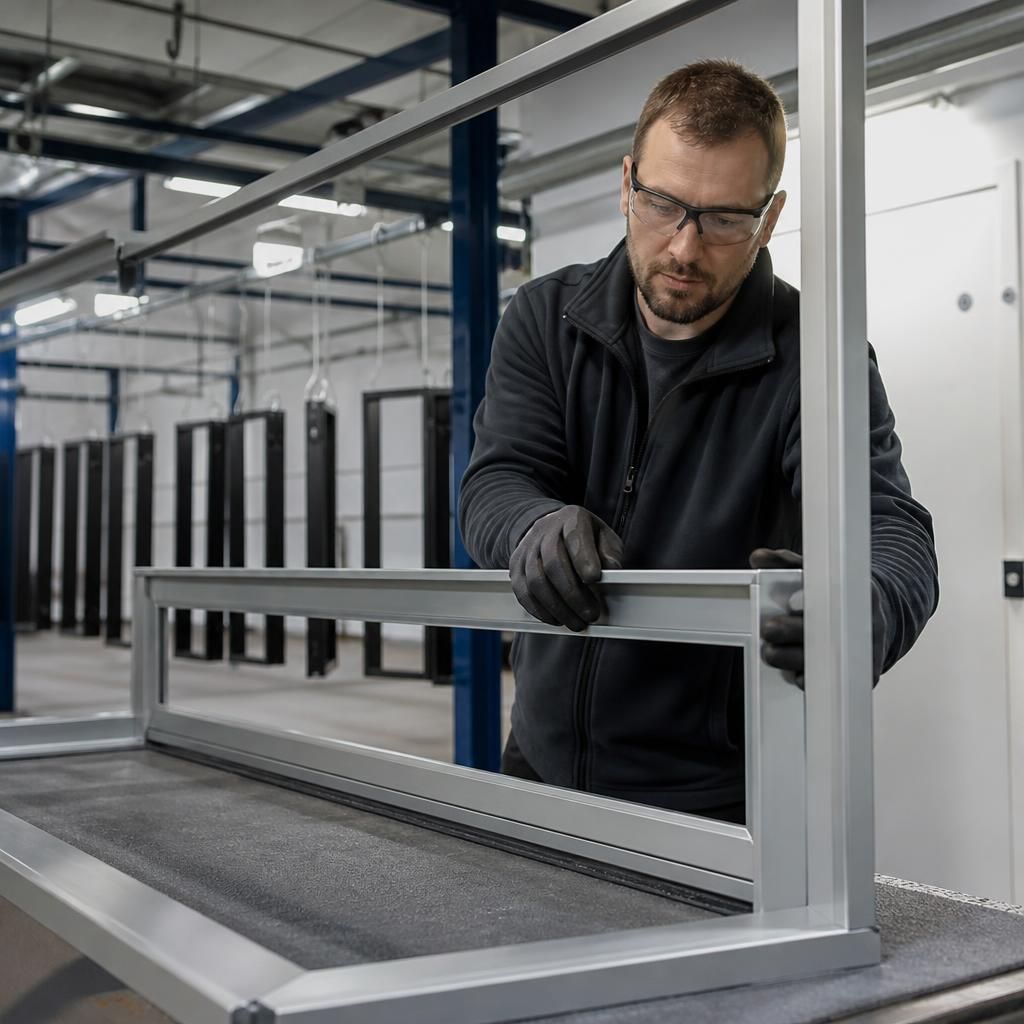
Customisation can include validating the proposed coating on a representative frame or test piece before the full batch is processed. This is useful where the aluminium profile, joint design or intended service conditions are unusual, because a small trial can reveal issues that are not apparent from drawings alone.
The review can assess coating adhesion, cure, coverage, surface appearance and whether mating parts still assemble correctly. If the frame will face a particular chemical, cleaning regime or mechanical wear, the trial can also be evaluated against those conditions. Agreeing the acceptance criteria in advance gives the manufacturer and coater a practical reference for repeat production, without relying solely on colour or visual inspection.
Discuss your custom powder coated aluminium frames
Discuss your custom powder coated aluminium frames with the coating team, sharing drawings, samples and operating requirements for review. This allows the proposed finish and any masking or dimensional considerations to be assessed before batch processing.