

What factors should be considered when selecting between nylon and protective aluminium coatings for specific industrial applications?
Select between nylon and protective aluminium coatings by assessing the component’s operating temperature, exposure to chemicals, moisture and corrosion, required abrasion or impact resistance, substrate, geometry, dimensional tolerances and finish. Nylon is generally suited to applications needing a tough, insulating and wear-resistant polymer layer, while protective aluminium coatings are often considered where metallic protection, heat resistance or a conductive finish is more important; the coating process and expected service conditions should confirm the choice.
The selection should be based on the component’s full duty cycle, the required coating specification and the practicalities of applying, inspecting and maintaining the finish. Nylon and protective aluminium coatings are not interchangeable versions of the same system: nylon is a polymer coating whose performance depends heavily on grade and film condition, whereas an aluminium-based system provides a metallic protective layer whose formulation and sealing arrangement determine its behaviour. The correct choice is therefore the one that meets the application requirement as a complete coating system, rather than the one with the most attractive single property.
Start with the required coating function. Establish whether the finish is mainly intended to provide a barrier, reduce surface wear, prevent contact between dissimilar parts, provide electrical separation, retain a metallic appearance or support a particular assembly function. These requirements may point in different directions. For example, a nylon layer may be appropriate where a resilient, non-metallic interface is needed, while an aluminium protective system may be more suitable where the specification calls for a metallic surface or compatibility with an existing metallic protection scheme.
Check the precise coating grade, not just the coating family. Nylon formulations can differ in hardness, flexibility, friction characteristics, moisture uptake and resistance to particular cleaning agents. Protective aluminium systems can also vary according to the aluminium content, binder, primer arrangement and any sealing or finishing layer. The technical data for the proposed system should be reviewed against the actual application, as a general reference to nylon or aluminium does not define the finished performance sufficiently.
Consider moisture-related changes in the polymer. Certain nylon grades can absorb moisture, which may affect their dimensions, stiffness or electrical behaviour. This matters where the component operates in a humid environment, is exposed to repeated wetting and drying, or must maintain a closely controlled interface. The relevant grade, film thickness and conditioning requirements should be confirmed before specifying nylon for such duties.
Assess the interface with other components. The coating can alter friction, grip, insertion force and the way parts seat against one another. It may also affect threaded connections, press fits, hinges, sliding interfaces, seals and areas that must make reliable contact during assembly. Identify these interfaces on the drawing and define whether they require masking, a controlled coating build, post-coating machining or a different finish. A coating that performs well on an exposed surface may be unsuitable on a precision mating area.
Define the application and inspection requirements. A robust specification normally records the approved coating system, preparation standard, colour where relevant, target thickness or acceptable range, masking locations and inspection method. It should also state how defects, edge coverage, pinholes and adhesion are to be assessed. For protective aluminium systems, visual uniformity alone may not confirm that the required protective layer has been achieved. For nylon, continuity and coverage are especially important where the coating is intended to isolate the underlying metal.
Review the component’s production route. The chosen finish must be compatible with handling, racking, masking, curing and subsequent assembly. Parts with trapped areas, narrow recesses or concealed faces may require specific process planning to achieve consistent coverage; this should be resolved from the engineering drawing rather than assumed. Consider whether the coating is applied before or after machining, welding, forming or assembly, and whether those operations could damage or contaminate the finish.
Include cleaning and maintenance in the decision. Identify the detergents, disinfectants, tools and cleaning methods that will be used throughout the component’s life. The system should be checked against the actual cleaning regime, including repeated washing and any pressure or temperature involved. Also consider how local damage will be identified, whether a repair can be made without removing the whole coating, and whether the component can be recoated at the end of its service life. These practical issues can favour one system even where both appear suitable on initial technical comparison.
Allow for regulatory and end-use restrictions. Some applications impose requirements relating to hygiene, fire behaviour, electrical insulation, contact with products, emissions or waste handling. The coating supplier or applicator should provide the relevant product documentation and declarations where these are required. Compliance should be verified for the exact coating grade and process, rather than inferred from the generic name of the material.
Compare whole-life suitability rather than purchase price alone. The comparison should include preparation, masking, application, inspection, rejected parts, assembly implications, cleaning and potential refurbishment. A system with a lower initial application cost may be less suitable if it complicates assembly or requires more frequent intervention. Conversely, a technically advanced finish may not be justified where its additional properties are not needed.
For an uncertain application, the most reliable approach is to create a written performance specification and assess representative components or test panels using the intended preparation and coating process. Results should be reviewed against measurable acceptance criteria, including adhesion, coating continuity, thickness and any application-specific tests. This gives the manufacturer, fabricator or coating specialist a common basis for selecting nylon or a protective aluminium system and avoids relying on a material name alone.
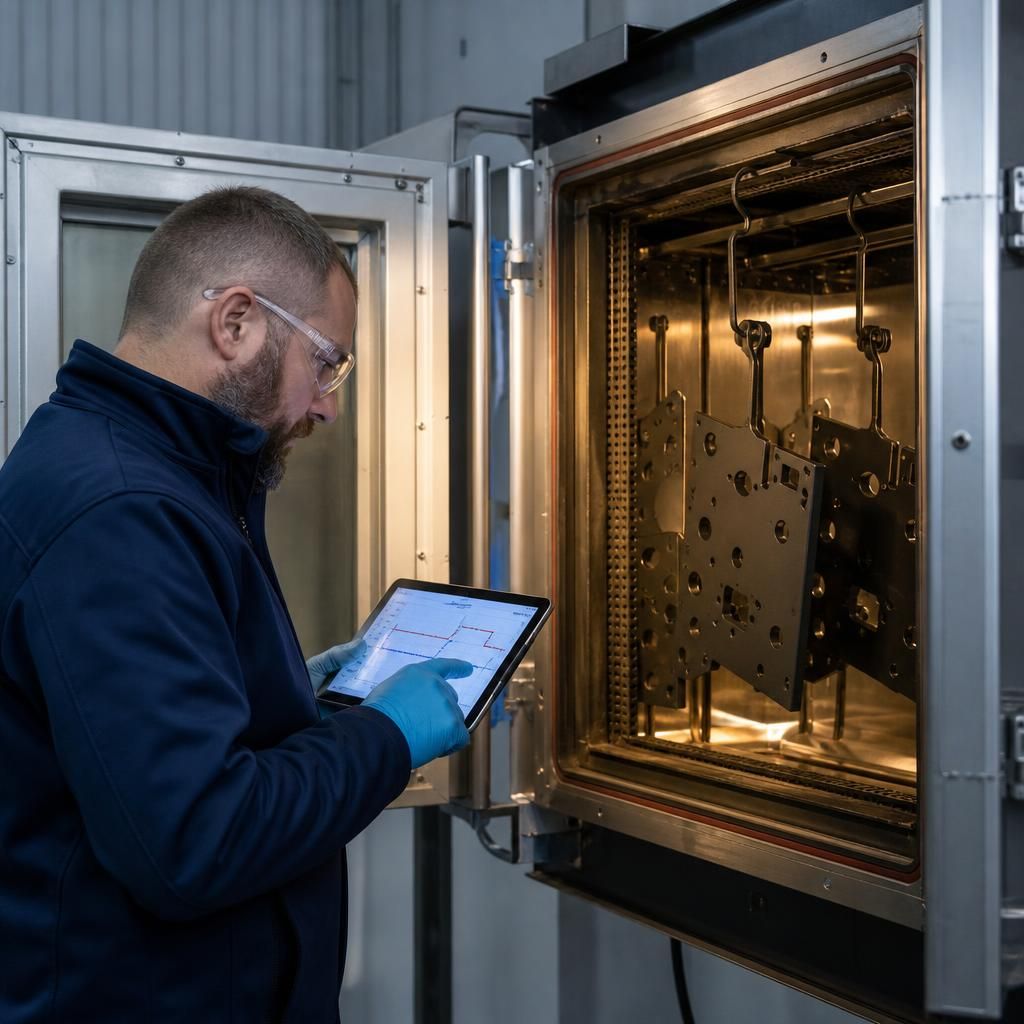
Thermal cycling should be assessed separately from the component’s maximum operating temperature. Repeated heating and cooling can create movement between the metal substrate and the coating, particularly where their rates of thermal expansion differ. Over time, this may contribute to cracking, loss of adhesion, edge damage or moisture reaching the substrate.
Nylon may be preferable where a degree of flexibility and impact tolerance is needed, but the selected grade must remain suitable through the full temperature cycle and any associated moisture exposure. A protective aluminium system may be more appropriate where a metallic surface and greater dimensional stability at elevated temperatures are required, although its adhesion, sealing arrangement and behaviour at damaged edges still need assessment. Representative test panels or components should be subjected to the intended heating, cooling and handling conditions before the coating is approved for production.
Discuss your nylon or protective aluminium coating requirements
Share your component drawings, substrate details and intended service conditions to discuss whether a nylon or protective aluminium coating is the more suitable option. The coating requirements can then be reviewed against the part’s geometry, interfaces and application environment.