

What are the benefits of edge powder coating for aluminium parts?
Edge powder coating protects exposed aluminium edges with a hard, continuous finish that improves resistance to chipping, abrasion and corrosion. It can also provide more consistent coverage and a uniform appearance across the component, helping maintain performance where edges are especially vulnerable to damage.
The main benefit of edge powder coating for aluminium parts is that it gives vulnerable edges a deliberately controlled protective layer rather than relying on general coverage across the flatter faces. This can help the component retain its functional performance, appearance and coating integrity at cut edges, corners, apertures and profile ends where handling, assembly and service conditions can cause localised damage.
Aluminium edges often experience more contact than broad surfaces. They may be gripped during fabrication, placed against jigs, exposed during transport or knocked during installation. A suitable edge coating can provide an additional barrier at these points, reducing the likelihood that routine handling will expose the underlying metal or create a visible defect. This is particularly useful for fabricated panels, extrusions, frames, enclosures and components with repeated cut-outs or shaped profiles.
- Better protection at vulnerable geometry: Edge treatment focuses attention on areas that are more difficult to coat and more likely to be contacted. This helps avoid treating the component as though its flat faces and edges have identical requirements.
- More reliable coating continuity: Carefully controlled preparation, application and curing can help the coating follow the edge and meet adjoining coated surfaces without an abrupt untreated transition. The result is a more dependable finish at junctions, corners and profile ends.
- Reduced risk during assembly: Coated edges are less likely to suffer immediate surface damage when parts are handled, fitted or positioned. This can be important where a component must remain visually acceptable after it has passed through several manufacturing stages.
- Improved part presentation: A properly specified edge finish can make the coating look intentional around apertures, returns and exposed sections. This matters for visible architectural, commercial, automotive and fabricated components where untreated or poorly finished edges would be noticeable.
- Greater suitability for complex aluminium designs: Edge powder coating can be considered for components with bends, rebates, holes, slots and changing profiles, provided the preparation and application method are matched to the geometry. It is therefore useful where a standard approach to broad, accessible faces would not fully address the part’s shape.
- Potentially simpler ongoing care: A sound powder-coated surface generally needs routine cleaning appropriate to the coating specification rather than repeated decorative treatment. Maintenance requirements still depend on the chosen formulation, exposure conditions, contamination and any damage sustained in service.
There are also specification benefits. Powder coatings are available in different formulations, colours, gloss levels and textures, allowing the edge treatment to form part of the wider component specification. The correct choice depends on whether the priority is appearance, resistance to handling, outdoor exposure, chemical contact, cleaning requirements or compatibility with adjoining materials. An edge coating should not be selected by colour alone.
The practical benefit depends heavily on the condition and design of the aluminium before coating. Burrs, sharp imperfections, oil, oxide contamination and fabrication residue can interfere with adhesion or leave the edge vulnerable beneath the finish. Edge radii, masking requirements, drainage, contact points and the required coating thickness should therefore be considered during design and preparation. Powder coating will not correct a poorly deburred edge or replace suitable mechanical preparation.
For parts with demanding service requirements, the specification should identify the aluminium grade and preparation method, the powder formulation, the intended film build, curing requirements and the performance checks relevant to the application. Sample pieces or representative sections can be useful when the component has unusual geometry, narrow edges or areas that are difficult to access. This allows the proposed finish to be assessed before a full production batch is processed.
In short, edge powder coating adds value by treating the most exposed and technically difficult parts of an aluminium component as a specific coating requirement. Its benefits are greatest when the edge design, surface preparation, powder selection and curing process are considered together rather than applied as an afterthought.
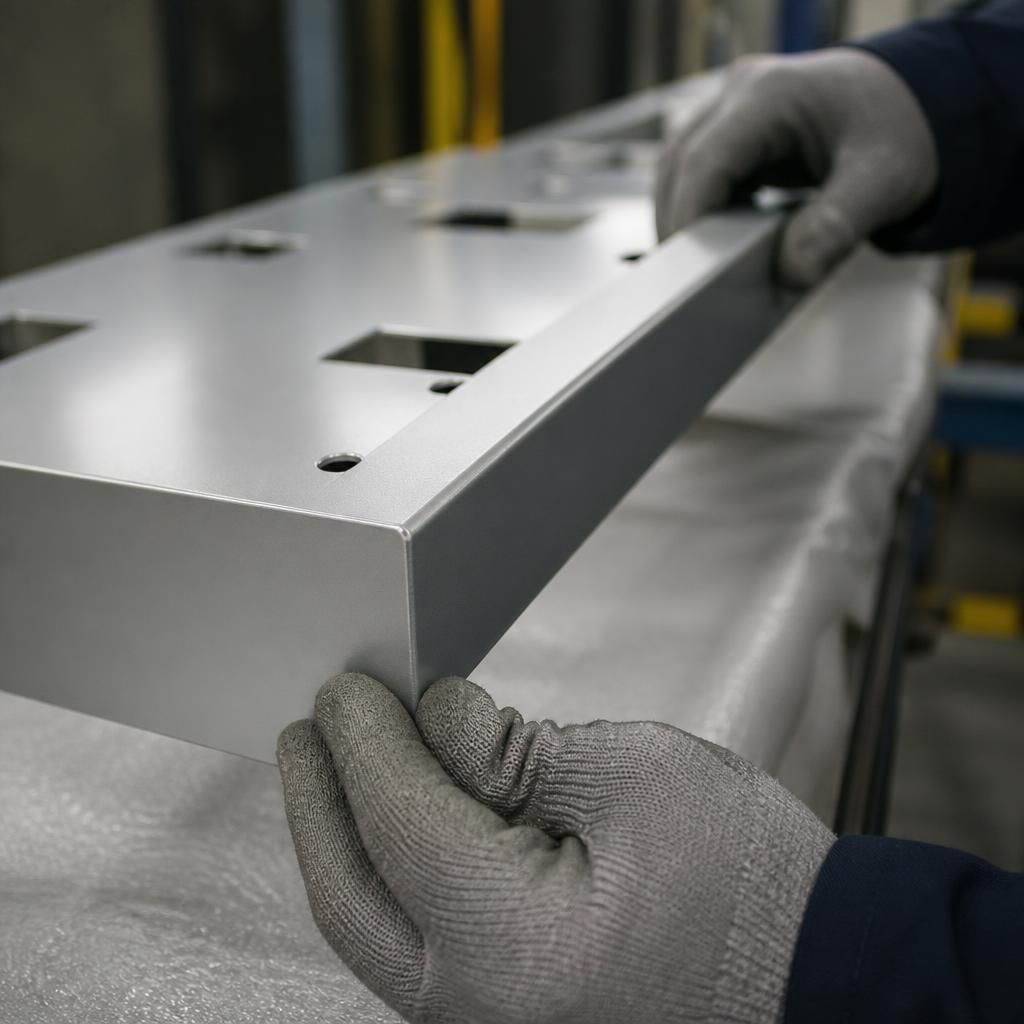
Edge powder coating provides a continuous barrier over exposed aluminium edges, helping limit contact between the metal and moisture, pollutants or other contaminants. This is valuable at cut edges, profile ends and apertures, where incomplete coverage or mechanical damage could otherwise create local points for corrosion to begin.
The benefit is greatest when the coating specification reflects the part’s environment and the finish remains intact throughout handling and use. Any chips or deep scratches should be assessed and repaired using a method compatible with the coating system, particularly where the component is exposed to persistent moisture or corrosive substances.
Discuss edge powder coating for your aluminium parts
Discuss your aluminium parts with Powder-coatings.co.uk to review the edge geometry, finish requirements and intended service conditions. This can help establish whether edge powder coating is suitable for your components and how the specification should be developed.