

How does edge powder coating improve aluminium's resistance to environmental factors?
Edge powder coating improves aluminium’s resistance to environmental factors by forming a durable barrier over exposed edges, cut sections and corners where moisture, salts and pollutants can reach the metal more easily. A correctly prepared coating also helps limit corrosion and protects the finish from weathering and ultraviolet exposure, reducing the need for frequent maintenance.
Edge powder coating improves aluminium’s environmental resistance by combining suitable surface preparation with a continuous, properly cured film that is designed to remain bonded around corners, cut-outs and exposed profiles. The result is more than a decorative layer: it helps isolate the aluminium from conditions that can weaken the finish, discolour the surface or initiate corrosion at vulnerable details.
Aluminium preparation is fundamental. Aluminium naturally develops a thin oxide layer, but that surface is not by itself a reliable foundation for a long-lasting coating. Cleaning removes oils, handling residues and contaminants, while an appropriate conversion or pre-treatment promotes adhesion and supports protection at the interface between the metal and the powder film. If preparation is inadequate, environmental exposure can exploit small areas of poor adhesion and cause blistering, flaking or corrosion beneath the finish.
Edge geometry affects the protection achieved. Powder particles tend to distribute differently around sharp corners, narrow returns, holes and internal angles than across a broad flat face. A well-controlled application therefore considers the component’s shape, the required film build and the risk of thin coverage at a knife edge. Where the design allows, a small radius is preferable to an exceptionally sharp edge because it enables a more even coating and reduces the likelihood of premature breakdown at the corner.
The cured film provides resistance to several forms of exposure:
- Ultraviolet radiation can fade pigments and degrade some coating binders. A powder formulation selected for exterior use can retain its appearance and protective properties more effectively than an unsuitable internal-grade finish.
- Rain, condensation and humid air can repeatedly wet the surface. Good adhesion and complete curing help prevent water from reaching weak interfaces or remaining trapped beneath a poorly bonded film.
- Airborne pollutants and salts can make surface contamination more aggressive, particularly in coastal, industrial or heavily trafficked environments. Regular cleaning and a coating system suited to the exposure reduce the opportunity for these deposits to attack the finish.
- Temperature changes cause aluminium and its coating to expand and contract. A correctly selected and cured system must accommodate this movement without losing adhesion or developing cracks at changes in profile.
Powder coating can also help protect the appearance of aluminium by separating the substrate from contact with dirt and handling contaminants. This does not make the component immune to damage: impact, deep scratches, poorly sealed joints and cut edges can still expose the metal. Those areas should be considered during design and fabrication rather than relying on the coating to compensate for an unsuitable detail.
Environmental performance depends on the complete coating system, not simply on choosing a colour. Important considerations include the aluminium grade and condition, pre-treatment, powder chemistry, intended internal or external use, expected exposure, edge design, application control and oven curing. A finish that is suitable for a sheltered component may not be appropriate for exposed architectural, construction or automotive parts subject to stronger ultraviolet, salt or chemical influence.
For that reason, specification should distinguish between general decorative protection and a finish selected for a defined service environment. The coating supplier or applicator may need information about location, exposure, component dimensions, joint design, cleaning methods and any chemicals encountered in use. Inspection should include the condition of the prepared metal, coverage at edges and recesses, adhesion, visible defects and evidence that the powder has been cured according to its technical requirements.
Maintenance remains part of environmental protection. Removing deposits before they build up limits the time that salts, pollutants and moisture remain in contact with the surface. Cleaning should use methods compatible with the coating, avoiding abrasive tools or aggressive chemicals that could damage the film. If an edge is scratched or cut during installation, it should be assessed and repaired using a compatible method rather than left as an unprotected defect.
When these factors are controlled together, edge powder coating gives aluminium a more consistent defence against weather-related deterioration while helping preserve the component’s finish. Its effectiveness is determined by the interaction of preparation, geometry, powder selection, curing and subsequent handling—not by the coating thickness alone.
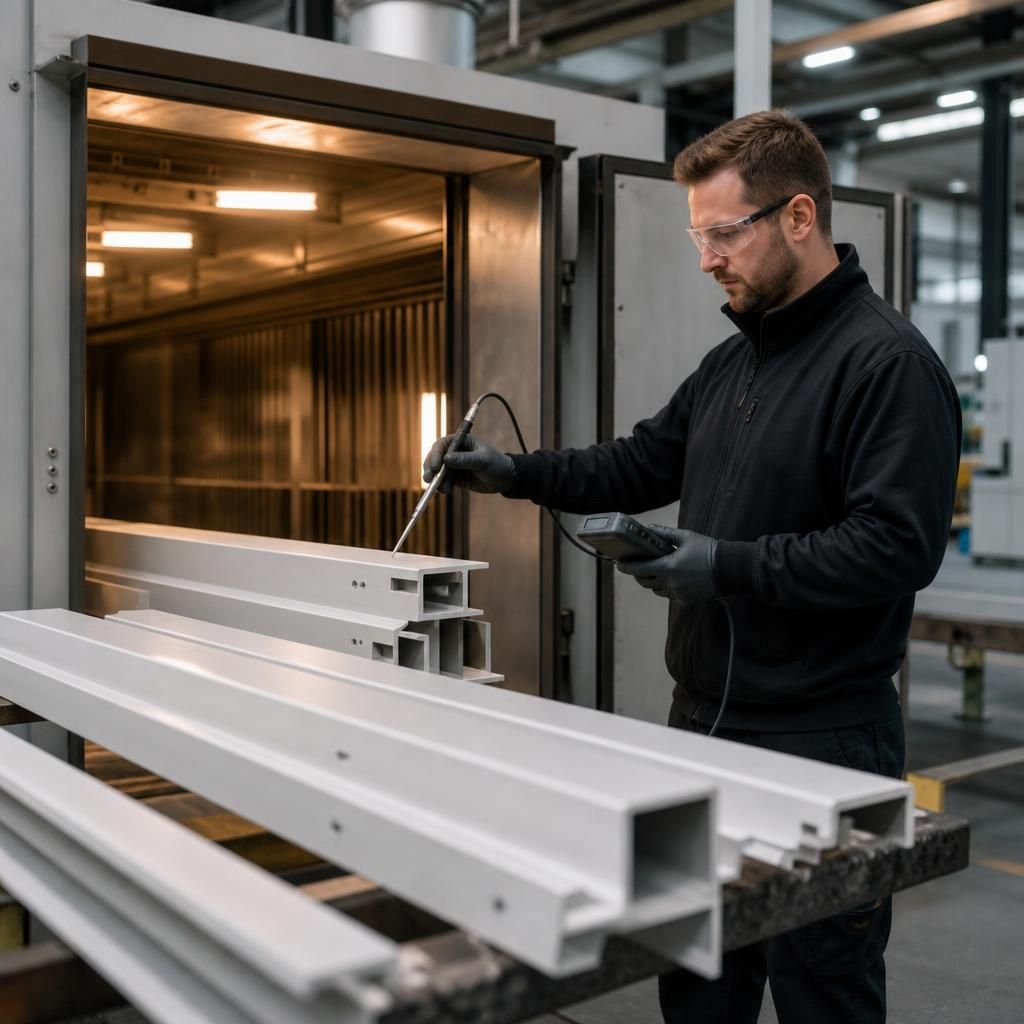
Correct curing is essential to the environmental resistance of edge powder coating on aluminium. The powder must reach the manufacturer’s specified metal temperature for the required cure period; oven air temperature alone does not confirm that the component has cured correctly.
This is particularly important for aluminium parts with varying wall thicknesses, dense sections or complex profiles, because different areas may heat at different rates. Insufficient cure can leave the film with reduced adhesion and resistance to moisture or chemicals, while excessive heat may affect the coating’s appearance and performance. Cure records and checks on representative components help confirm that exposed edges have developed the intended protective properties.