

What specific preparation is required for aluminium surfaces before applying RAL 9023 powder coating to ensure optimal adhesion and finish quality?
Aluminium should be thoroughly cleaned and degreased to remove oil, grease, dirt, oxidation and other contaminants, then rinsed and dried without leaving residue. Any surface damage or unsuitable existing finish should be addressed, followed by an aluminium-compatible chemical pretreatment or suitable mechanical preparation to provide a clean, sound surface for RAL 9023 powder coating adhesion and an even finish.
Preparation for RAL 9023 powder coating on aluminium involves more than removing visible dirt: the substrate must be assessed, any defects or incompatible coatings corrected, and an aluminium-suitable pretreatment selected and controlled. RAL 9023 is a colour designation, so it does not require a special preparation method; the correct approach depends mainly on the aluminium alloy, component design, existing surface condition and intended service environment.
Inspect and assess the aluminium first. The coater should establish whether the parts are mill-finished, anodised, previously painted, cast or fabricated from different aluminium components. Alloy identification can be important because alloys vary in their response to chemical pretreatment and may contain silicon, copper or other elements that affect surface behaviour. Castings and extrusions should be checked for porosity, embedded debris, die lines and other manufacturing irregularities before they enter the coating process.
- Remove burrs, sharp edges, weld spatter and loose fragments that could interfere with coating coverage.
- Correct deep scratches, dents, machining marks and surface distortion where a smooth RAL 9023 appearance is required.
- Remove unsuitable existing paint, lacquer, anodising or conversion layers rather than coating over them without assessment.
- Check joints, folds, recesses and contact points for residues that could later affect adhesion or cause staining.
Use mechanical preparation selectively. Light abrasion or suitable blasting can provide a consistent key where the aluminium surface is glossy, uneven or affected by an old finish. The method must be appropriate for aluminium: excessive pressure, unsuitable abrasive media or prolonged working can distort thin sections, create a rough texture or drive contaminants into the surface. After mechanical work, the parts need to pass back through the specified preparation sequence so that abrasive dust and residue are not carried into the powder coating stage.
Apply a compatible conversion pretreatment. A chemical conversion coating is commonly used after the initial cleaning stages because it changes the surface chemistry and provides a more receptive base for powder coating. The treatment must be selected for aluminium and applied at the correct concentration, contact time and temperature for the process. Poorly controlled pretreatment can leave residues, produce uneven colour or reduce adhesion. Thorough rinsing between stages is therefore essential, and the final rinse quality should be controlled rather than judged solely by appearance.
Drying is also part of preparation. Water must not remain in joints, blind holes, channels, folded sections or behind assembled components. Trapped moisture can interfere with powder application and may create defects during curing. Components should be racked so that water can drain freely and so that all faces are accessible to the pretreatment and later powder spray. Racking points should be planned in areas where a small contact mark can be tolerated or subsequently addressed.
Deal with component design risks before coating. Hollow aluminium sections may require suitable venting and drainage provisions for safe processing, while porous castings may release gases when heated. This can lead to pinholes, blisters or surface eruptions in the cured finish. Where the component is prone to outgassing, the coating specification may need a controlled preheating or outgassing stage, an appropriate powder system or a design review before production. These measures should be agreed after inspecting representative parts rather than applied as a universal rule.
Masking should be completed before pretreatment and coating wherever powder or conversion coating must not enter threads, bearing seats, electrical contact areas, precision bores or other functional surfaces. Plugs, caps and high-temperature masking materials need to suit the process temperature and component geometry. Masking edges should be secure enough to prevent bleed-through, while avoiding contact marks on visible faces.
Before powder is applied, prepared parts should be handled with clean gloves or equivalent controls and protected from renewed contact, dust and workshop contamination. A practical quality check includes visual inspection under suitable lighting, confirmation that masking and racking are correct, and checks for moisture, residue, remaining oxidation or exposed defects. For demanding applications, adhesion and finish checks on representative test pieces can help confirm that the selected aluminium pretreatment and RAL 9023 powder system are compatible before the full batch is processed.
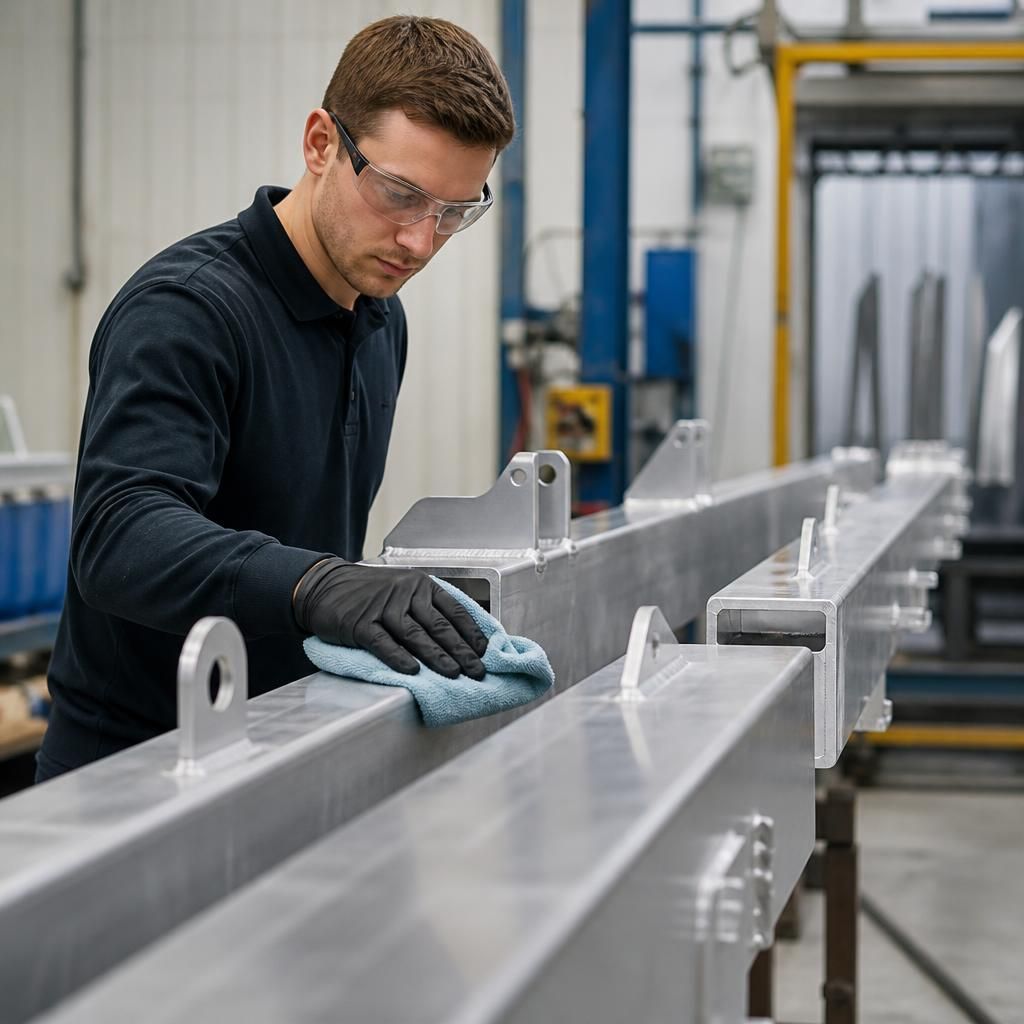
Aluminium must not be prepared using an unmodified steel-coating routine. Its soft surface and naturally forming oxide layer can be affected by aggressive abrasion, unsuitable blasting media or highly alkaline cleaners, while ferrous contamination may become trapped in the surface and undermine the finished coating.
Preparation should therefore use clean equipment, aluminium-compatible chemicals and an abrasive method suited to the alloy and component thickness. Where blasting is appropriate, the media and pressure should be controlled to create an even surface without excessive roughness or distortion. This is particularly important for visible RAL 9023 components, because uneven preparation can show through as texture variation after coating.
For unfamiliar alloys, castings or mixed-material assemblies, a representative sample can be processed first to confirm that the preparation route produces a clean, uniform surface and supports the required powder-coating finish.
Discuss your aluminium preparation requirements for RAL 9023 powder coating
Discuss your aluminium components, existing finish and service requirements with Powder-coatings.co.uk before specifying RAL 9023. Providing drawings or representative parts can help establish a suitable preparation and coating route.