

What specific advantages does RAL 8029 aluminium powder coating offer over other shades for industrial applications?
RAL 8029, a pearl copper shade, offers industrial components a distinctive warm metallic appearance that can provide greater visual differentiation than standard black, white or grey finishes. Its main advantage over other shades is aesthetic rather than inherently superior performance: durability, corrosion resistance and adhesion depend on the powder formulation, substrate preparation and application process.
RAL 8029 aluminium powder coating offers its clearest advantages where a project needs a recognisable metallic copper finish, consistent visual identification and a more considered appearance than a conventional neutral shade. It does not automatically provide better adhesion, corrosion protection or service life than another colour; those properties are governed by the coating system, aluminium preparation, curing conditions and exposure requirements.
Distinctive identification of components
A RAL 8029 finish can help distinguish finished parts, assemblies or product ranges without relying solely on labels, markings or changes in geometry. This can be useful where several visually similar components are handled within a manufacturing, fabrication or installation process. A defined colour may support internal product coding, help separate grades or applications, and give completed equipment a consistent identity.
This benefit is practical rather than technical. The colour should be included in the organisation’s drawing, parts schedule or coating specification if it is being used for identification. It should not replace safety signs, permanent labelling or formal traceability controls.
A warmer alternative to standard industrial neutrals
Black, white and grey remain common because they suit many environments and are straightforward to specify. RAL 8029 provides a warmer copper-toned alternative for equipment, panels, fabricated aluminium and architectural or commercial metalwork where a neutral finish would look too plain or would not support the intended design.
For projects in which metalwork is visible to customers, visitors or building users, this can make the coating colour part of the overall product or site design. It can also coordinate with other copper, bronze, brown or warm-toned materials, provided samples are reviewed under the lighting conditions in which the finished components will be seen.
Useful visual contrast on aluminium components
On aluminium parts, a darker metallic copper shade can create clearer contrast between the coated surface and uncoated features such as machined faces, fixings, apertures or engraved details. This may make the form of a component easier to read than a very light shade, although the result depends on the component’s geometry, lighting and level of gloss.
The contrast can be particularly relevant for enclosures, frames, covers, brackets and fabricated assemblies where appearance and visual definition matter alongside protection. It should be assessed with a representative sample rather than inferred from a digital colour display.
Consistent appearance across a defined batch
When the same RAL 8029 powder system, aluminium preparation and application controls are used, the shade can provide a repeatable appearance across a batch. This supports a consistent presentation of related components, which may be more important than selecting the most widely used industrial colour.
Metallic and pearlescent finishes require particular attention to application consistency. Gun settings, powder flow, film build, part orientation, recovery powder and curing can influence how the metallic effect is perceived. Components intended to appear together should therefore be coated under comparable conditions and, where practical, processed in the same production sequence. Colour approval should be based on an agreed physical sample or standard, not only on the RAL reference.
What RAL 8029 does not provide by itself
- It is not inherently more corrosion-resistant than another shade in the same coating family.
- It does not compensate for grease, oxide, contamination or inadequate preparation on the aluminium surface.
- It does not guarantee identical appearance after local repairs, recoating or exposure to different environments.
- It does not determine suitability for heat, chemicals, abrasion or outdoor exposure; the powder formulation and product data must be checked for those conditions.
For an industrial specification, the meaningful comparison is therefore between complete coating systems rather than colours alone. Confirm the required pretreatment, powder type, gloss level, film thickness, cure schedule, environmental classification and inspection criteria with the coater and powder supplier. RAL 8029 is the strongest choice where its copper appearance, component differentiation and design coordination solve a genuine project requirement; another shade may be more appropriate where visibility, colour coding, cleaning or exposure conditions take priority.
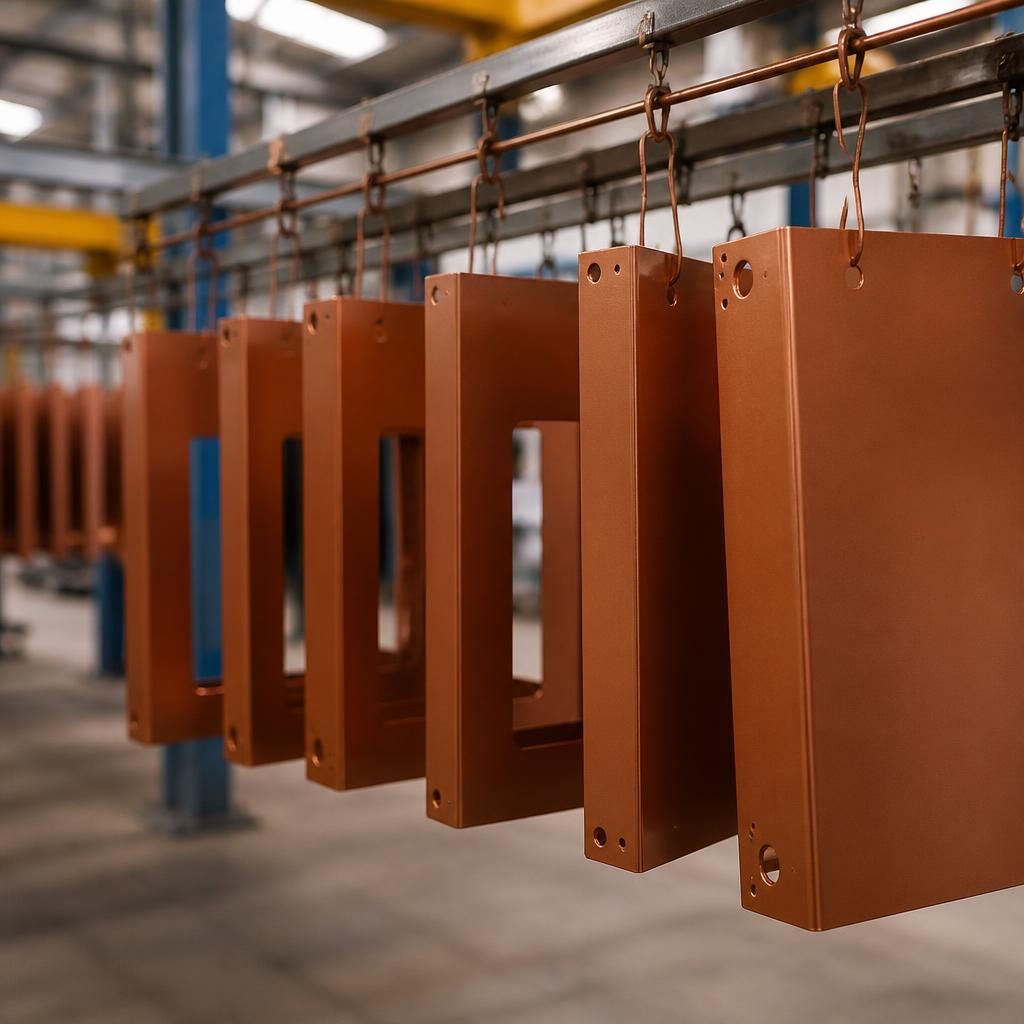
One practical advantage of RAL 8029 is its ability to give a group of related aluminium components a defined visual identity without changing their design or construction. This can help a finished product, enclosure or fabricated assembly appear deliberately coordinated when the metalwork forms part of a wider equipment or building scheme.
The shade is most appropriate where the surrounding materials and visual brief favour a warm metallic tone. Its suitability should be assessed against the actual adjacent materials, lighting and viewing distance, because the appearance of a pearl copper finish can differ between a sample, a coated component and the completed installation.