

What critical factors should be considered when assessing the quality standards and certification of RAL 7035 powder coated aluminium for your projects?
Assess RAL 7035 powder coated aluminium by checking the coating specification, aluminium pretreatment, film thickness, adhesion, curing, colour and gloss tolerances, corrosion resistance, and weathering performance required for the project. Confirm that the coater can provide relevant test records, batch traceability and evidence of compliance with the specified industry standard or certification scheme, rather than treating the RAL colour designation alone as proof of quality.
The quality of RAL 7035 powder coated aluminium should be assessed against the project’s required performance class and an applicable quality scheme, not by the RAL designation alone. RAL 7035 identifies the intended light grey colour; it does not certify the powder formulation, the preparation of the aluminium, the application process or the finished component. A reliable assessment therefore links the coating system, substrate, application method and acceptance criteria to a recognised standard or documented project specification.
Start by identifying the correct standard or certification route. For architectural aluminium, EN 12206-1 may be relevant, while schemes such as Qualicoat or GSB International can provide additional requirements for approved coating systems and controlled production. These schemes are not interchangeable with a colour reference. Check which standard is appropriate for the component’s use, exposure and expected service life, then confirm that the stated certification covers the actual coating location and process being used.
- Check the certificate holder’s legal name and the production site covered by the certificate.
- Confirm that the certificate is current and has not been limited, suspended or issued only for a different process.
- Review the classes, product categories and applications included within its scope.
- Establish whether the certification applies to the powder product, the applicator, the finished aluminium, or a combination of these.
A certificate associated with a powder manufacturer does not automatically demonstrate that every applicator achieves the same result. Conversely, an applicator’s quality approval may apply only to particular lines, substrates or coating systems. The evidence should relate to the production route proposed for the project rather than to a general claim that the business follows an industry standard.
Check that the aluminium itself is suitable for the intended finish. Alloy, temper, extrusion quality, cast features and surface condition can affect the final appearance and service performance. Components with welds, deep recesses, sharp transitions, trapped moisture or dissimilar attachments may need specific design controls. Aluminium parts should also be presented in a condition that allows the specified process to be carried out consistently. Oil, marking materials, storage contamination and embedded debris can undermine the result even where the powder and application equipment are suitable.
Project documentation should define what is acceptable visually. This can include the viewing distance, lighting conditions, permitted variation between adjacent parts, treatment of joins and the handling of minor surface features that originate in the aluminium rather than the coating. A single reference panel or approved sample is useful where appearance is important, but it should be agreed before production and should not replace the applicable technical requirements.
Assess the quality of the inspection system, not just the finished appearance. A professional inspection plan explains who checks the work, which instruments or reference methods are used, how samples are selected and what happens when a result falls outside the agreed limit. Measurements should be linked to identifiable parts or production batches so that a non-conforming group can be isolated without unnecessarily rejecting unrelated work.
For larger or repeat orders, request a documentation pack that may include:
- the agreed coating and substrate specification;
- the relevant certification or approval documents;
- powder product identification and supplier technical documentation;
- production and inspection records linked to the batch or job reference;
- details of any deviations, rework, repairs or concessions;
- the final release record and care information where applicable.
Independent laboratory reports can be valuable when the application is safety-critical, highly exposed or subject to a formal construction specification. Their usefulness depends on the test being carried out on a representative coating system and on the report identifying the sample, method, date and party responsible for the work. A generic report for an unrelated powder or substrate should not be treated as evidence for the finished aluminium components.
Define non-conformance and repair arrangements before production. The project documents should state whether parts may be stripped and recoated, locally repaired or rejected, and who authorises any concession. Repairs can alter appearance and may not restore the same level of protection as the original system, particularly where the defect has exposed the substrate or resulted from unsuitable component design. The agreed approach should also cover packaging, handling and storage, because damage after inspection can be mistaken for an application fault.
For procurement purposes, the strongest quality requirement combines a named standard or certification scheme with a clear specification, an approved sample where appearance matters, documented inspection responsibilities and traceable release records. This gives the buyer a practical way to compare quotations and verify conformity without assuming that a RAL 7035 reference, a certificate logo or an attractive visual finish is sufficient on its own.
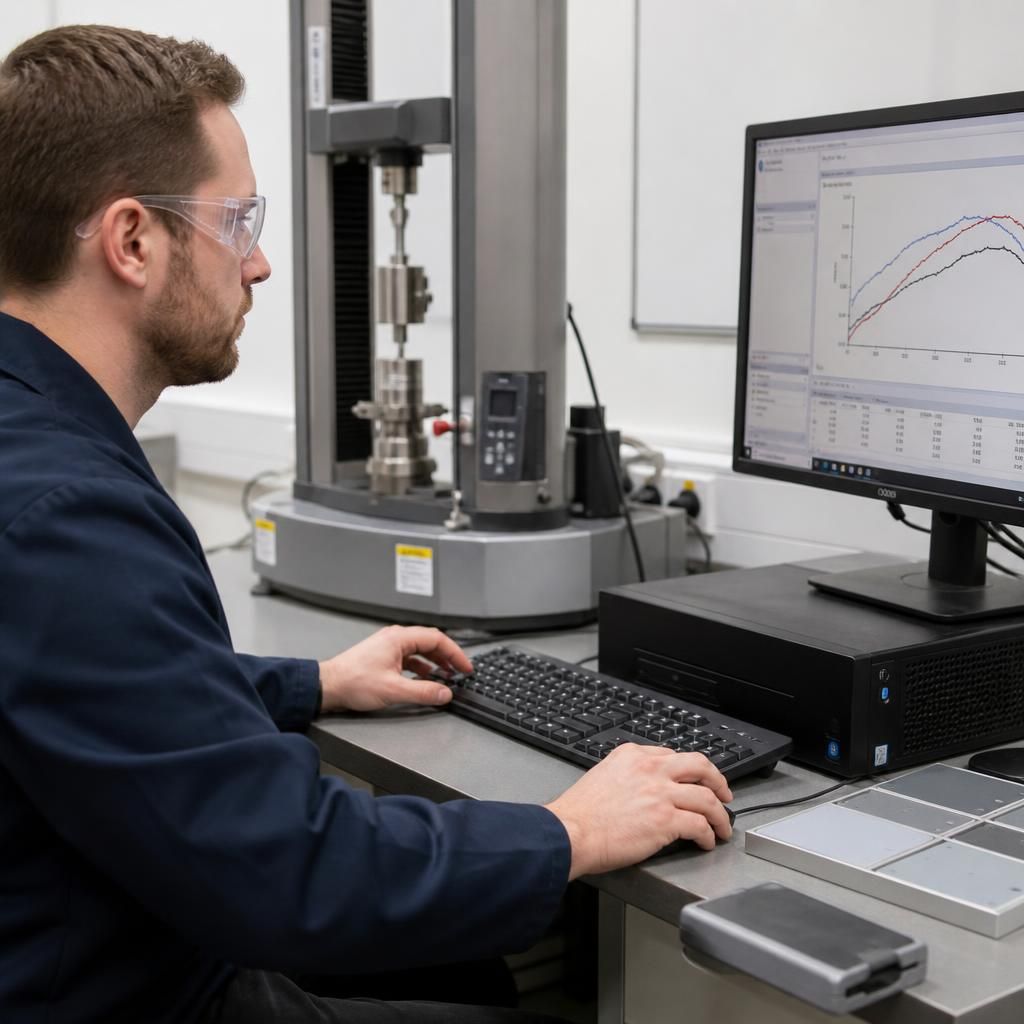
Test results for RAL 7035 powder coated aluminium are useful only when the test method, specimen and acceptance limit match the intended application. A result from an accelerated corrosion or weathering test can indicate how a coating system performs under defined conditions, but it does not by itself predict an exact service life in every location.
When reviewing test evidence, check whether the sample used the same aluminium alloy, pretreatment, powder system, film build and curing conditions as the proposed production parts. Also confirm how the result was assessed and whether the stated limit relates to appearance, adhesion or substrate protection. This prevents a favourable result from an unrelated coating system being treated as proof of conformity for the finished components.
Discuss Your RAL 7035 Aluminium Specification
Discuss your RAL 7035 aluminium specification with Powder-coatings.co.uk to review the required finish, coating system and quality documentation for your project. Share your component details and acceptance criteria so the proposed powder coating route can be assessed against the relevant requirements.