

What maintenance practices are recommended to ensure the longevity and performance of RAL 1018 powder coated aluminium in demanding industrial settings?
Maintain RAL 1018 powder coated aluminium through regular inspection and gentle cleaning with clean water, a mild detergent and a soft, non-abrasive cloth. Remove chemical deposits, dirt and moisture promptly, avoid harsh solvents or abrasive tools, and have chips, scratches or coating breakdown assessed and repaired before corrosion develops.
The longevity and performance of RAL 1018 powder coated aluminium depend on controlling the conditions around the coating, not only on surface cleaning. In demanding industrial settings, maintenance should combine sound installation, protection from mechanical and chemical damage, effective drainage, compatible repairs and documented control of the operating environment.
Prevent water retention
Install and position coated aluminium so that water can drain rather than collect in ledges, joints, folded sections, fixings or hollow profiles. Persistent dampness can affect cut edges, crevices and areas where the coating has been damaged. Keep drainage paths clear and review locations where condensation, process wash-down or rainwater may remain trapped. Components should not be stored or installed in a way that holds moisture against the coating.
Control contact with other materials
Aluminium should be separated from incompatible metals and treated materials where galvanic corrosion could occur in the presence of moisture. Use suitable isolating washers, gaskets or barriers where the design brings aluminium into contact with steel, copper or other conductive materials. Fasteners and brackets should be appropriate for the environment, and damaged protective finishes on adjacent hardware should not be allowed to create a corrosion path onto the coated component.
Protect the coating during handling and installation
- Use clean, non-marking supports when moving or stacking components.
- Prevent metal-to-metal rubbing, dragging and point loading during fabrication, transport and fitting.
- Remove temporary films or protective materials in accordance with the coating and component supplier’s guidance, particularly where heat or sunlight may cause adhesive residue to bond more firmly.
- Ensure drilling, cutting and machining swarf is removed from the assembly rather than left in contact with the finish.
- Avoid placing tools, sharp-edged materials or heavy components directly on visible coated surfaces.
These precautions are especially important for yellow finishes such as RAL 1018, where scuffs, transfer marks and local discolouration can be visually apparent even when the aluminium remains structurally sound.
Manage industrial contaminants
Manufacturing processes can expose coated aluminium to oils, coolants, welding residues, airborne salts, cement dust, traffic film or chemical vapours. Identify the contaminants present in the specific workplace and prevent them from remaining on the coating or accumulating around joints. Where a process change introduces a new chemical, confirm its compatibility with the powder coating before the coated component is exposed to it. Chemical exposure should be controlled at source through extraction, splash protection, containment and suitable separation wherever practicable.
Do not use an unapproved coating treatment, solvent, sealant or adhesive simply because it is suitable for another painted or plastic surface. Compatibility depends on the powder formulation, concentration, contact time and operating temperature. The coating applicator or product documentation should be consulted before introducing a maintenance chemical or protective treatment.
Maintain seals, joints and interfaces
Sealants, gaskets and jointing materials can deteriorate independently of the powder coating. Include these interfaces in the maintenance plan, looking for shrinkage, cracking, lifting, loss of adhesion or gaps that could admit water and contaminants. Replace failed materials with products compatible with powder coated aluminium, and avoid damaging the surrounding finish during removal. Pay particular attention to joints near wash-down areas, external transitions and locations subject to movement or vibration.
Limit mechanical and thermal stress
Prevent repeated impact from tools, pallets, vehicle traffic, loose components and handling equipment. Where impact is unavoidable, use guards, spacing or sacrificial protection rather than relying on the coating to absorb continual contact. Investigate recurring damage at doors, access panels, loading points and machinery interfaces, since replacing the coating without addressing the source will not provide a lasting solution.
Large temperature changes can also place stress on assemblies through differential expansion between aluminium, fixings, seals and adjacent materials. Allow for movement in the design and keep drainage and joint details functional. Do not expose the finish to process temperatures beyond the coating system’s specification.
Use a controlled repair process
Minor coating damage should be recorded by location and cause, then repaired using a system confirmed as compatible with the original powder coating and the service environment. Preparation should remove loose material and contamination without unnecessarily enlarging the affected area. The repair must restore suitable coverage and edge protection; applying an arbitrary paint over a damaged area may produce a poor colour match or an incompatible film.
Where damage is extensive, corrosion is present at edges or interfaces, or the coating has lost adhesion, obtain a technical assessment before deciding between local repair, removal and recoating, or component replacement. Repairs should be checked after curing and documented so that recurring failure patterns can be addressed in the design or operating procedure.
Keep maintenance records
A useful record identifies the component, its location, the surrounding exposure, the condition found, any chemical or mechanical cause, the materials used for repair and the action taken. This information helps distinguish isolated handling damage from wider problems such as poor drainage, incompatible fixings or an unsuitable coating specification. Maintenance frequency should then reflect the actual exposure: sheltered internal components, external elevations, coastal or heavily polluted locations and areas subject to process chemicals will not present the same risks.
For critical installations, align the maintenance plan with the powder coater’s technical guidance, the component manufacturer’s instructions and the site’s chemical-control procedures. This approach preserves the protective function and appearance of RAL 1018 powder coated aluminium while reducing avoidable damage during its industrial service life.
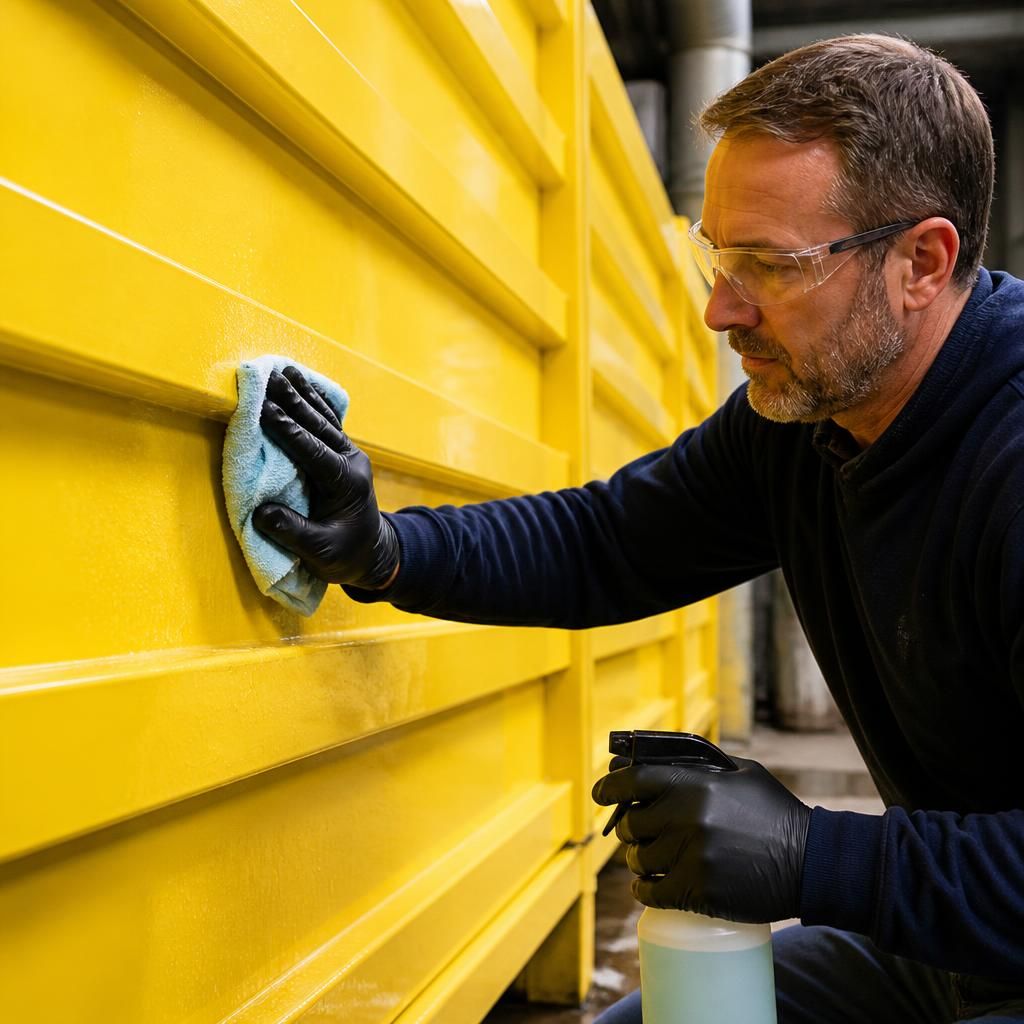
Cleaning RAL 1018 powder coated aluminium should be matched to the contaminant rather than made more aggressive by default. Loose dust and dry process residue can usually be removed with a clean-water rinse before the surface is washed. Oily films may require a compatible mild detergent, while cement, salt or chemical deposits need careful removal before they harden or concentrate at edges and joints.
- Rinse away loose particles before wiping to reduce the risk of surface abrasion.
- Use a clean, soft cloth and work in manageable sections, avoiding force on stained areas.
- Rinse off detergent or dissolved residue so it does not dry back onto the coating.
- Escalate persistent staining or suspected chemical attack for technical assessment rather than repeatedly increasing the cleaner’s strength.
Discuss your RAL 1018 powder coated aluminium requirements
If you are assessing worn or damaged RAL 1018 powder coated aluminium, discuss the component’s exposure conditions, existing coating and maintenance history with our specialists. We can help identify a suitable next step, from compatible repair advice to recoating requirements.