

What makes Interpon D1036 Matt coating particularly suitable for large-scale industrial aluminium projects?
Interpon D1036 Matt is particularly suitable for large-scale industrial aluminium projects because it combines a consistent matt appearance with a durable powder-coated finish across substantial quantities of components. Its repeatable application makes it practical for batch production where uniform colour, texture and coverage are important.
Interpon D1036 Matt is particularly suitable for large-scale industrial aluminium projects because it provides a controlled, low-sheen finish that can be applied as part of a repeatable production process. This is important when a project includes many aluminium items that must meet the same visual and performance specification, such as panels, frames, sections, fabricated components or architectural features.
Its suitability comes from several practical characteristics:
- Consistent appearance across extensive work: A matt finish gives aluminium a restrained, contemporary appearance without the high reflectivity associated with gloss surfaces. On a large installation, controlling sheen and surface appearance helps the completed work look coherent when viewed across adjoining or repeated components.
- Compatibility with production-line planning: Powder coating can be integrated into a defined sequence covering preparation, coating, curing, inspection and packing. Establishing the same process controls for each production run makes it easier to manage substantial quantities of aluminium without treating every component as an entirely separate finishing job.
- Suitable for fabricated aluminium parts: Large projects often involve components with different profiles, edges, apertures and fixing details. Interpon D1036 Matt can be considered where these items need a common finish, provided the aluminium is suitably prepared and the component design allows the coating to be applied and cured correctly.
- Practical quality inspection: A specified matt finish gives the coating team a clear visual reference when checking coverage, colour, texture and surface defects. Inspection criteria can be agreed before production, helping identify issues before coated parts are packed or assembled.
- Reduced dependence on site finishing: Completing the coating in a controlled industrial setting can simplify the project sequence by allowing finished aluminium components to arrive ready for installation. This can be particularly useful where the quantity, size or location of the components would make painting or other finishing work on site impractical.
- Protection for the aluminium substrate: The coating forms a continuous finished layer over prepared aluminium surfaces. The level of protection achieved depends on correct preparation, application, curing, handling and the conditions in which the finished components will be used, so these factors should be addressed in the specification rather than relying on the product name alone.
Large-scale suitability also depends on how the project is specified. The required colour, gloss level, coating build, component dimensions, edge detail, masking requirements and intended environment should be confirmed before production begins. Aluminium parts should be designed and presented for effective pretreatment and coating, with contact points and areas that must remain uncoated identified in advance.
Handling and logistics are equally important. Coated components need suitable support, protection and packing to reduce the risk of abrasion, impact or contamination between coating and installation. For projects involving numerous parts, clear identification and an agreed delivery sequence can also help ensure that components reach fabrication or construction teams in the correct order.
Interpon D1036 Matt is therefore a strong option where a project requires a controlled matt aesthetic, repeatable industrial processing and a clearly managed finish across a substantial aluminium package. It should be selected alongside an appropriate preparation and application specification, rather than as a substitute for those process controls.
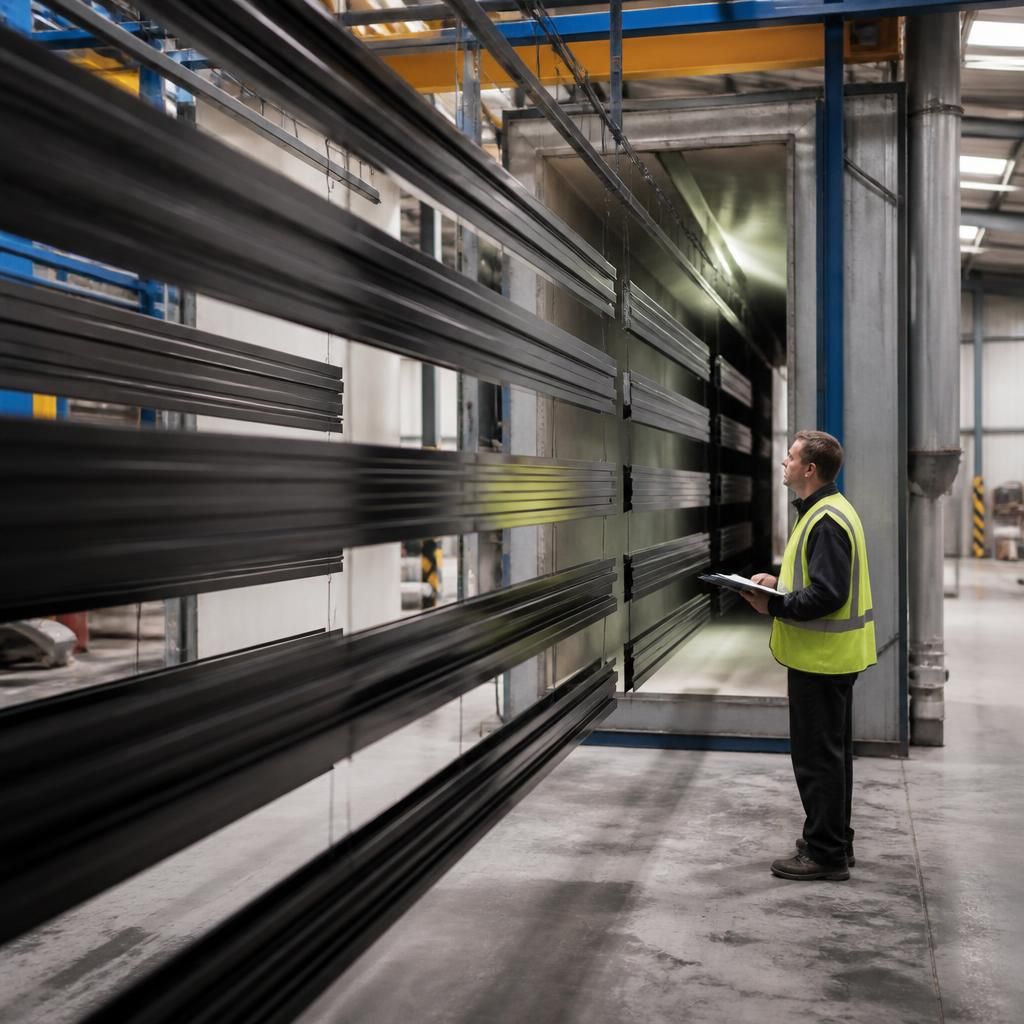
For large aluminium projects, suitability also depends on whether the components can pass through the coating and curing equipment without compromising process control. Interpon D1036 Matt should therefore be assessed against the longest, widest and most complex parts, including frame assemblies, deep sections and items requiring masking. The applicator needs to confirm racking, electrical contact, oven capacity and curing requirements before production, as these factors determine how consistently the components can be processed.
This assessment helps distinguish a coating specification that works for individual samples from one that is practical across a complete project package. Where components differ significantly, they may need grouping by profile or mass while retaining the agreed matt appearance. Equipment capability and component presentation are therefore important considerations when selecting Interpon D1036 Matt for large-scale aluminium work.
Discuss Your Large-Scale Aluminium Coating Requirements
Discuss your large-scale aluminium coating requirements with the team, including component profiles, dimensions, intended environment and finish specification, so the proposed Interpon D1036 Matt process can be assessed against your project needs.