

What is the application process for applying Interpon D2015 and D2525 finishes to aluminium surfaces?
Applying Interpon D2015 and D2525 finishes to aluminium involves thorough surface preparation and pretreatment, followed by electrostatic powder application and controlled oven curing. The coating specification, part design and manufacturer’s requirements determine the precise preparation and curing parameters.
The application process for Interpon D2015 and D2525 finishes on aluminium is a controlled sequence of inspection, cleaning, chemical pretreatment, powder application, curing and quality checks. The selected finish, aluminium alloy, component design and project specification determine the exact preparation and oven settings, so the coating system should be agreed before production begins.
1. Review the aluminium and coating specification
Before work starts, the applicator assesses the aluminium components, their intended use and the required appearance. This review should cover the specified Interpon system, colour, gloss level, texture, film requirements, exposed faces, masking points and any areas that must remain uncoated. Drawings should identify threads, drainage paths, contact faces and assembly tolerances that could be affected by the coating.
The aluminium alloy and its condition are also relevant. Extrusions, sheet, castings and previously treated components can carry different levels of oxide, lubricant, marking or contamination. Welded areas, sharp edges and repairs may require particular attention because they can influence coating coverage and visual uniformity.
2. Inspect and prepare the parts
Parts are checked for oil, grease, adhesive residue, dirt, corrosion, handling marks and surface damage. Any fabrication work, drilling, welding and deburring should normally be completed before coating. Sharp burrs and excessive edges are removed where appropriate, while the surface is prepared without introducing scratches or contamination that could remain visible through the finish.
Components must be suitable for the cleaning and pretreatment line. Entrapped water, oils or residues in hollow sections can interfere with processing, so the design and orientation of parts should allow effective drainage and rinsing. Items that cannot be adequately cleaned or rinsed may require a revised preparation method or design detail.
3. Clean and chemically pretreat the aluminium
Cleaning removes manufacturing oils and other contaminants. The aluminium then passes through a compatible pretreatment sequence intended to provide a stable surface for powder adhesion and to support corrosion resistance. Depending on the approved system and production equipment, this can include cleaning, rinsing, a conversion treatment and further rinsing or drying.
Pretreatment chemistry, concentration, contact time and operating conditions need to be controlled by the applicator. The process must be appropriate for aluminium and for the selected Interpon finish; a preparation method suitable for another metal cannot simply be assumed to be suitable here. After pretreatment, components are dried thoroughly before powder is applied.
4. Mask areas that must remain clear
High-temperature masking materials are used for surfaces such as earth points, threaded holes, bearing seats, mating faces and assembly interfaces where powder would affect fit or electrical contact. Masking must be secure enough to prevent overspray but positioned accurately so that the finished part meets the drawing and assembly requirements.
Complex shapes need additional planning. Recesses, internal corners and narrow sections can be affected by the Faraday cage effect, in which the electrostatic field makes it harder for powder to reach enclosed areas. Gun angle, powder output, air settings and application technique are adjusted to improve coverage without creating excessive build-up on accessible edges.
5. Apply the powder
The dry powder is applied using an electrostatic spray gun. The gun imparts an electrical charge to the powder, while the earthed aluminium component attracts the particles. The operator controls the application distance, gun movement, powder flow and voltage to achieve an even deposit across the approved surfaces.
Coverage is checked on faces, edges, corners and recessed areas rather than relying only on the appearance of broad flat sections. Powder application must also account for part thickness and thermal mass, as these affect how the component reaches the required curing condition. Components are handled carefully between spraying and curing to avoid disturbing the deposited powder.
6. Cure the coating in the oven
After spraying, the parts enter a controlled curing oven. The coating develops its final properties only when the aluminium reaches the specified metal temperature for the required time. Oven settings are therefore based on the coating manufacturer’s technical requirements and the actual component load, not simply the air temperature shown on the oven controller.
Parts with different sizes or thermal mass may heat at different rates. The applicator must ensure that the complete coating surface receives the required cure while avoiding conditions that could damage the finish, distort the component or affect colour and gloss. Cure records and production checks help confirm that the agreed process has been followed.
7. Inspect the finished coating
Once the components have cooled sufficiently for safe handling, the coating is inspected against the agreed specification. Typical checks include:
- even colour, gloss and texture across visible surfaces;
- coverage of edges, corners and recesses;
- film thickness where specified;
- adhesion and surface condition;
- absence of runs, pinholes, blisters, contamination and obvious inclusions;
- correct masking, dimensions and uncoated contact areas.
Inspection requirements vary according to the project specification and the selected finish. Colour comparisons should be made under consistent viewing conditions, particularly where separate batches or multiple components must appear uniform. Any defect or area outside tolerance should be assessed before parts are released for packing or assembly.
8. Protect and prepare the coated components for delivery
Finished aluminium must be allowed to cool and handled with clean equipment to reduce marking. Protective separators, suitable packaging and careful stacking help prevent rubbing, impact damage and contact between coated faces. The packaging method should reflect the component geometry and the conditions expected during storage, collection and delivery.
For a reliable result, the application process is treated as one connected system rather than as powder spraying alone. Correct pretreatment, controlled deposition, complete curing and documented inspection all contribute to the performance and appearance of an Interpon D2015 or D2525 finish. A specialist powder coater can review drawings, masking requirements and batch handling arrangements before processing aluminium components for manufacturers, fabricators, construction firms and automotive businesses across the Midlands, with collection and delivery options where required.
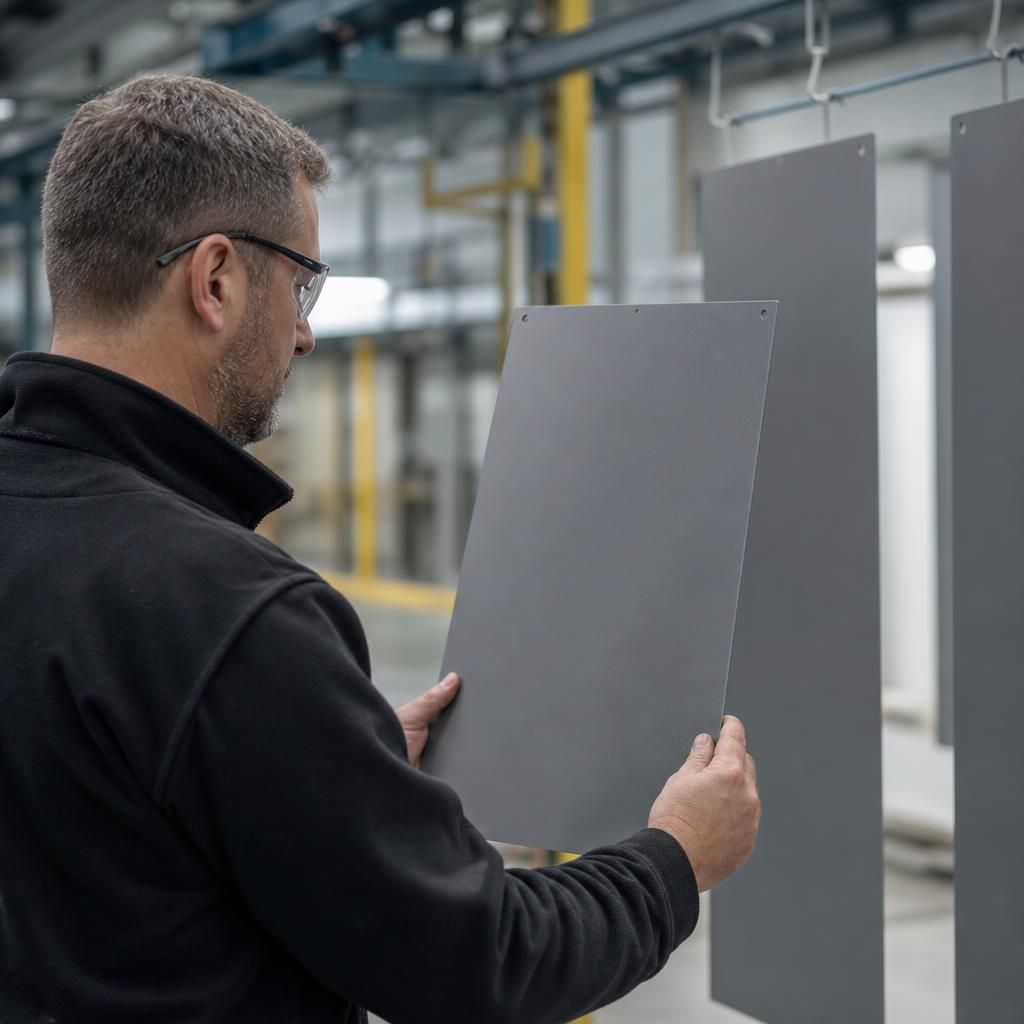
First-off approval helps confirm the agreed finish before batch processing begins. Where the project specification requires it, a representative aluminium component or sample panel can be processed using the proposed Interpon D2015 or D2525 system. This allows the parties to assess colour, gloss, texture, coverage and the treatment of visible edges under the intended application conditions.
Approval should also confirm practical details such as masked areas, acceptable surface variation and how the finish is viewed under consistent lighting. Once agreed, the approved sample provides a reference for subsequent production checks without replacing the specified inspection requirements.