

What considerations should be made regarding the thickness of the black powder coating for specific industrial applications?
The required thickness of a black powder coating depends on the substrate, component geometry, exposure conditions, required corrosion and wear resistance, and the tolerances of the finished part. It should be agreed with the coater before production so the coating provides the necessary protection without affecting fit, moving parts, edges, threads or other critical dimensions.
For an industrial component, black powder coating thickness should be specified as an acceptable dry-film range rather than as a single nominal value. The correct range must deliver the required barrier, wear and appearance performance while remaining compatible with assembly, movement and any subsequent processing. The specification should therefore define the measurement method, target range, minimum acceptable reading and maximum permitted build.
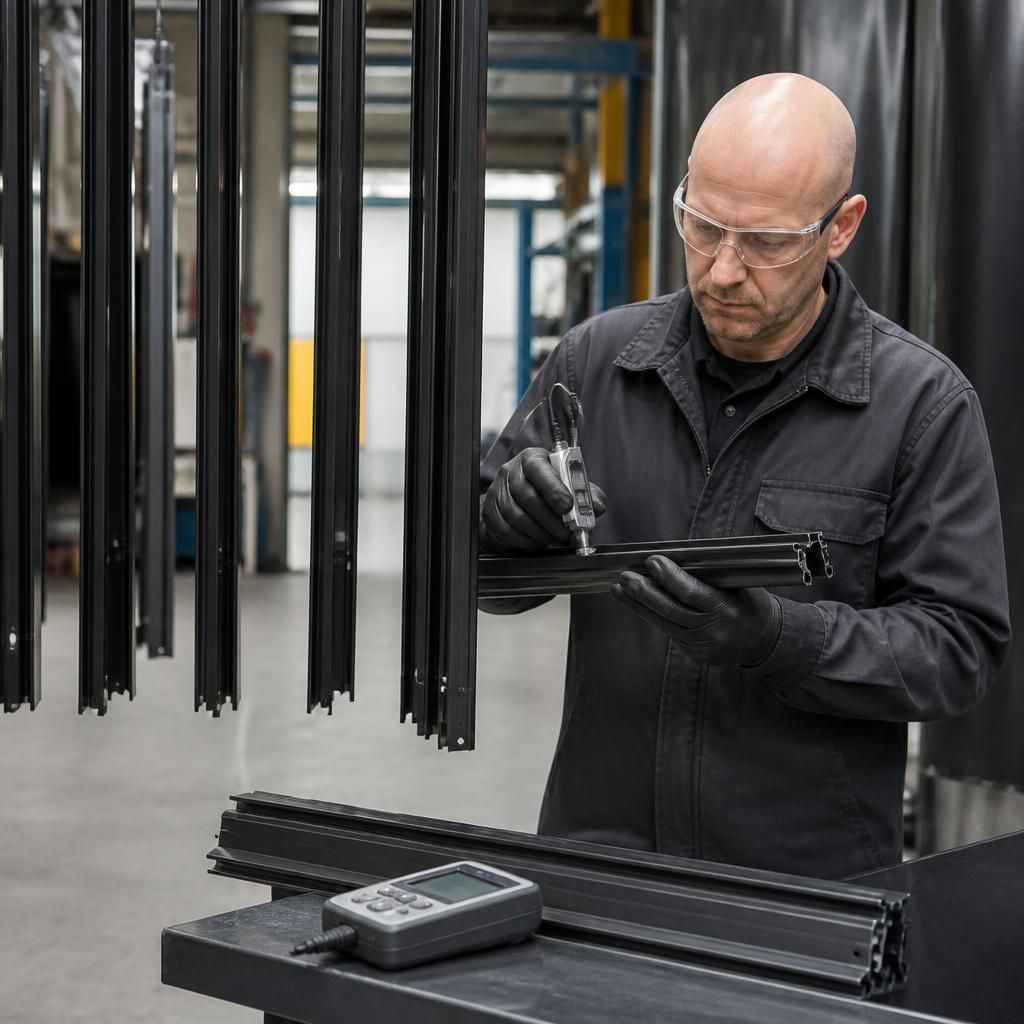
Specify dry-film thickness, not powder weight. The relevant measurement is the thickness of the cured coating on the finished metal surface. Powder quantity applied before curing is not a reliable substitute because transfer efficiency, part shape, reclaim material and curing behaviour can all affect the final film. A coating specification should state that readings are to be taken after curing and should identify the gauge or test method used.
It is also important to distinguish between an average thickness and a local minimum. A component may have an acceptable average while thinner areas remain vulnerable to corrosion or early wear. Conversely, isolated heavy deposits can create assembly problems even when the overall result appears satisfactory. A practical specification will identify the areas that are functionally important and set suitable acceptance criteria for them.
Thickness should reflect the job performed by each surface. A visible outer panel may require a consistent, smooth film for appearance and weather resistance, whereas a bracket, frame or machine guard may place greater emphasis on impact resistance and edge coverage. Parts exposed to abrasion, repeated handling or contact with other components need a specification that considers wear at the working surface rather than relying only on a general finish requirement.
Some components also contain surfaces that must remain partly uncoated. Masking may be required for earthing points, bearing seats, threaded holes, press fits, machined faces and interfaces where another part must locate accurately. Where masking is impractical, the drawing should identify the permitted coating build in these areas. Otherwise, a coating that is protective in general terms can prevent correct assembly.
Allow for dimensional build-up. Powder coating adds material to both sides of a component, and the effect is more significant on close-tolerance assemblies. Threads may become tight, holes may reduce in effective diameter and sliding or rotating parts may bind. Designers should consider coating thickness in the component tolerance stack and, where necessary, increase clearances or nominate surfaces for masking and post-coating finishing.
Edges and corners require particular attention. Powder can pull away from a sharp edge during application and curing, leaving less protection at the point most exposed to handling and impact. Radiused edges generally support more consistent coverage. Deep recesses, internal corners and enclosed sections can produce the opposite problem: local accumulation, uneven penetration or difficulty removing uncured powder. These areas should be reviewed before production rather than assessed only after coating.
Application control affects the result as much as the chosen target. Electrostatic attraction varies with the part’s electrical conductivity, grounding, orientation and distance from the spray equipment. Recesses and shielded areas can receive less powder, while accessible faces may receive more. The coater may adjust hanging positions, gun settings, part rotation and application passes to improve uniformity. A defined thickness range gives these adjustments a measurable objective.
Thickness must also be considered alongside curing. A heavy film can require careful control of oven conditions so that the coating cures throughout its depth without losing appearance or performance. The cure schedule should be based on the metal part reaching the required metal temperature for the specified time, rather than on oven air temperature alone. Excessive build, insufficient cure or uneven heating can produce defects such as poor flow, colour variation, pinholing or reduced adhesion.
Black finishes can make visual assessment particularly useful for identifying uneven coverage, contamination, gloss variation and visible surface defects, but appearance cannot establish film thickness. Thickness should be checked with a suitable calibrated gauge on representative areas, with readings recorded in a way that distinguishes accessible faces, edges and critical features. On complex parts, an agreed inspection plan is more meaningful than a single reading from an easy-to-reach surface.
For repeat or batch production, the coating specification should be confirmed on an initial sample or first-off component. This allows the fabricator and coater to check masking, racking, drainage, edge coverage, fit and measurement locations before the full batch is processed. Any areas that cannot be measured directly should be identified in advance, with the inspection approach agreed between the parties.
A useful thickness specification should therefore include:
- the required dry-film target and acceptable range;
- the surfaces that are functionally critical;
- areas requiring masking or a restricted coating build;
- the measurement method, gauge type and reading locations;
- requirements for edges, recesses, threads and mating faces;
- the applicable curing requirements for the selected powder system; and
- the inspection and approval process for an initial or representative part.
Where the end use is not covered by a recognised product or project specification, the coating requirement should be agreed from the component’s actual duty rather than selecting the thickest possible film. Excessive thickness does not automatically provide better protection and may introduce cracking, poor appearance, dimensional interference or curing difficulties. A controlled, measurable specification is more reliable than treating black powder coating as a one-size-fits-all finish.
The powder chemistry determines the suitable thickness range as well as the colour and finish. A black coating selected for external exposure, chemical contact, impact or general indoor protection may have different film-build requirements, so thickness should be checked against the powder manufacturer’s technical data rather than increased automatically.
The technical data should be reviewed alongside the component’s operating conditions and required finish. Applying a system outside its recommended range can affect flow, flexibility, adhesion, gloss and curing, even when the measured thickness appears acceptable. The coating specification should therefore identify the powder system and its recommended dry-film range, then confirm that this range meets the application’s performance requirements.