

What are the benefits of choosing black powder coated aluminium for outdoor applications?
Black powder coated aluminium provides a durable, uniform finish that helps protect outdoor components from weathering, corrosion and everyday wear. It also offers a clean architectural appearance with comparatively straightforward maintenance, making it suitable for external applications where both performance and visual consistency matter.
Black powder coated aluminium is aluminium finished with a thermoset powder coating that is electrostatically applied and then cured to form a continuous surface layer. For outdoor applications, its main benefits are the low weight of aluminium combined with a hard-wearing, design-led finish that can be specified for the level of exposure, colour retention and performance required.
Low weight with useful structural performance: Aluminium has a favourable strength-to-weight ratio, so coated components can be easier to handle and install than equivalent steel parts. This is useful for architectural trims, panels, frames, screens, housings, railings and other external fabrications where reducing dead weight can simplify supporting structures, transport and assembly without using a bulky section.
Protection tailored to the substrate: The powder coating is not the only factor determining outdoor performance. Aluminium naturally forms a thin oxide layer, while the coating provides an additional barrier against moisture, pollutants and contact with the surrounding environment. Correct cleaning, chemical pre-treatment and curing are essential because they determine how well the finish bonds and how effectively it protects the underlying metal. For coastal, industrial or heavily polluted locations, the specification should account for the particular exposure rather than treating every outdoor setting as equivalent.
Design flexibility: Black is suitable where external metalwork needs to coordinate with glazing, masonry, timber, roofing materials or other dark elements. It can provide visual contrast around openings and help frames, brackets and profiles appear less prominent. Powder coating also allows aluminium components to retain defined edges, apertures and formed details without the brush marks, runs or film thickness variation associated with some liquid-applied finishes.
Efficient coverage of manufactured parts: Powder coating can be applied to fabricated aluminium items in batches, making it suitable for repeat components as well as larger assemblies. The finish is formed during curing rather than by evaporating a liquid carrier, which can support a controlled production process and avoid the use of solvent-based paint for the coating application. The component still needs suitable preparation, clean handling and an agreed curing schedule; powder coating cannot compensate for oil, oxide contamination or unsuitable fabrication.
Useful finish options for different environments: A black finish can be selected in different gloss levels and coating grades, depending on the required appearance and exposure. Where colour retention is important, the coating chemistry and product specification should be checked for external use, particularly on façades or components exposed to strong sunlight. A standard internal-grade powder should not be assumed to provide the same result outdoors.
Consider solar heat absorption: Black surfaces absorb more solar radiation than pale colours, so the choice is not purely visual. On thin panels, enclosed housings, window systems or components beside heat-sensitive materials, the darker finish may contribute to higher surface temperatures. Designers should consider ventilation, clearances, thermal movement and the operating temperature of adjacent parts. This is especially important where aluminium sections are long, tightly fixed or exposed to direct sun.
For a reliable specification, assess the aluminium alloy and fabrication, the location’s exposure, the required coating grade, the intended gloss and colour, and the curing limits of the component. A specialist coating provider can review drawings and batch requirements before production, helping identify masking, racking, access and dimensional issues that could affect the finished outdoor part.
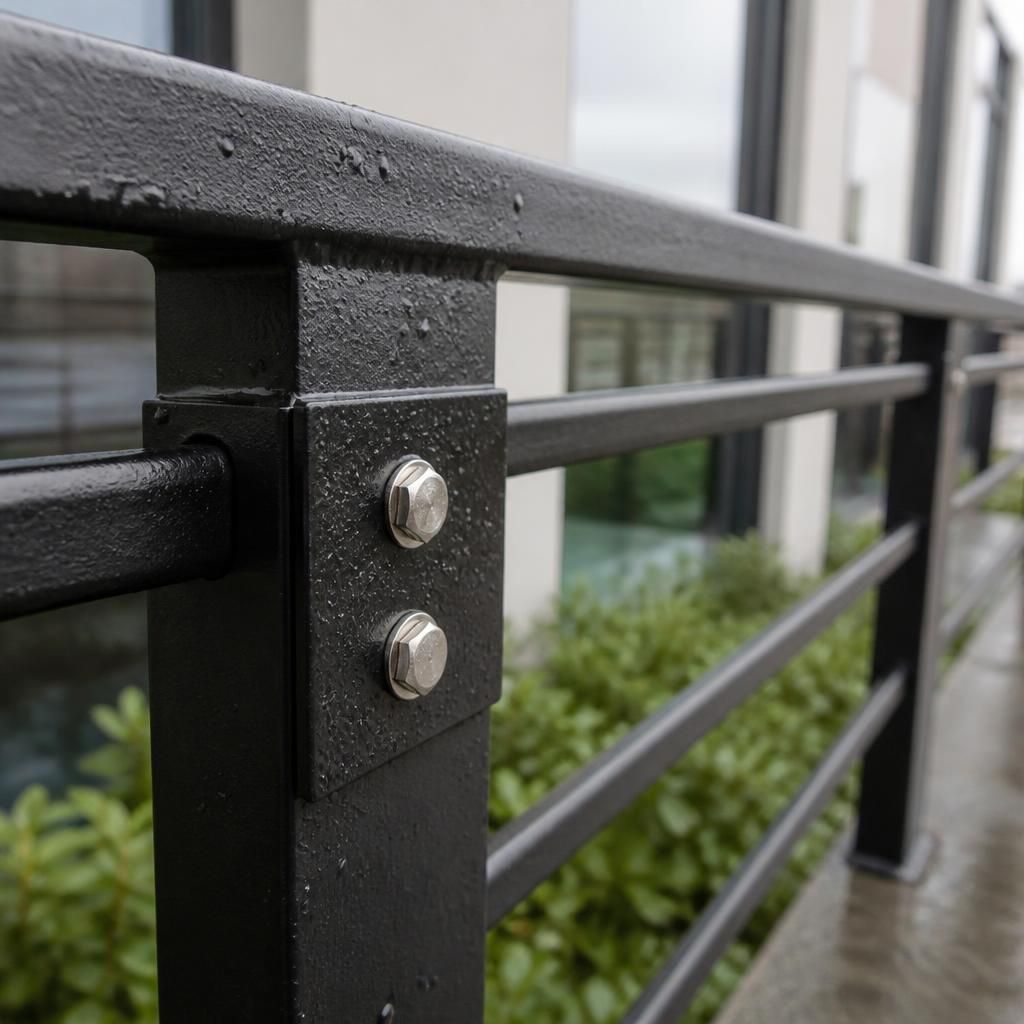
Black powder coating can help reduce contact between aluminium and dissimilar metals used in an outdoor assembly. By forming an electrically insulating barrier over the aluminium, the coating may limit the conditions that contribute to galvanic corrosion where moisture is present between unlike metals.
This benefit depends on the complete design rather than the colour alone. Fasteners, brackets and cut edges should be selected and detailed to avoid trapped water and direct metal-to-metal contact. Any damage to the coating should also be addressed before the component is exposed, particularly in assemblies combining aluminium with steel or other conductive materials.
Discuss Your Outdoor Black Powder Coated Aluminium Requirements
Discuss your outdoor black powder coated aluminium requirements with our specialists, including the component design, exposure conditions and finish specification. We can review your drawings and batch requirements to help identify suitable preparation, masking and curing considerations before production.