

What factors should I consider when choosing a provider for aluminium powder coating services to ensure quality and durability?
Choose an aluminium powder coating provider that can demonstrate suitable surface preparation, controlled curing, compatible coating specifications and consistent quality inspection. Also assess their experience with your component sizes and quantities, ability to achieve the required colour and finish, handling of dimensional or masking requirements, and clear communication about collection and delivery across the Midlands.
Choose an aluminium powder coating provider by assessing whether they can match the coating system to the alloy, component design and service environment, then control the work consistently from specification through to packing. Quality and durability depend on more than the powder itself: substrate condition, coating thickness, curing behaviour, handling, inspection and documented process control all influence the finished part.
1. Confirm the aluminium grade and component history
Different aluminium alloys, tempers and manufacturing methods can respond differently during coating. Extrusions, sheet, machined parts, castings and recycled aluminium may present different levels of oxide, lubricant, porosity or embedded contamination. Provide the coating provider with the alloy information where available, together with details of machining fluids, welding, anodising, previous finishes or repairs. Cast aluminium may require particular attention because trapped gases or porous areas can cause pinholes, blistering or surface defects during heating.
The provider should also understand the component’s intended use. A decorative architectural part, an enclosed industrial guard and an automotive component may require different priorities for appearance, corrosion resistance, impact resistance or chemical exposure. A technically suitable coating for one application may be inappropriate for another.
2. Match the coating system to the operating environment
Ask how the proposed powder coating is selected for the conditions the aluminium will experience. Relevant factors include indoor or outdoor exposure, ultraviolet light, moisture, salt, industrial pollutants, cleaning chemicals, abrasion, impact and operating temperature. Areas near the coast, in manufacturing environments or exposed to frequent washing can place greater demands on the coating than a dry, sheltered interior.
The specification should identify the required resin type, gloss level, texture, colour reference and any enhanced performance properties. It should also make clear whether one coating layer is appropriate or whether a primer and topcoat system is more suitable. A provider should be able to explain the reasoning behind the recommendation rather than selecting a finish solely by appearance.
3. Check how the design affects coating performance
Review the component design before production. Sharp internal corners, narrow recesses, deep cavities, overlapping joints and inaccessible faces can make it difficult to achieve even coverage. Drainage and vent holes may be necessary in hollow or enclosed sections to allow pretreatment liquids and heated air to move through the part safely. Poorly designed closures can retain moisture or chemicals and become weak points after coating.
For fabricated assemblies, consider whether coating before or after assembly is more appropriate. Contact surfaces, threads, bearing fits, earth points and sliding interfaces may need masking or a coating allowance. These details should be recorded on a drawing or job specification so that the provider can work to defined requirements rather than make assumptions.
4. Establish acceptable appearance and dimensional limits
Powder coating can improve appearance while adding a measurable film to the component. Confirm which surfaces are critical, where joins or hanging marks are permissible, and what level of visual variation is acceptable. Texture, gloss and metallic effects can make colour matching and visual assessment more complex, particularly between separate production batches.
Where parts fit together, check the permitted coating build on mating faces, holes, threads and close-tolerance areas. A provider should be given the relevant dimensional tolerances and masking requirements before quoting or processing. For visible products, agree how inspection will be carried out, including viewing distance, lighting conditions and the treatment of minor surface imperfections that originate in the aluminium rather than the coating.
5. Ask for evidence of process repeatability
Reliable results require controlled application conditions, consistent powder handling and a curing cycle suited to the actual metal temperature. Ask whether the provider records job parameters and can link the finished batch to the powder specification, production instructions and inspection results. Traceability is particularly important for repeat orders, safety-related components and projects involving several part numbers.
It is also useful to understand how the provider manages changes. A different alloy, casting source, powder formulation, part thickness or loading arrangement can alter the result. A controlled change process helps prevent an apparently minor substitution from producing a different colour, gloss level, adhesion performance or cure state.
6. Evaluate testing and inspection rather than relying on appearance alone
A smooth, attractive finish does not by itself demonstrate adhesion or long-term performance. Depending on the application, ask what checks are appropriate for the work, such as coating thickness, adhesion, cure, colour, gloss, visual coverage and resistance to relevant environmental or chemical exposure. Testing should reflect the agreed specification and the component’s service conditions.
For a new product or an important repeat contract, consider approving a representative sample or first-off part before the full batch. This can reveal issues with masking, hanging, coverage, fit, colour or surface defects while changes are still manageable. The sample should use the same material, design features and processing route as the production components wherever practical.
7. Consider the provider’s handling and packing controls
Freshly coated aluminium can be damaged by contact, stacking, friction and unsuitable packaging. Ask how parts are cooled, separated, protected and identified after processing. Packaging should prevent rubbing and impact without trapping moisture or contaminating the finish. Large frames, tubes and irregular fabrications may need tailored supports to prevent distortion or pressure marks during transport and storage.
Part identification is equally important when a project contains several finishes or specifications. Clear labelling and batch records reduce the risk of mixed components reaching assembly, especially where left- and right-handed parts or different masking arrangements look similar.
8. Look for clear technical documentation
A useful quotation or technical review should state the assumptions behind the proposed work, including the supplied condition of the aluminium, coating specification, preparation route, finish, critical areas, inspection requirements and any limitations. It should distinguish between defects caused by the substrate and defects introduced during coating.
Before appointing a provider, compare the technical scope rather than price alone. A lower-cost proposal may exclude masking, special handling, sample approval, additional testing or protective packaging. A clear scope makes quotations comparable and gives both parties a practical reference if a result needs investigating.
9. Assess suitability for the whole production requirement
For batch work, ask how components will be grouped and processed to maintain consistency across the order. Parts with different thicknesses, geometries or finish requirements may need separate loading or curing arrangements. For repeat production, discuss how retained samples, agreed standards and job records will be used to maintain the approved result from one order to the next.
The strongest choice is therefore a provider that can translate the component’s material, design and operating environment into a documented coating specification, validate the result on representative parts and maintain traceability through processing, inspection and delivery. This approach gives a more reliable basis for judging durability than selecting a provider on finish colour or quoted price alone.
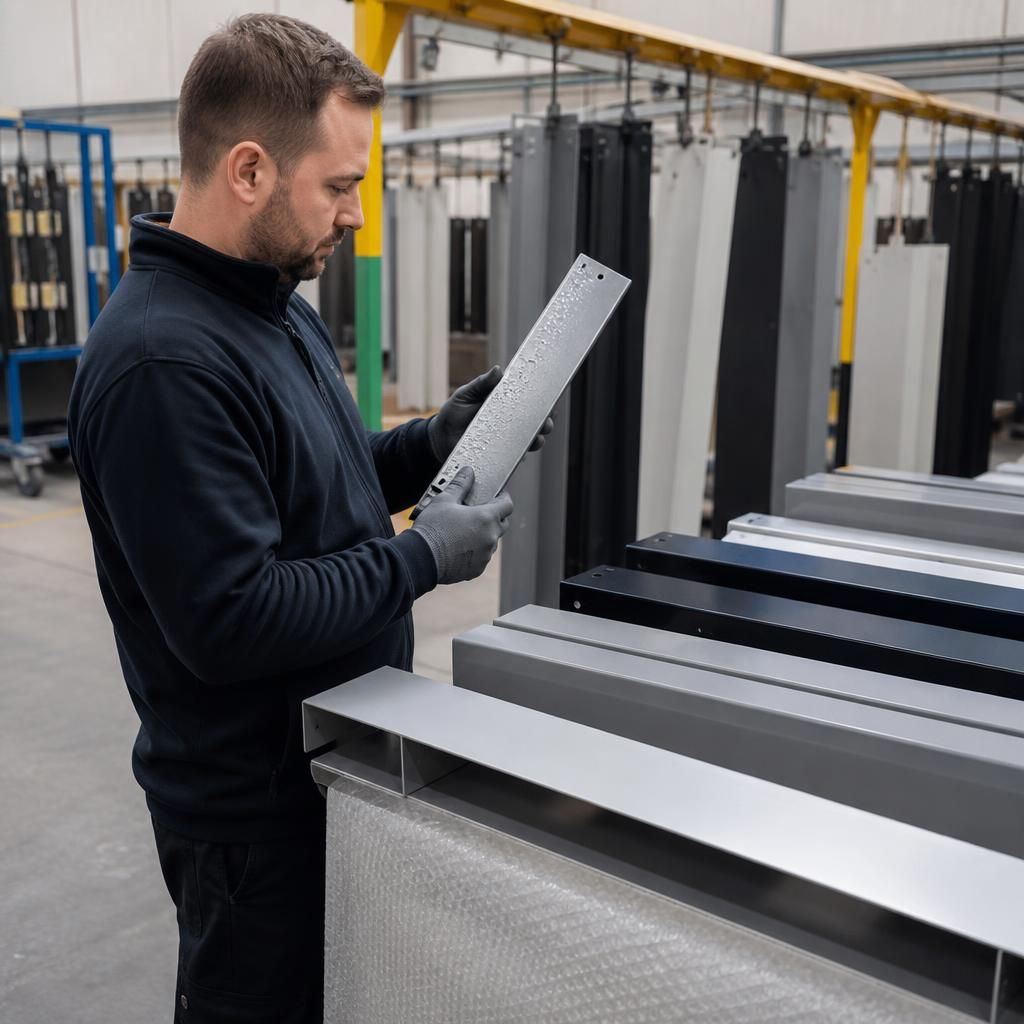
A useful measure of a powder coating provider is how they handle non-conforming parts, not only how they process acceptable batches. Ask what happens if a coating shows poor adhesion, uneven coverage, colour variation or handling damage, and whether affected components are segregated before dispatch.
The provider should be able to investigate the likely cause, such as contamination, inadequate preparation, incorrect curing or damage after coating, then explain the proposed corrective action. Rework should only be considered where it is technically suitable for the aluminium and the required finish. Clear records of the issue, decision and outcome help prevent the same defect from being repeated on future orders.