

What are the potential colour and finish options available for aluminium powder coating, and how do they affect durability?
Aluminium powder coating is available in a wide range of colours, including standard and custom shades, with finishes such as matt, satin, gloss, metallic and textured. The coating type and surface texture influence appearance, scratch and abrasion resistance, cleanability and weathering performance, while durability also depends on correct aluminium pretreatment, film coverage and the intended environment.
Aluminium powder coating colours and finishes affect durability through the coating formulation, pigment selection and surface profile, rather than colour alone. For a reliable specification, the finish should be chosen alongside the aluminium’s location, exposure to sunlight, contact with chemicals or abrasion, cleaning requirements and the expected service life of the component.
Colour selection and pigment performance
Standard colour ranges provide a practical route to consistent production, particularly where multiple batches or replacement components may be required. A custom colour match may be appropriate where the coated aluminium must align with an established corporate, architectural or product scheme. The colour reference should be agreed before production, as visual appearance can vary with gloss level, coating texture, viewing angle, substrate shape and batch conditions.
Pigments also influence resistance to ultraviolet exposure and heat. Some bright, dark or highly saturated shades can show fading, chalking or a change in tone more noticeably than neutral colours when exposed to strong sunlight. This does not mean that a particular colour is automatically unsuitable, but it does make the choice of exterior-grade formulation and the intended exposure especially important. For outdoor aluminium, the specification should identify the required weathering performance rather than relying on colour alone.
Solid, metallic and special-effect finishes
Solid colours generally give the most straightforward appearance control. Metallic and pearlescent effects contain reflective or effect pigments, so the perceived shade can change with viewing angle and the direction in which parts are sprayed or handled. These finishes may also make small differences between batches more visible. If components are to be installed side by side, they should be processed under an agreed specification and, where practical, as one controlled production run.
Metallic finishes can require additional care during application because pigment distribution affects uniformity. Touch-up work can be more apparent than on a plain solid finish, particularly on broad, visible panels. For that reason, the specification should address acceptable variation, the orientation of parts and whether future replacement pieces need to match an existing installation.
Gloss level and surface profile
A smoother, higher-gloss coating can make marks, handling damage and surface irregularities easier to see, although its smooth surface is normally easier to wipe clean. Lower-gloss and textured surfaces can reduce the visual impact of minor scuffs and provide a less reflective appearance. A textured surface may, however, retain more dirt in its profile and can be more difficult to clean thoroughly than a smooth coating.
Texture does not automatically mean that a coating is more resistant to impact or scratching. Its practical benefit is partly visual: damage may be less conspicuous, while the underlying resistance still depends on the selected coating system and the conditions the aluminium will face. Heavy handling, rubbing, sliding contact or repeated cleaning should therefore be considered separately from the desired appearance.
How the environment affects the choice
- External architectural components: prioritise resistance to ultraviolet exposure, moisture and weathering, with a colour and gloss level that remain suitable for the appearance required.
- Industrial equipment: assess contact with oils, solvents, detergents, heat and abrasive materials. A decorative finish alone is not evidence of chemical or industrial resistance.
- High-touch or frequently cleaned items: consider how easily the surface can be wiped without becoming marked, polished or contaminated in the texture.
- Components exposed to impact or friction: specify the coating system for the mechanical demands, rather than assuming that a darker, glossier or textured finish will provide additional protection.
- Concealed or internal parts: appearance may be less critical, allowing the specification to focus on the operating environment and the most suitable coating chemistry.
The coating chemistry matters more than the colour label
Powder coatings are formulated for different environments. A system intended for interior use should not automatically be selected for exposed external aluminium, while a coating designed for weathering may be unnecessary for a protected internal component. The resin, pigment package and performance classification should be reviewed together. Epoxy-based systems, for example, can be suitable for some internal applications but are not normally selected solely for long-term colour retention in direct sunlight. Exterior applications generally require a formulation selected for weathering performance.
Where corrosion protection is important, the complete system must be considered. Aluminium preparation, conversion treatment, coating coverage and the design of edges, joints and fixings all influence how well the finish protects the component. Colour and texture cannot compensate for unsuitable preparation or an inappropriate coating specification.
Cleaning, maintenance and future repairs
The selected finish should be compatible with the planned cleaning method. Smooth finishes are usually simpler to wash down, whereas textured surfaces may need more attention to remove deposits from the profile. Strong chemicals, abrasive pads and unsuitable pressure-washing practices can damage the appearance even when the original coating was correctly specified.
Future repairs should also be considered. A new powder-coated component may not appear identical to an older one because of natural weathering, differences in batch production or changes in the substrate and finish. Metallic, textured and very low-gloss finishes can be particularly difficult to blend invisibly. Where visual continuity is important, retain the original colour reference, gloss requirement, coating description and any agreed sample for later comparison.
What to include in the specification
- The colour reference or approved sample, including whether a custom match is required.
- The required gloss and surface texture, rather than describing the finish only as “powder coated”.
- The intended location and exposure, including sunlight, moisture, pollutants, heat and chemicals.
- Expected contact with impact, abrasion, handling or repeated cleaning.
- The required coating formulation or exterior performance classification where relevant.
- Any requirements for batch consistency, visible-face approval, masking, touch-up or future replacement parts.
The most durable result is therefore not necessarily the darkest, thickest-looking or most heavily textured finish. It is the combination of an appropriate colour and appearance with a coating system selected for the environment, controlled application and suitable aluminium preparation. A specialist coater can use the component’s dimensions, quantity, end use and exposure conditions to help determine whether the preferred colour and finish are technically appropriate as well as visually suitable.
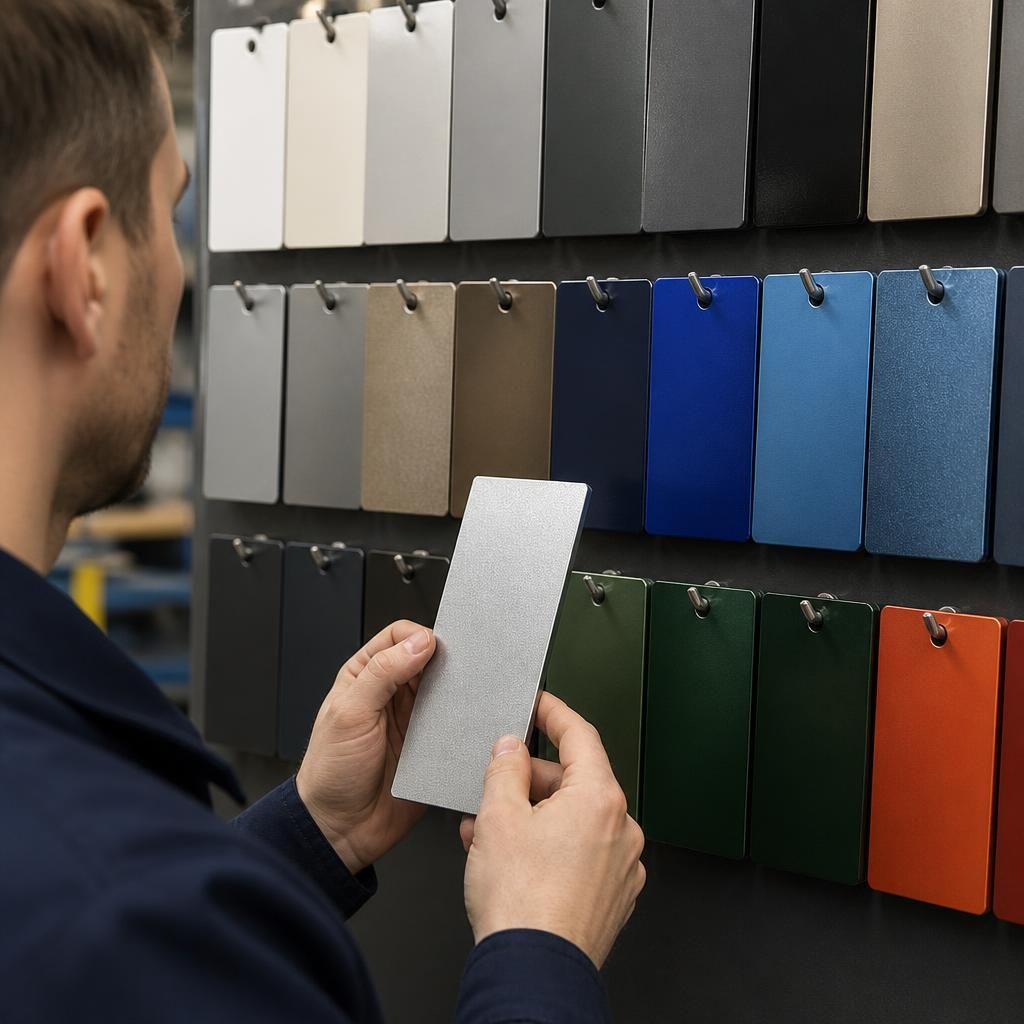
Colour and finish samples should be assessed on the same aluminium grade and component profile as the finished parts wherever practical. A flat colour card may not show how the coating will appear across edges, recesses or formed sections, and metallic or textured powders can look different when viewed from different directions. Reviewing an applied sample helps confirm both the visual result and whether the selected surface is practical for the component’s shape and use.
For projects involving several visible aluminium parts, agree how colour variation will be assessed before production. This is particularly important where components are manufactured in separate batches or replaced at a later date. Keeping the approved sample and full finish description provides a useful reference, although natural weathering and differences in application can still affect how closely later parts match.