

What are the specific benefits of powder coated aluminium frames and tubes for industrial environments compared to other finishing options?
Powder coating gives aluminium frames and tubes a tough, continuous protective layer that improves resistance to corrosion, abrasion, weathering and industrial handling compared with untreated aluminium. Compared with conventional liquid paint, it generally provides a more uniform, durable finish with strong colour and texture options, while offering a practical alternative to anodising where a wider decorative or protective specification is required.
For industrial aluminium frames and tubes, powder coating offers benefits beyond basic surface protection: it provides a controlled, repeatable finish across production batches, accommodates a wide range of colours and textures, and can reduce some of the application problems associated with liquid paint. Its main advantages are consistency, coverage, process efficiency and specification flexibility, although the correct preparation and curing conditions remain essential.
More consistent production finishes
Powder is applied as a dry, electrically charged material that is attracted to the earthed aluminium component before being cured in an oven. This process allows the coater to control film build, curing conditions and appearance more systematically than brush or spray application. It also avoids common liquid-paint issues such as runs, sags and solvent entrapment when the coating is correctly applied.
This consistency is particularly useful for frames and tubes produced in batches. Components can be specified against the same colour, gloss, texture and coating requirements, making it easier to maintain a uniform appearance across assemblies supplied at different times or made from multiple aluminium sections.
Effective coverage of profiles and fabricated shapes
Aluminium frames and tubes often include corners, returns, brackets, welds, apertures and partially enclosed sections. Powder can cover these areas as part of a single controlled application, rather than requiring several separate wet-paint coats. The result can be a more continuous finish around the profile, provided the component is designed, racked and pre-treated appropriately.
There are limitations. Deep recesses and internal corners can experience the Faraday cage effect, where the electrical charge makes it harder for powder to reach the area. Tubes may also require specific consideration of their internal surfaces, drainage and racking points. These issues do not make powder coating unsuitable, but they should be reviewed before production if complete internal coverage is required.
Fewer solvent-related application issues
Unlike conventional liquid paint, powder coating does not rely on a solvent carrier to transport the coating material. This removes problems associated with solvent evaporation during application, including solvent odour, wet overspray and some risks of solvent being trapped in the film. Powder overspray can also be collected in suitable systems, although recovery and reuse depend on the equipment, colour management and coating specification.
For industrial users, this can simplify the coating process and reduce the amount of liquid coating material handled on site. It does not remove the need for suitable extraction, personal protective equipment, housekeeping or controlled curing, since powder is still an industrial coating material that must be handled responsibly.
Useful control over appearance and identification
Powder systems are available in a broad range of colours, gloss levels and surface effects. Textured or fine-textured finishes can help disguise minor visual variation in an extruded or fabricated profile, while matt and low-gloss finishes may be selected where reflections need to be limited. Different colours can also support identification of frames, guards, supports or sections within an industrial installation.
This flexibility can be greater than with anodising, which is closely linked to the appearance of the aluminium substrate and the anodising method. Powder coating is therefore often more suitable where a project requires a defined colour reference, a particular texture or a finish that is not readily achieved through anodising.
Potentially simpler coating build-up than liquid paint systems
A powder coating specification may achieve the required finish in a streamlined application and curing cycle, rather than relying on primer, intermediate coat and topcoat stages used by some liquid systems. Fewer application stages can reduce opportunities for contamination, intercoat adhesion problems and variation between operators.
That comparison depends on the performance requirement. A specialist liquid system may still be preferable where the component cannot tolerate oven heat, where very precise local touch-in is expected, or where a multi-layer chemical-resistance system has been specified. Powder coating is most effective when the aluminium parts can withstand the curing process and the design allows them to be handled and racked correctly.
Electrical and functional properties
Once cured, a powder film is generally electrically insulating. This can be useful for aluminium frames, guards, housings and supports where the finished surface should reduce direct metal-to-metal contact or provide a non-conductive barrier. It can also help separate dissimilar components within an assembly.
However, this characteristic must be treated as a design consideration rather than an automatic benefit. Earthing points, bonding areas, contact faces, threads and sliding interfaces may need to remain uncoated or be masked. The coating must not be allowed to interfere with electrical continuity, fastener torque, dimensional fits or the operation of moving parts.
Improved repeatability for fabricated assemblies
Frames and tubes are often coated after cutting, drilling, welding or assembly. Powder coating can provide a consistent finish across these related components when the preparation process accounts for weld contamination, sharp edges, machining residue and concealed moisture traps. This makes it suitable for fabricated items that need a coordinated appearance rather than separate pieces finished by different methods.
For the best result, the specification should identify masking locations, acceptable rack marks, required pretreatment, colour and gloss, coating thickness range, cure requirements and any areas that must remain conductive or dimensionally accurate. These details are more important than choosing a finish by appearance alone.
Where other finishing options may be preferable
Powder coating is not universally superior. Anodising may be selected where the natural metallic appearance of aluminium is important, where tight dimensional control of the surface is required, or where the specification is based on an anodic oxide finish. Liquid paint can be more practical for very large fixed structures, heat-sensitive parts, on-site work or small local repairs. Plating and specialist conversion treatments may be chosen where particular electrical, chemical or sliding properties are required.
The specific benefit of powder coating is therefore its balance of repeatability, finish choice, profile coverage and industrial practicality. When the aluminium design, pretreatment, masking and curing conditions are suitable, it provides a controllable alternative to untreated, liquid-painted or anodised surfaces without requiring the same finish specification for every application.
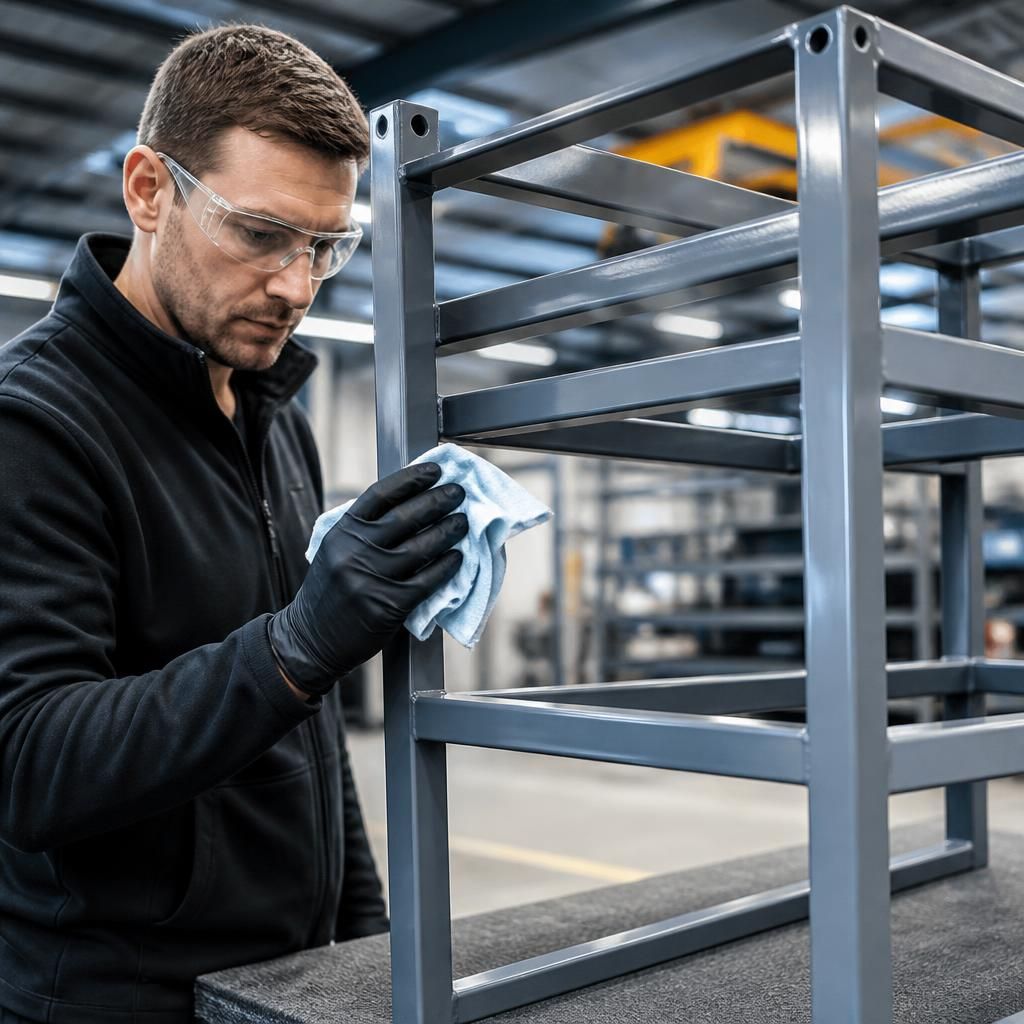
One specific benefit of powder coated aluminium frames and tubes is the hardness of the cured film. Unlike a liquid coating that remains dependent on solvent evaporation and may be more vulnerable to marking during handling, a correctly cured powder film forms a solid surface that can better withstand routine contact, cleaning and movement within an industrial installation.
This can help maintain the appearance of machine frames, guards, supports and tubular components that are regularly handled or exposed to dust and workshop contamination. The coating chemistry still needs to match the environment: areas exposed to oils, detergents or aggressive chemicals may require a specialist powder specification rather than a standard decorative grade. This makes coating selection, pretreatment and curing important when comparing powder coating with other finishing options.
Discuss the benefits of powder coated aluminium frames and tubes
Discuss your aluminium frames or tubes with the coating team to identify a suitable powder specification for the operating environment, required appearance and any masking or dimensional constraints. You can also request guidance on preparing components for coating and arranging collection or delivery.