

What are the key benefits of choosing powder coated aluminium frames and tubes for industrial applications?
Powder coated aluminium frames and tubes combine aluminium’s low weight and corrosion resistance with a tough, uniform finish that helps protect components from abrasion, weathering and routine industrial handling. The coating also provides a consistent colour and surface appearance, making these components suitable for manufactured assemblies, structural frameworks and equipment where both performance and presentation matter.
Powder coated aluminium frames and tubes offer a combination of low structural mass, a controlled manufactured finish and improved resistance to the conditions commonly found in industrial use. Beyond basic protection, the process can improve design consistency, simplify component specification and provide a repeatable surface suitable for fabricated assemblies, enclosures, guards and support structures.
Key benefits include:
- Lower handling and installation loads: Aluminium components are easier to move, position and assemble than many steel alternatives of comparable form. This can be useful where frames or tubular sections are incorporated into modular equipment, access structures or fabricated units that must be handled during manufacture and installation.
- Greater design flexibility: Aluminium frames and tubes can be cut, drilled, formed and assembled into complex profiles before coating. Powder coating then provides a defined finish across the exposed surfaces, allowing the finished components to be specified as part of a wider product or equipment design rather than treated as unfinished stock.
- Improved resistance to common industrial exposure: A correctly selected and properly applied coating separates the aluminium surface from contact with moisture, dirt, oils and routine contaminants. The appropriate coating system depends on the environment, including whether the component is used internally, externally, near chemicals or in an area subject to frequent cleaning.
- More straightforward identification and specification: Colour can help distinguish equipment zones, access points, guards, framework sections or different product variants. Where a project requires a particular colour or gloss level, defining the finish before production supports clearer purchasing and quality-control requirements.
- Consistent coverage on repeat components: Powder coating is applied as a controlled finishing process, making it suitable for batches of frames and tubes that need to match. Consistency depends on preparation, grounding, spray coverage, curing and handling, so the coating specification should be agreed with the coater rather than relying on colour alone.
- Reduced reliance on wet-paint application: Powder is applied without the liquid carrier used in conventional solvent-based paint systems. This can reduce solvent-related considerations during finishing, although the environmental and performance characteristics still depend on the powder formulation, pretreatment, curing energy and production controls.
- Useful electrical design properties: Once cured, the coating is non-conductive. This may be beneficial where an aluminium tube or frame needs surface insulation or reduced risk of accidental contact between conductive parts. However, it also means that earthing points, bonding faces, threaded interfaces and contact areas may need to be masked or cleaned back as part of the design.
- Compatibility with efficient fabrication: Aluminium’s machinability allows components to be prepared with accurately positioned holes, cut-outs and fixing points before finishing. Powder coating can then be applied after fabrication, reducing the need to coat individual pieces separately and helping preserve a uniform appearance across the completed assembly.
The benefit is greatest when the coating is matched to the aluminium alloy, component geometry and operating environment. Pretreatment is particularly important because aluminium forms a natural oxide layer that can affect adhesion if the surface is not prepared correctly. Parts should be free from oil, swarf and other contamination, and the coating process should account for hollow sections, internal faces, sharp edges, recesses and areas that will be covered during assembly.
Specification should also address functional areas before production begins. Threads, sliding fits, hinge points, close-tolerance interfaces and welded or bolted contact zones may require masking or post-coating finishing. If the frame or tube forms part of an electrically bonded structure, the required contact points should be identified on the drawings. Similarly, if the assembly will be exposed to heat, chemicals, aggressive cleaning or continuous outdoor conditions, the powder type and coating thickness should be selected for those demands rather than chosen solely for appearance.
For batch manufacture, it is useful to define the substrate, pretreatment, colour, sheen, coating requirements, masking points and inspection criteria in one specification. This helps reduce variation between production runs and makes it easier to assess finished parts for coverage, adhesion, visible defects and correct assembly fit. Powder coated aluminium is therefore not simply a decorative alternative to untreated metal; it is a finishing system whose value depends on matching material preparation and application controls to the component’s industrial role.
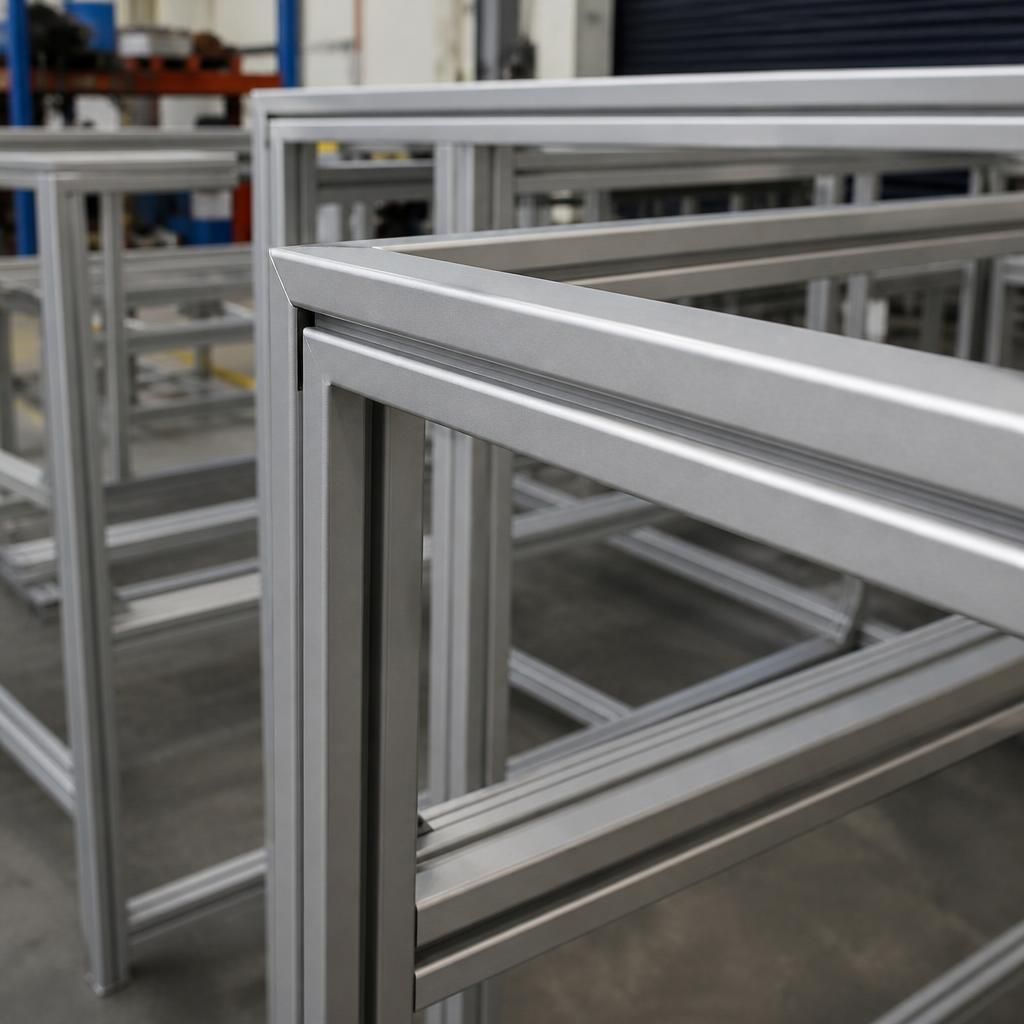
A further benefit of powder coated aluminium frames and tubes is the additional separation they provide between the aluminium substrate and surrounding components. This can help reduce direct contact with moisture, handling contaminants and dissimilar metals in an assembled structure, which is particularly relevant where aluminium is fixed to steel or other conductive materials.
The coating is not a substitute for suitable fasteners, drainage or joint design. Cut edges, drilled holes and fixing points may expose the substrate, while trapped moisture at interfaces can contribute to galvanic corrosion between different metals. Specifying compatible fixings, isolating washers or sleeves, and identifying areas that require masking or post-coating treatment helps preserve the practical benefits of the finished aluminium component.