

What are the critical factors to consider when selecting nylon and special coatings for aluminium in various industrial applications?
Selecting nylon or another special coating for aluminium depends on the component’s operating environment, including exposure to abrasion, chemicals, moisture, temperature changes, UV and electrical requirements. Also assess the required finish, component geometry, surface preparation, coating thickness, colour, compliance needs and application method to ensure the coating is suitable for its intended industrial use.
The critical factors are the coating’s functional purpose, compatibility with the aluminium component, dimensional requirements, production method and required evidence of performance. Nylon is not selected simply because it is hard-wearing; the grade and application process must suit the way the part is designed, handled, assembled and inspected.
Define the duty of the component
Start with the physical job the coating must perform. A coating used as a sliding or bearing surface has different requirements from one intended to protect a fabricated enclosure, support frame or vehicle component. Identify whether the coating will provide low-friction contact, impact resistance, insulation, noise reduction, a protective barrier or a combination of these functions. This prevents a general-purpose coating from being specified where a specialist formulation is needed.
Consider the type of contact involved, including repeated movement, point loading, clamping, sharp mating edges and contact with other metals. The coating must be able to tolerate the design load without excessive deformation, cracking or detachment. Where the aluminium part forms part of a moving assembly, allow for the coating’s contribution to friction and clearance rather than treating it as a purely cosmetic layer.
Check the aluminium substrate and component design
Aluminium alloys and manufactured forms can respond differently during coating. Castings, extrusions, sheet, machined parts and welded fabrications may have different surface conditions, porosity, weld zones and residual contaminants. The chosen coating system should therefore be assessed against the actual alloy and manufacturing route, not only against the nominal component description.
Component design also affects coating quality. Deep recesses, narrow channels, internal corners, threaded holes and areas that are difficult to access can create uneven coverage or require masking. Designers should identify surfaces that must remain uncoated for earthing, assembly, bonding or dimensional reasons. It is useful to provide a coating drawing that marks keep-clear areas, datum faces, masking points and surfaces subject to close tolerances.
Evaluate the coating system, not just the coating name
“Nylon coating” can describe different grades and application systems, while special coatings may be formulated for particular mechanical, protective or insulating functions. Ask for the relevant product and process information, including the coating type, intended substrate, recommended film build, curing requirements and known limitations. A material selected for one duty should not be assumed to perform identically in another formulation or application method.
Where the coating will be exposed to a combination of stresses, assess the complete system. The aluminium preparation, any primer or bonding layer, nylon or specialist topcoat and curing cycle all contribute to adhesion and service performance. A strong topcoat cannot compensate for an unsuitable interface with the substrate.
Allow for dimensional and assembly effects
Coating adds material to the component. This matters for press fits, bearing seats, sliding interfaces, holes, threads, slots, hinges and locating faces. Establish the acceptable coating build and resulting finished dimensions before production, particularly where parts are machined to close tolerances or assembled with limited clearance.
Masking can protect critical areas, but it also influences the process and may leave transition lines. Specify whether masking edges are permitted, where they may be located and how they should be finished. Parts that cannot tolerate any coating on a particular face may need a defined mechanical allowance or a post-coating finishing operation.
Consider the manufacturing route and batch requirements
Parts should be assessed for how they can be presented, supported, coated and cured. Weight, size, shape, hanging points and the location of non-visible contact marks can all affect the practical application. Large or awkward components may need an agreed handling method, while small repeat parts benefit from consistent racking and batch identification.
For repeat production, specify whether parts must match an approved reference sample, remain consistent across batches or meet a defined inspection standard. The specification should cover acceptable variation in colour or texture where appearance matters, as well as the treatment of rejects, touch-up areas and parts requiring rework. Clear acceptance criteria reduce disputes between the designer, coater and end user.
Decide what testing and documentation are proportionate
The level of verification should reflect the consequence of coating failure. Possible checks include visual inspection, coating thickness measurement, adhesion testing and dimensional inspection. Depending on the application, a sample part or test panel may be used to confirm the selected system before a full batch is released.
For regulated or safety-related applications, establish the required records at the specification stage. These may include material identification, batch traceability, process records, inspection results and declarations relevant to the finished component. Requirements should come from the product standard, customer specification or governing industry rules rather than being added after coating has begun.
Assess whole-life practicality
Selection should include installation, cleaning, inspection, repair and eventual replacement. A coating that performs well in service may still be unsuitable if damaged areas cannot be identified, if the part cannot be removed for recoating or if the finished surface is difficult to inspect. Define how minor damage will be treated and whether the component can be returned for assessment or refurbishment.
It is also important to separate the coating’s role from the aluminium design itself. Drainage, joint design, fastener selection, isolation between dissimilar metals and protection of cut edges may still be necessary. Nylon or a special coating should support the wider design strategy rather than being used as the sole control for every potential failure mode.
Prepare a complete enquiry or specification
- Describe the aluminium alloy, component manufacturing method and part dimensions.
- State the coating’s primary function and the consequences of failure.
- Identify contact surfaces, tolerances, masking requirements and areas that must remain clear.
- Provide drawings, photographs or representative samples showing difficult features.
- Specify the required appearance, finish and inspection standard where relevant.
- Confirm batch sizes, repeat-order expectations, packaging needs and traceability requirements.
- Ask the coating specialist to confirm system suitability, process limitations and any design changes needed before production.
For manufacturers and fabricators across the Midlands, discussing these points with a specialist powder coater before finalising the component can expose problems that are difficult or costly to correct later. Collection and delivery options can also be considered as part of the production plan, particularly for larger batches or components that need controlled handling.
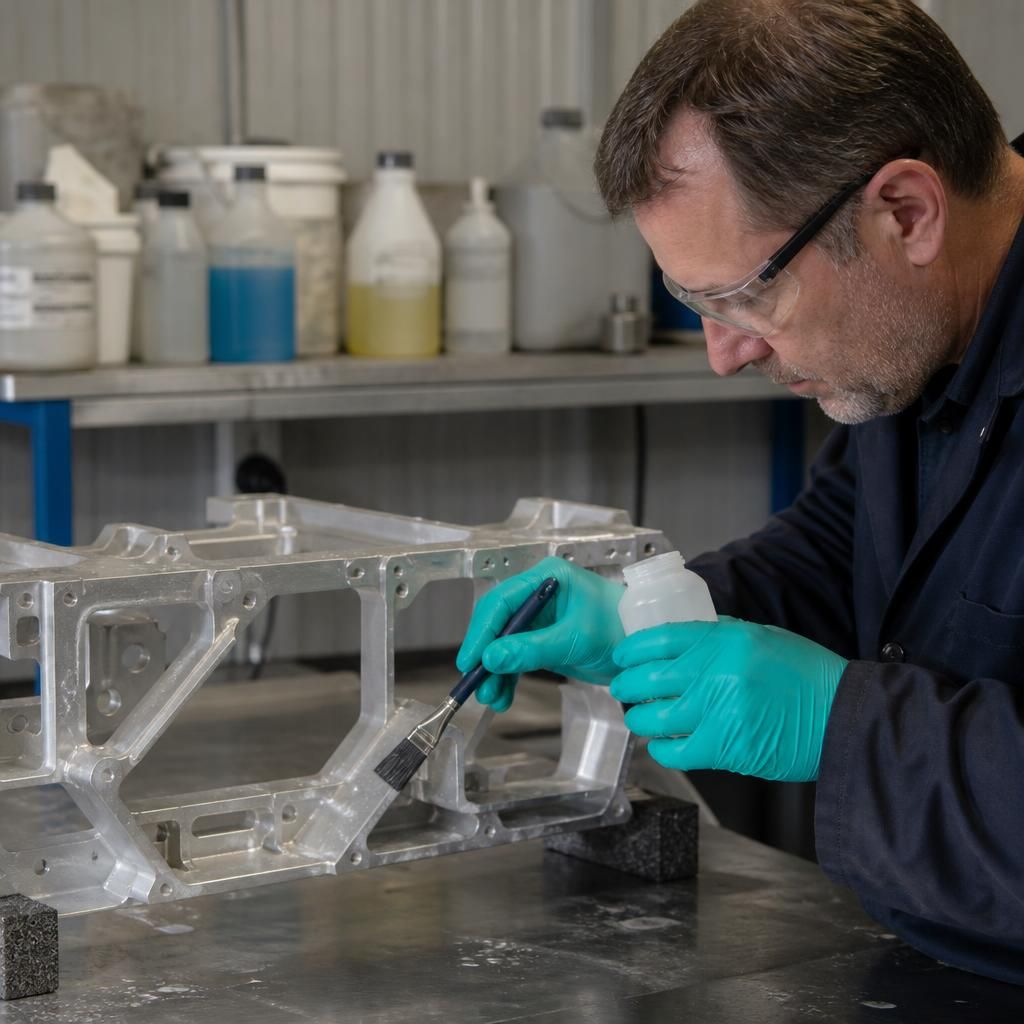
Chemical compatibility is a critical factor when selecting nylon or special coatings for aluminium. The coating must tolerate the actual substances it will encounter, including cleaning agents, oils, coolants, solvents, salts and process chemicals, rather than being assessed only for general corrosion resistance.
Review the concentration, temperature, contact time and exposure pattern involved. Occasional splashing creates different demands from continuous immersion, while heated cleaning solutions can place greater stress on the coating and its bond with the aluminium. Request technical compatibility information for the proposed coating system and, where failure would have serious consequences, consider testing representative coated components in the intended operating conditions.