

How can I assess the environmental impact of aluminium powder coating services offered by different providers?
Assess aluminium powder coating providers by comparing their energy use, powder recovery and waste controls, volatile organic compound (VOC) emissions, pretreatment chemicals, water management and disposal practices. Ask for specific evidence, such as process details, waste-handling procedures and environmental certifications, rather than relying on general claims about powder coating being environmentally preferable.
Assess the environmental impact of aluminium powder coating services by comparing the complete finishing lifecycle for the same component and specification, not simply by asking whether a provider uses powder coating. A meaningful assessment considers the coating formulation, surface preparation, application, curing, transport, packaging, expected service life, rework and end-of-life treatment, using evidence that is consistent between providers.
Start with a comparable basis. Ask each provider to assess the same aluminium parts, coating thickness, colour, finish, durability requirement and production quantity. Environmental results can otherwise be misleading: a quotation for a simple decorative finish is not directly comparable with one requiring enhanced corrosion protection, specialist pretreatment or additional processing. Compare impacts per finished component, per square metre of coated surface or per batch, rather than comparing general statements about the provider’s overall operation.
Define the assessment boundary. Establish whether the information covers only activity at the coating plant or also includes collection, delivery, incoming materials, packaging and the handling of rejected or reworked parts. A provider may report an efficient application process while excluding impacts associated with transport or repeat processing. The boundary should be stated in writing, and any exclusions, assumptions or estimates should be identified.
Examine material efficiency. Request information about the type and quantity of powder used for the specified job, how application settings are controlled, and how colour changes or small batches are managed. The relevant question is not only how much powder is applied to the component, but also how much material is consumed across the whole process, including overspray, contamination, unsuitable material and rework. Ask how the provider records these flows and whether the figures relate to the particular work being assessed rather than to an unrelated average.
Consider the coating’s useful life. A finish that remains serviceable for longer can avoid premature stripping, recoating, replacement or transport. Assess whether the proposed coating system is suitable for the component’s exposure conditions, including moisture, chemicals, ultraviolet radiation, abrasion and temperature changes. This should be based on the required performance specification and relevant test or inspection information, not on a general assumption that every powder coating has the same durability.
Include quality and rework in the comparison. Poor masking, inadequate preparation, uneven coverage, contamination or curing defects can lead to rejected parts and another coating cycle. Ask how the provider checks film thickness, appearance, adhesion and cure, and how non-conforming work is recorded and managed. A provider that can explain its inspection and corrective-action process gives a clearer basis for estimating the environmental consequences of avoidable rework.
Review transport and packaging. Collection and delivery form part of the service’s environmental profile, particularly for bulky frames, tubes or batch work. Compare the proposed transport arrangements using the same assumptions about distance, load utilisation, delivery frequency and return movements. Also ask whether parts are protected with reusable or recyclable packaging, whether packaging is supplied by the customer or provider, and how damaged or surplus packaging is handled.
Check the evidence behind environmental claims. Useful evidence may include:
- Documented environmental objectives and records showing how performance is monitored.
- Waste transfer documentation or contractor records for relevant waste streams.
- Product information for powders and pretreatment materials, including safety and environmental data where relevant.
- Maintenance and inspection records for application, curing and extraction equipment.
- Utility or resource data allocated to the relevant process, with the measurement period and allocation method explained.
- Independent certification or audit evidence, where claimed, including the precise scope and site covered.
Do not treat a certificate, environmental policy or statement that powder coating is a lower-impact option as a complete assessment. Check what is actually certified or measured, whether the information applies to the facility carrying out the work, and whether it covers the process being quoted. Unsupported terms such as “green”, “eco-friendly” or “zero waste” provide little basis for comparison without definitions and records.
Assess chemicals and water as part of the whole system. Different pretreatment routes can have different resource, handling and disposal requirements. Ask for the process stages relevant to the aluminium grade and the required finish, together with information on chemical consumption, bath management, rinsing and disposal controls. The aim is not to select a process from one environmental characteristic alone: reducing one impact may alter another, so the provider should explain the overall system and its limitations.
Consider end-of-life compatibility. Ask whether the coating system creates any specific issue when aluminium parts are repaired, stripped, remanufactured or recycled. The answer may depend on the condition of the part, the chosen coating and the requirements of the organisation handling it at end of life. Keeping records of the coating specification can help future owners or recyclers identify what has been applied and avoid unnecessary testing or treatment.
For a procurement comparison, issue the same questions and technical specification to each provider, record the source and date of every answer, and separate measured data from estimates or qualitative claims. A simple comparison table can include process boundary, material use, rework controls, transport assumptions, packaging, service-life evidence, waste documentation and any independent verification. The strongest assessment is the one that is transparent about what has been measured, what has been assumed and where uncertainty remains.
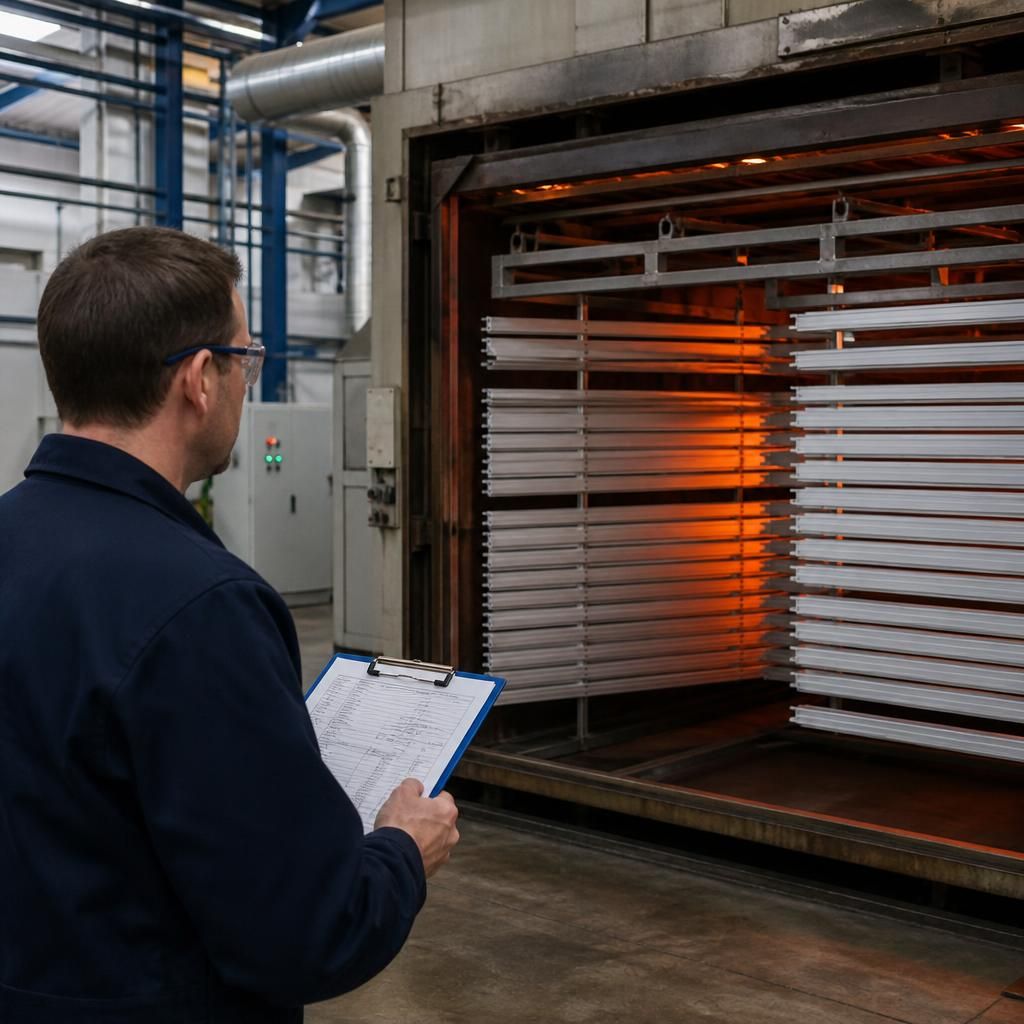
Curing is a significant part of the environmental assessment because the oven must bring the aluminium and coating system to the required cure condition. Compare how each provider controls cure temperature, dwell time and oven loading for the same component, rather than assuming that a lower stated temperature automatically has less impact. Aluminium sections with different thicknesses or thermal mass may require different process settings.
Ask how cure is verified and what happens when a load falls outside the specified range. Under-curing can result in rejected work, while unnecessary over-curing can consume additional energy without improving performance. Evidence such as cure records, calibrated monitoring equipment and documented process settings can help distinguish a controlled curing process from an estimate based only on the oven’s rated capacity.
Discuss Your Aluminium Powder Coating Environmental Requirements
Discuss your aluminium powder coating environmental requirements with the team, providing the component specification and assessment criteria relevant to your project. This gives the proposed coating system and process boundary a clear basis for consideration.