

How does electrostatic aluminium powder spraying ensure a consistent finish across different component shapes and sizes?
Electrostatic aluminium powder spraying creates consistency by charging the powder particles and applying them to a correctly grounded component, so the coating is drawn towards the metal surface. Operators control gun distance, spray angle, powder flow and coverage around edges, recesses and larger areas, then cure the deposited film under controlled conditions to produce an even finish across different shapes and sizes.
Electrostatic aluminium powder spraying achieves a consistent finish across different component shapes and sizes by combining controlled electrical attraction with suitable part handling, coating parameters and curing. Consistency does not come from applying identical settings to every component; it comes from adapting the process to the geometry, surface area and thermal mass of each part while keeping the key variables within controlled limits.
Component design has a direct effect on powder deposition. Broad, exposed faces are generally straightforward to coat, whereas deep recesses, boxed sections, sharp internal corners and closely spaced features can affect how powder reaches the surface. These areas may experience the Faraday cage effect, where the electrical field concentrates around outer edges and makes it more difficult for charged powder to enter enclosed or recessed sections. Experienced operators account for this by choosing an appropriate application sequence and ensuring that difficult areas receive suitable attention without creating excessive build-up on exposed edges.
The way parts are supported also influences uniformity. Aluminium components must maintain a reliable electrical connection through their hanging points or fixtures. Contact areas need to remain free from insulating contamination, and the racking arrangement must support the component without unnecessarily shielding surfaces from the powder. For repeat batches, consistent positioning helps expose equivalent areas in the same way from one component to the next. Different fixtures may be required for long sections, small brackets, castings or assemblies with irregular profiles.
Orientation is particularly important for large or three-dimensional items. Rotating or repositioning a component can improve access to concealed faces and reduce the risk of untreated areas behind flanges, returns or projecting features. The operator also considers how powder may collect on lower ledges and horizontal surfaces. Excessive accumulation in these locations can affect the final film thickness, while insufficient coverage on less accessible faces can reduce protection and create a visibly uneven appearance.
Powder selection and application control must match the component. Powder flow, particle behaviour and the required film build all affect how the material settles on the metal. A setting that suits a large, open panel may not be appropriate for a small component with narrow recesses. Operators therefore assess the part profile and coating specification rather than treating every item in a batch as geometrically identical.
Edges require particular care. Powder can build more heavily around external corners because of the electrical field, while sharp edges may also present a weaker protective film if the geometry makes complete coverage difficult. Suitable edge preparation, controlled application and inspection help maintain a continuous coating over these transitions. Openings, threads, mating faces and areas intended for welding or assembly may also need masking so that the coating remains only where it is required.
Curing provides the final stage of consistency. Once the powder has been deposited, the component must reach the required metal temperature for the specified coating system and remain there for the appropriate cure. Large, heavy or densely loaded items heat differently from small, lightweight parts, so oven settings cannot be judged solely by the surrounding air temperature. The load arrangement, component thickness and thermal mass must be considered to avoid under-curing, over-curing or variation between sections of the same item.
Quality checks help confirm that the process has produced a uniform result. Depending on the specification, checks may include:
- visual examination under suitable lighting for missed areas, uneven appearance, contamination or excessive build-up;
- film-thickness checks at representative points, including edges, recesses and broad faces;
- inspection of masking, threaded holes, contact points and other functional surfaces;
- confirmation that the coating has cured correctly and is firmly bonded to the prepared aluminium; and
- comparison of repeat components against an agreed sample or coating standard.
For a mixed batch, inspection should cover more than the easiest-to-coat surface. Sampling different component sizes and geometries helps identify problems that may only occur on deep sections, complex castings or large panels. Where a design is unusually intricate, a pre-production assessment can identify access, racking, masking and curing requirements before the full batch is processed.
In practice, a consistent finish is therefore the result of matching the application method to each component rather than relying on electrostatic attraction alone. Correct preparation, dependable electrical contact, suitable orientation, controlled deposition, appropriate masking and validated curing work together to produce an even coating across varied aluminium parts.
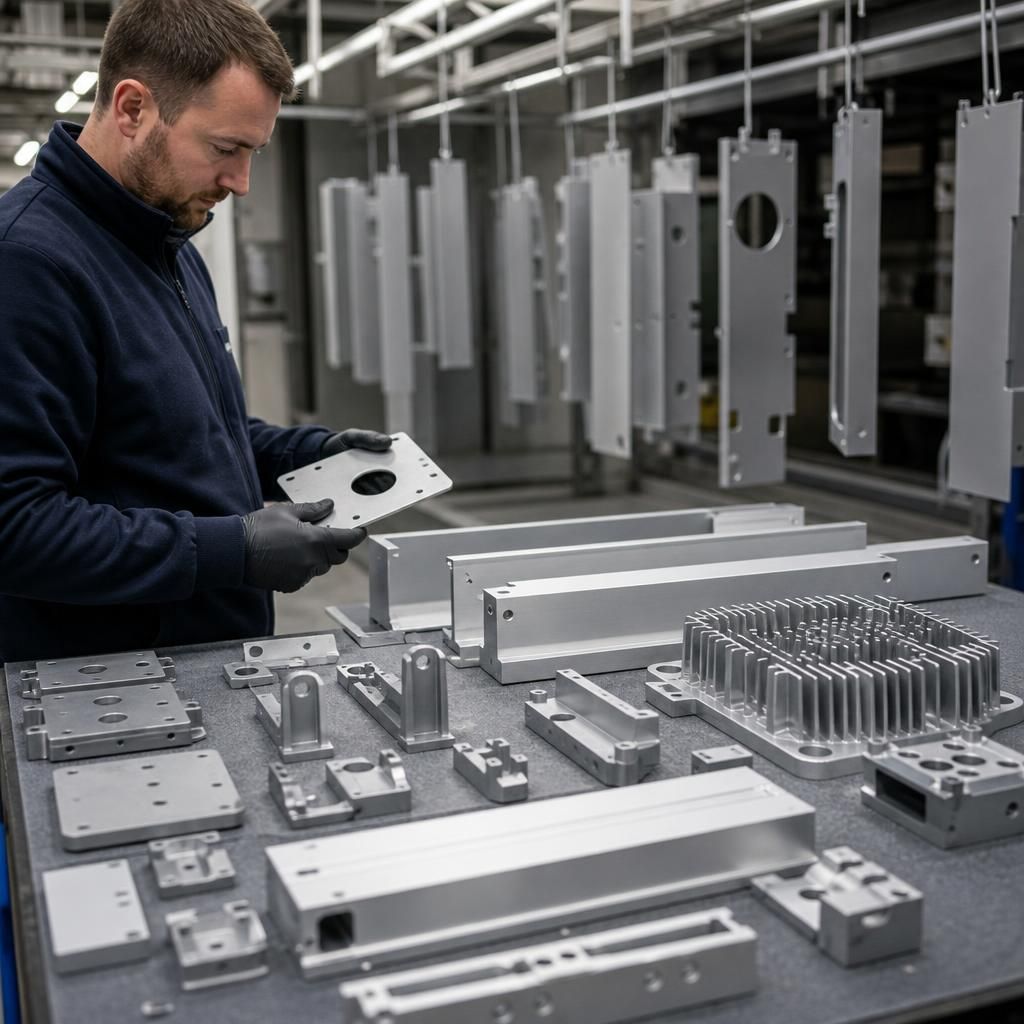
Consistency across mixed aluminium components depends on grouping parts by comparable geometry before coating. Open panels, narrow sections, castings and deeply profiled items should not automatically share one spray plan, because their exposed area and powder access differ. Establishing a suitable approach for each component group allows the operator to keep deposition controlled without treating a small intricate part like a large flat section.
This also supports more reliable batch comparison. Parts with similar profiles can be positioned and assessed against the same coating requirements, while unusually shaped items can be identified for separate handling before they affect the wider batch. The result is a finish that remains visually and functionally consistent across varied component sizes without forcing one application method onto every shape.
Discuss Your Aluminium Components and Coating Requirements
Discuss your aluminium components, drawings and coating requirements with the powder-coating team to establish a suitable approach for your parts. Providing details of the component shapes, sizes and intended use will help inform the assessment.