

What specific processes are involved in aluminium pretreatment?
Aluminium pretreatment typically involves degreasing and cleaning, rinsing, light etching or blasting to prepare the surface, followed by conversion coating and controlled drying. These stages remove contaminants, create a suitable key for the powder coating and help protect the aluminium beneath the finished coating.
Aluminium pretreatment is a controlled sequence of surface preparation, chemical conditioning, rinsing, inspection and handling steps. The exact route depends on the alloy, the condition of the component, the required coating performance and whether the part has previously been anodised, painted or exposed to contamination.
1. Initial assessment and preparation
Before processing, the component is inspected for oil, grease, oxidation, mill residue, weld contamination, adhesive, marking ink and existing coatings. The alloy and construction are also considered because extrusions, castings, sheet, machined parts and welded assemblies can react differently during treatment. Deep scratches, sharp edges, trapped residues and inaccessible joints may affect the finished coating and should be identified before the preparation cycle begins.
Components are arranged so that treatment solutions can reach all required surfaces and drain away afterwards. Hollow sections, recesses and overlapping joints need particular attention because retained liquid can cause staining, incomplete rinsing or later corrosion. Areas that must remain uncoated may be masked where the design requires it, although the suitability of masking depends on the shape and process conditions.
2. Alkaline or solvent-assisted cleaning
Cleaning removes organic contamination that would otherwise prevent the pretreatment chemicals from contacting the aluminium evenly. Depending on the condition of the parts, this may involve an alkaline cleaner, a suitable solvent-based process, or a combination of cleaning stages. Oils from machining and handling are especially important because even a thin residue can produce poor wetting, uneven conversion treatment or local adhesion defects.
The cleaning stage is controlled so that it removes contamination without unnecessarily attacking the aluminium. Excessively aggressive alkaline treatment can alter the surface profile, particularly on thin sections, detailed parts or alloys containing constituents that react differently from the surrounding metal. After cleaning, the surface should be visibly free from grease, but visual cleanliness alone is not sufficient; process control and subsequent rinsing are also important.
3. Rinsing between treatment stages
Rinsing separates one chemical stage from the next and prevents carry-over. This is a significant part of the process rather than a simple wash. Residual cleaner can dilute or contaminate an etching or conversion bath, while residual treatment chemicals can leave deposits as the component dries. Rinse quality, contact time, drainage and the condition of the rinse water all influence consistency.
Components should be positioned to avoid pooling, with particular care around holes, channels and folded sections. Where several rinse stages are used, they help reduce the transfer of chemicals through the line and provide a cleaner surface for the next operation.
4. Etching and removal of surface irregularities
A controlled etch can remove a very small amount of aluminium and reduce the effect of light oxidation, handling marks and minor surface variation. It can also provide a more uniform surface for the subsequent conversion treatment. Etching must be matched to the material and component geometry: over-treatment may cause dimensional change, dull patches, excessive roughness or preferential attack around welds and inclusions.
Some aluminium surfaces develop a dark residue after alkaline etching. This residue is associated with alloying elements and intermetallic constituents that do not dissolve in the same way as the main aluminium matrix. A desmutting or deoxidising stage may therefore follow the etch to remove remaining residues and expose a more chemically active surface. The need for this stage varies with the alloy, finish and condition of the component.
5. Deoxidising and surface activation
Deoxidising removes tenacious oxide films and residues that ordinary cleaning may not eliminate. It is particularly relevant where aluminium has been stored, heated, welded or exposed to weathering. The treatment needs to be carefully controlled because the objective is to condition the surface, not to strip away excessive metal or create an uneven appearance.
For some components, light mechanical preparation may be used alongside chemical activation. Blasting can remove loose oxide or existing residues and provide a suitable texture, but aluminium is relatively soft and can be distorted, embedded with unsuitable media or excessively roughened by an incorrect technique. Mechanical preparation should therefore be selected according to the alloy, thickness, geometry and required finish, followed by appropriate cleaning to remove dust and loose particles.
6. Conversion coating
Conversion coating changes the chemical nature of the aluminium surface to produce a thin protective layer that supports adhesion of the powder coating. Unlike a conventional paint film, it is formed by reaction with the prepared metal. The treatment may be based on an approved chromate or chrome-free chemistry, depending on the specification, environmental requirements and performance criteria.
Uniform coverage is essential. Inadequate contact can leave untreated areas, while excessive treatment or poor rinsing can lead to residues that interfere with powder application. The condition of the bath, solution concentration, temperature, contact time and rinsing sequence are controlled to keep the conversion layer consistent. The selected chemistry should be compatible with the aluminium alloy and the intended service conditions.
7. Final rinse and drying
Following conversion treatment, the component is rinsed as required by the process and dried thoroughly. Drying removes retained moisture from joints, recesses and drilled holes before powder application. Water marks, trapped liquid and residual chemicals can otherwise contribute to surface defects or interfere with the coating process.
Drying conditions need to be sufficient for the component without causing unnecessary oxidation or thermal effects. Parts should be handled with clean equipment after drying so that fingerprints, dust and workshop contamination are not reintroduced onto the prepared surface.
8. Inspection before powder application
The final pretreatment check confirms that the aluminium is clean, evenly prepared and free from visible residues, excessive staining and retained moisture. Inspection also considers coverage in difficult areas, the condition of masking and any damage caused during handling. If the surface does not meet the required standard, it may need to be reprocessed rather than sent forward.
For repeat production, consistency is maintained through documented process controls, checks on chemical conditions, rinse management and records of the treatment route. This is particularly important where components are supplied in batches or where different aluminium alloys and fabrication methods are processed together. Careful control of these individual stages gives the powder coating a stable surface on which to form its finished film.
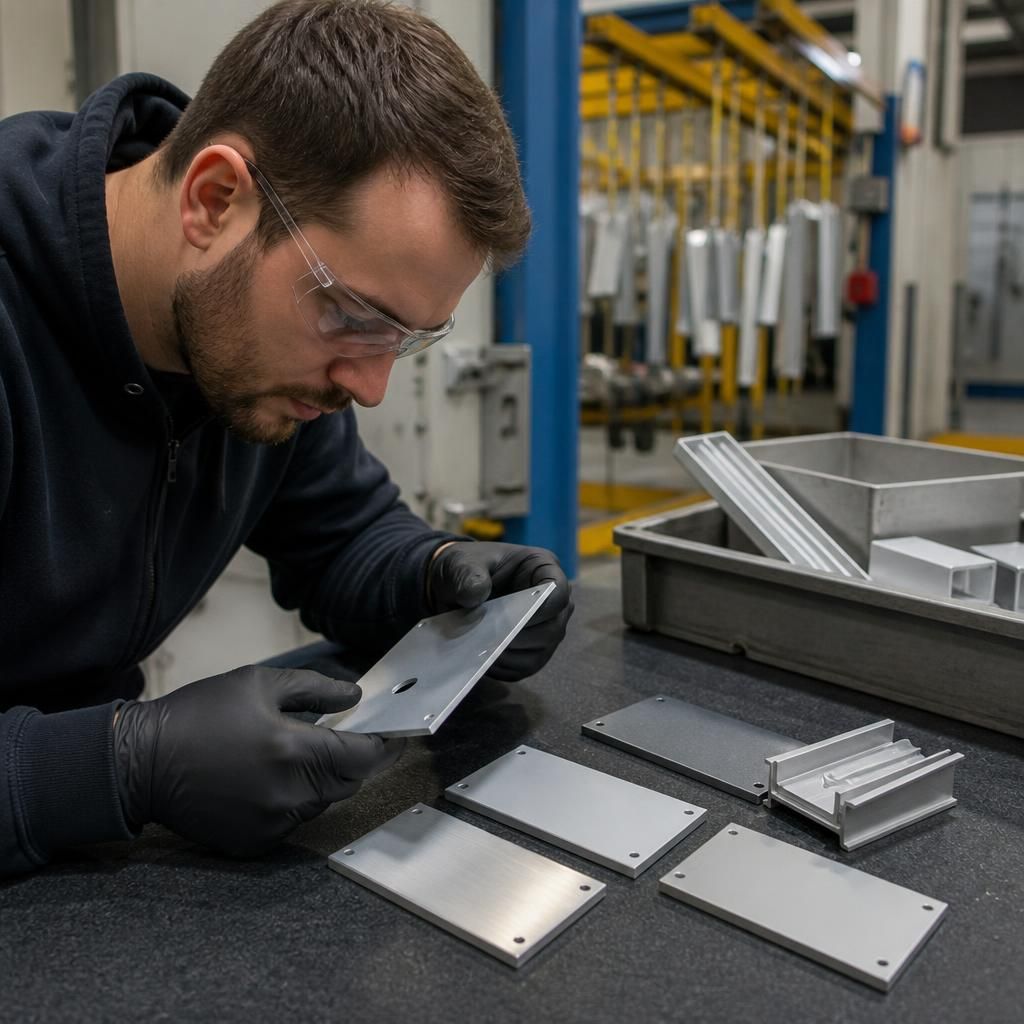
Before a full production run, the pretreatment route can be validated on representative aluminium samples or test pieces. This helps confirm that the selected cleaning, etching and conversion stages suit the alloy, surface condition and component design without relying solely on visual appearance.
Validation may include checking powder adhesion and examining the prepared surface for uneven treatment, staining or residue. It is especially useful when a batch contains different alloys, welded areas, cast sections or previously treated surfaces, as these can respond differently to the same chemical sequence. Any required adjustment can then be made before the complete batch enters powder application.
Discuss Your Aluminium Pretreatment Requirements
Discuss your aluminium components with the powder-coating team to identify a suitable pretreatment route for the alloy, geometry and required coating performance. Providing details of the part condition and intended application will help establish the appropriate preparation requirements.