

What specific pretreatment methods should be used for aluminium components in different industries?
Aluminium pretreatment should match the component’s end use and exposure: automotive parts commonly require thorough degreasing, controlled etching and a suitable conversion coating, while construction components benefit from robust cleaning and corrosion-resistant chemical conversion before powder coating. Fabricated or industrial components may also need light, carefully controlled blasting to remove contamination and provide a consistent surface without damaging the aluminium.
The correct pretreatment method for aluminium depends on the alloy, manufacturing process, component geometry and service environment. Automotive parts generally need a tightly controlled multi-stage chemical process; architectural and construction components require consistent treatment across long extrusions and assembled sections; while fabricated industrial parts often need targeted cleaning and mechanical preparation around welds, joints and handled areas. The objective is to remove contamination, control the naturally occurring oxide layer and create a chemically stable surface for powder coating.
Automotive components
Automotive aluminium may arrive with machining fluids, pressing oils, polishing residues, adhesive traces or deposits from welding and handling. A suitable process normally starts with a compatible alkaline or neutral cleaner selected for the alloy and the type of soil present. The cleaner must be strong enough to remove organic contamination without causing excessive attack, staining or uneven texture.
After cleaning, an acidic deoxidising stage can be used where the surface contains embedded residues or alloying-element deposits. This helps produce a more uniform surface before conversion treatment. The process should be controlled carefully because aggressive chemical exposure can alter dimensions, affect sharp edges and leave an inconsistent appearance on cast or machined components.
A conversion coating is often selected where the component needs improved resistance to underfilm corrosion and reliable adhesion beneath the powder. The appropriate chemistry depends on the coating specification, alloy and exposure conditions. Rinsing between stages is essential: residues from cleaner, deoxidiser or conversion chemistry can interfere with the next stage and may contribute to blistering or loss of adhesion if retained.
Construction and architectural aluminium
Aluminium used for façades, doors, windows, balustrades and other building products is frequently supplied as long extrusions or complex profiles. Pretreatment must reach internal corners, recesses and drainage features without leaving trapped chemical residues. Spray systems are useful for consistent coverage, while immersion may be suitable for parts whose shape allows complete drainage and rinsing.
For components exposed to rain, condensation, de-icing salts or coastal air, the pretreatment specification should be selected in relation to the intended environment rather than appearance alone. A conversion layer provides a controlled interface between aluminium and powder coating, but it cannot compensate for oil, silicone, fingerprints or poorly rinsed chemistry. Profiles should therefore be handled with clean equipment after preparation, and hollow sections should be positioned so that rinse water can escape.
Architectural work may also require close control of colour and surface uniformity across batches. The pretreatment process should be consistent from one production run to the next, particularly where adjacent profiles will be installed together. Alloy variation, extrusion marks and localised abrasion can otherwise show through the finished powder coating even when the coating application itself is consistent.
Fabricated and general industrial components
Fabricated aluminium parts often contain a mixture of contamination types. Welded areas may carry heat-affected residues, soot or oxide; cut edges may hold swarf; and assembly can introduce grease, sealant or handling marks. These areas should be inspected individually rather than assuming that one treatment will have the same effect across the complete component.
Light mechanical preparation may be appropriate for localised contamination or difficult-to-reach areas, provided the abrasive and pressure are suited to aluminium. The purpose is to remove the defect or residue without embedding abrasive, rounding functional edges or creating a surface profile that differs markedly from the surrounding metal. Mechanical preparation should normally be followed by thorough cleaning so that dust and loose particles do not remain beneath the powder.
For castings, the process may need to address porosity, release-agent residues and a more irregular surface than that of an extrusion or machined part. Cleaning must not force contaminants deeper into pores or blind holes. Components with threaded holes, close-fitting interfaces or drainage passages may need masking, plugs or a defined orientation during treatment to prevent chemical entrapment and preserve critical dimensions.
Components for harsher or specialist environments
Parts intended for industrial plant, transport infrastructure or other demanding settings should be assessed according to the likely combination of moisture, pollutants, abrasion and temperature. A more robust conversion system may be specified, but the choice still needs to match the aluminium alloy and powder coating system. Pretreatment is not a substitute for correct coating thickness, edge coverage or design drainage.
Where a component combines aluminium with steel, stainless steel, fasteners or other metals, the process must consider galvanic interaction and the possibility of chemical residues collecting at joints. Masking, separation or a compatible sealing detail may be needed. Areas that will later be bolted, bonded or electrically connected should be identified before treatment because powder coating and conversion layers can affect fit, bonding or conductivity.
Controls that apply across industries
- Identify the alloy, previous treatment and manufacturing contaminants before selecting the chemistry.
- Use a cleaning method that removes the actual soil without unnecessarily attacking the aluminium.
- Control chemical concentration, temperature, contact time, spray coverage and rinse quality.
- Prevent water and treatment residues from remaining in cavities, joints, blind holes or hollow profiles.
- Keep prepared surfaces free from fingerprints, dust, silicone and unapproved handling materials before powder application.
- Inspect for water-break-free cleanliness, staining, smut, missed areas and damage to critical features.
In practice, the most suitable method is chosen from the component drawing, alloy information, production history and expected service exposure. A process that is appropriate for a clean extruded profile may be unsuitable for a welded casting or a machined automotive part. Where the end use is unclear, a trial on representative components can help confirm that the selected preparation produces a clean, uniform and chemically compatible surface before full batch processing.
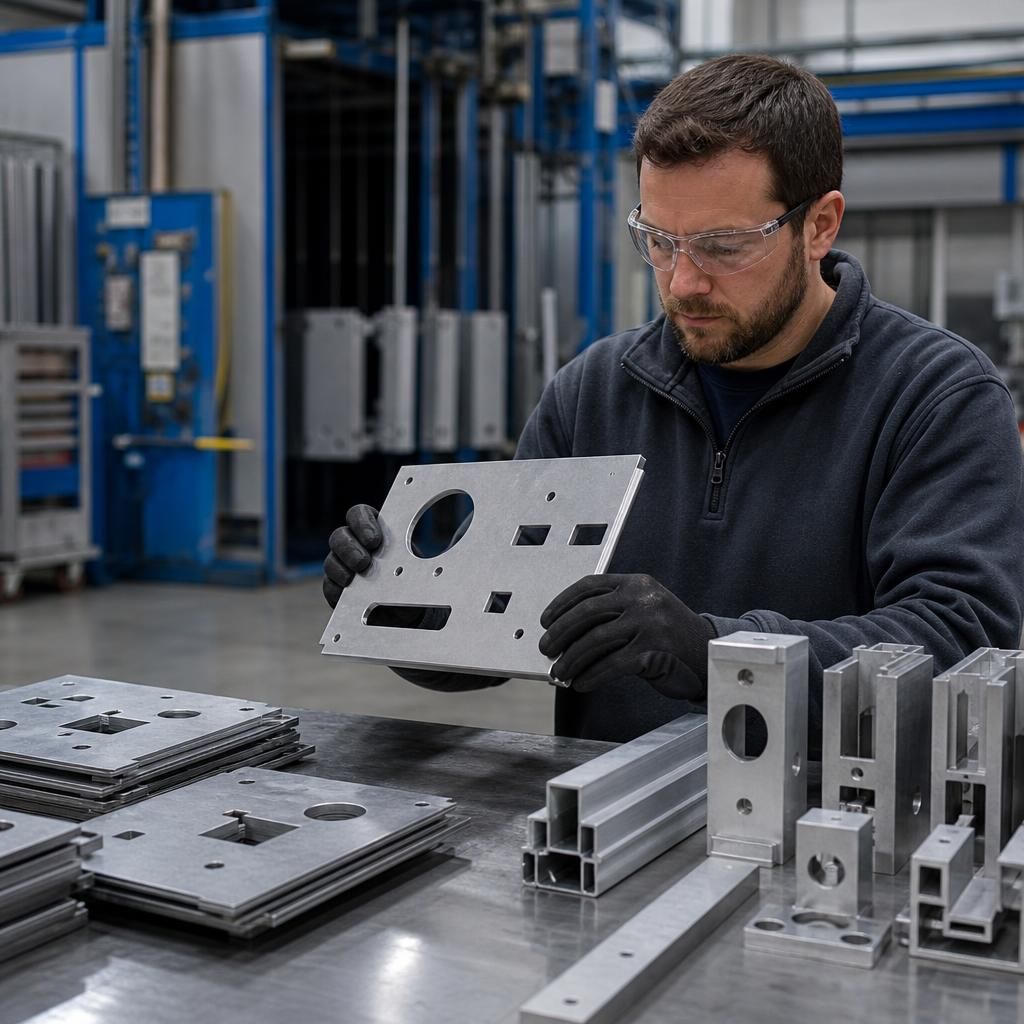
Industry-specific aluminium pretreatment should be validated against the coating specification and service conditions before production parts are processed. Representative samples can be used to check that the selected cleaning, deoxidising and conversion stages produce a consistent surface without staining, excessive attack or residues that could affect powder adhesion.
Validation should consider the actual alloy, geometry and manufacturing history rather than relying solely on a standard process. Test pieces should include features that may be difficult to treat, such as welds, recesses, edges and cavities. The results provide a practical basis for confirming whether the pretreatment is suitable for the intended automotive, construction or industrial application.