

What are the advantages of using chemical treatments over mechanical methods in aluminium pretreatment?
Chemical treatments can prepare aluminium more uniformly than mechanical methods across recesses, edges and complex profiles, where abrasive access may be limited. They can also remove contaminants and create a conversion layer that improves coating adhesion and resistance to corrosion, while avoiding the surface damage or profile changes that overly aggressive abrasion may cause.
The main advantages of chemical treatments over mechanical methods in aluminium pretreatment are greater process control, minimal material removal and better suitability for components where blasting could be impractical. Instead of preparing the surface through impact from an abrasive, chemical stages condition the aluminium through controlled cleaning, etching and surface conversion.
More consistent treatment of the aluminium substrate
Chemical pretreatment can produce a more repeatable surface condition across a production batch when the bath concentration, temperature, contact time and rinsing stages are controlled. Mechanical preparation depends on factors such as abrasive condition, nozzle distance, angle, pressure and operator technique. Variations in these factors can produce differences in the prepared surface from one part to another.
This controllability is particularly useful for manufacturers processing repeat components, where a consistent pretreatment specification is needed before powder coating. It also makes chemical processing easier to monitor through documented bath checks and defined operating parameters.
Minimal alteration to dimensions and detail
Chemical methods do not depend on abrasive impact to remove material. This is valuable for aluminium parts with fine machined features, close tolerances, narrow slots or delicate edges. The treatment can condition the substrate while retaining the component’s designed geometry, provided the chemistry and immersion time are suitable for the alloy and finish required.
This can reduce the need to protect small features from aggressive blasting and helps avoid changes to the appearance of machined or formed surfaces. Treatment must still be controlled carefully: excessive etching can affect the surface, and different aluminium alloys may respond differently to the same chemical process.
Useful for enclosed or difficult-to-process constructions
Chemical solutions can contact surfaces that are hard to reach with a blasting nozzle, including internal passages, folded sections and partially enclosed areas. This can be important where a component’s construction prevents a clear line of sight for mechanical equipment. The part must, however, be designed or positioned so that treatment fluid can enter, drain and rinse effectively. Trapped solution is a process risk and may lead to staining, residue or later coating defects.
Reduced risk of abrasive-related contamination
Mechanical preparation can leave abrasive particles lodged in recesses or carried between processing stages. Chemical treatment avoids the use of blasting media, so there is no media selection, recovery or embedded-particle issue. This can simplify handling for components with threaded features, fine openings or surfaces where loose particulate would be difficult to remove.
It does not remove the need for thorough rinsing. Chemical residues, dissolved metals and process salts must be removed before drying and powder application. Clean water quality, rinse-stage management and complete drying are therefore essential parts of the process rather than optional final steps.
Potentially lower noise and airborne dust at the preparation stage
Because chemical pretreatment is not based on abrasive impact, it can reduce the noise and airborne dust associated with blasting. This may make it more suitable for facilities where dust control, extraction and segregation of preparation areas are significant considerations. Chemical processes introduce different controls, including ventilation, chemical storage, spill prevention, personal protective equipment and appropriate waste handling.
When chemical treatment is not the complete answer
Chemical pretreatment is not automatically preferable for every aluminium component. Heavy corrosion, thick coatings, welding residues or substantial surface deposits may require an initial mechanical operation before the chemical stages. A combined process can therefore be more appropriate than choosing one method exclusively.
- Mechanical preparation may be used first where substantial material must be removed.
- Chemical stages can then condition the exposed aluminium and prepare it for coating.
- Rinsing, drying and handling must prevent recontamination before powder application.
The correct choice depends on the alloy, component design, existing surface condition, required appearance, production volume and environmental controls available. Chemical treatment offers its greatest benefit when the process is matched to the aluminium grade and verified through controlled cleaning, rinsing and drying stages.
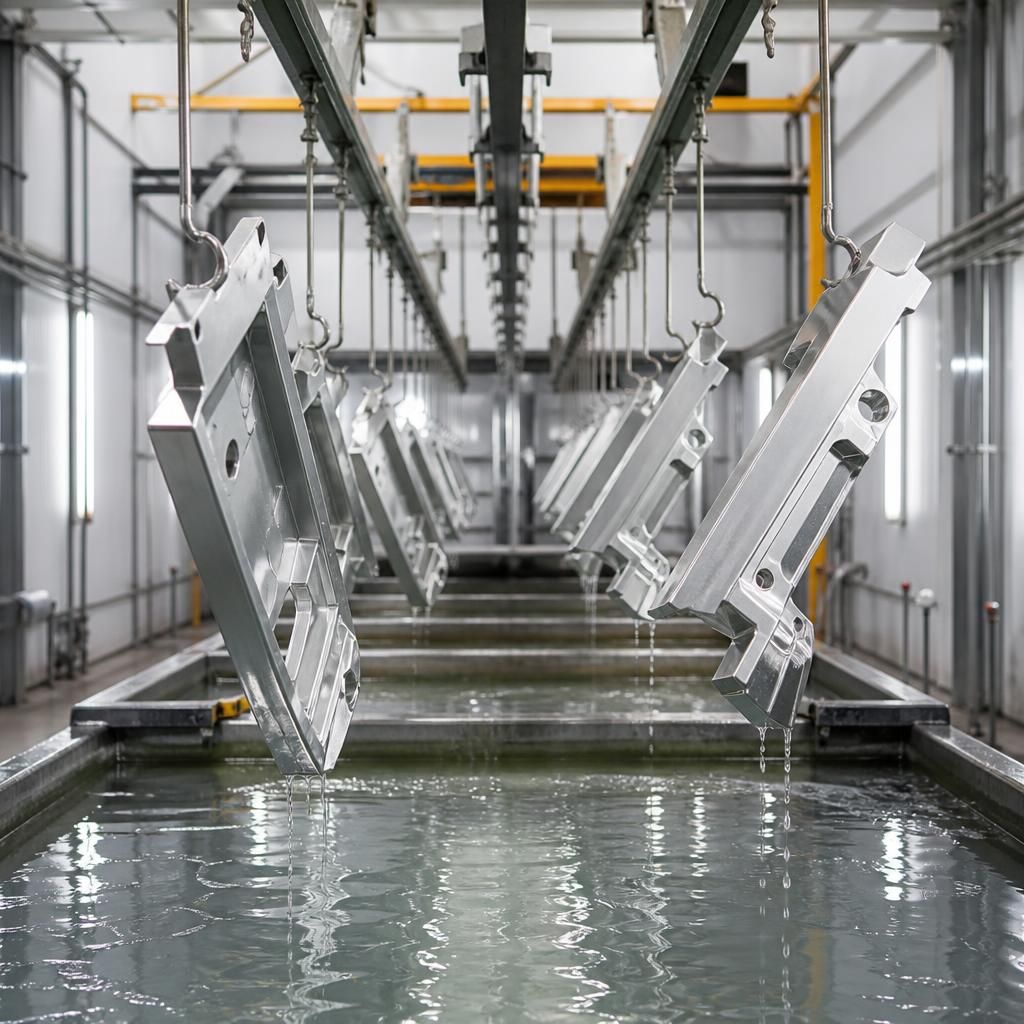
A key advantage of chemical pretreatment is that it changes the surface chemistry of aluminium rather than relying solely on a mechanical key. A conversion treatment forms a controlled interfacial layer on the substrate, giving the powder coating a more suitable surface to bond with and helping protect the aluminium beneath the coating. This is particularly useful where retaining a smooth, precise or visually consistent surface is important.
The benefit depends on accurate process control. The aluminium must be correctly cleaned, treated and rinsed so that oils, dissolved residues and process chemicals do not remain at the coating interface. Complete drying and careful handling are also required before powder application, because contamination after treatment can reduce the benefit of the chemically conditioned surface.
Discuss chemical treatments for aluminium pretreatment
If you are assessing aluminium components for powder coating, discuss the alloy, component design and existing surface condition with the powder-coating team. They can help determine whether chemical pretreatment, mechanical preparation or a combined process is the most suitable approach.