

What role does sandblasting play in the quality and adhesion of aluminium powder coatings?
Sandblasting prepares aluminium for powder coating by removing contaminants, oxidation and weak surface material while creating a controlled profile for the coating to grip. When suitably controlled for the aluminium grade and component, this improves adhesion and helps produce a more durable, consistent finish.
Sandblasting plays a key role in aluminium powder coating by mechanically conditioning the substrate before the coating system is applied. Its influence is not limited to appearance: the abrasive, equipment settings and blasting technique affect how uniformly the powder film forms, how well it withstands handling and service conditions, and whether defects develop beneath the finish.
Why aluminium requires careful blasting
Aluminium is relatively soft compared with ferrous metals, so an abrasive process that is suitable for steel may be too aggressive for an aluminium component. Excessive air pressure, an unsuitable abrasive or prolonged blasting can produce an overly rough surface, round sharp details, deform thin sections or leave embedded particles. These problems can reduce coating quality rather than improve it.
The objective is therefore controlled mechanical preparation rather than maximum abrasion. The blasting specification should take account of the aluminium alloy, the component’s thickness, its geometry and the powder coating system that will follow. Delicate fins, threads, machined faces and thin edges may require lower-intensity treatment or local protection, while robust fabricated sections can tolerate a different approach.
How blasting affects coating adhesion
Abrasive blasting gives the coating system a clean, receptive surface with microscopic variations that help the first powder layer remain anchored during handling and service. The result depends on the profile being suitable for the intended coating thickness. If the surface is too smooth, there may be insufficient mechanical keying; if it is excessively coarse, powder may not cover the surface uniformly and the peaks can remain vulnerable to wear or corrosion.
Adhesion also relies on the surface remaining free from residues after blasting. Abrasive dust, loose particles, oil transferred by handling and moisture can interfere with the interface between aluminium and the coating. Components should therefore be blown down or otherwise cleaned using a controlled method, inspected, and handled so that prepared faces are not recontaminated before coating.
Choice of abrasive and process controls
- Abrasive type: the medium must be appropriate for aluminium and clean enough not to introduce ferrous contamination or other unwanted residues.
- Particle size: finer and coarser media produce different surface textures and affect how readily detail is retained.
- Air pressure and stand-off: these determine the energy reaching the surface. Excessive intensity can damage the component or create an inconsistent profile.
- Nozzle movement: a consistent angle, distance and traverse speed help prevent stripes, local over-blasting and untreated areas.
- Equipment condition: worn nozzles and contaminated abrasive can alter the process and make results less repeatable across a batch.
Consistent control is particularly important for batch work. Variation between operators, faces or components can lead to differences in powder coverage and visual texture, even where the same powder and curing cycle are used.
Blasting complex aluminium components
Component geometry affects both preparation and the final coating. Recesses, internal corners and shadowed areas may receive less abrasive action, whereas exposed edges can receive too much. Fixing points, threaded holes, bearing seats and close-tolerance machined surfaces may need masking or a separate preparation strategy. Masking also prevents powder from being applied where it could interfere with assembly or function.
Edges deserve particular attention. A sharp edge can receive a thinner coating during spraying because powder tends to distribute unevenly around it. Blasting should not unnecessarily damage the edge, and the coating specification may require suitable edge treatment or design allowances to maintain protection through the corner.
Inspection after blasting
Visual inspection should check for unprepared areas, embedded abrasive, excessive roughness, shadowing and damage to features. Where the specification requires it, surface profile and cleanliness can be assessed using appropriate inspection methods rather than relying solely on appearance. The part should also be checked for flash rust or moisture-related contamination where the preparation process or surrounding environment could introduce it.
Good preparation is indicated by a uniform surface condition that matches the coating specification, not simply by a visibly rough finish. If defects are found after blasting, they should be corrected before powder is applied. Coating over an inconsistent substrate can conceal the problem temporarily but will not remove the underlying adhesion risk.
Sandblasting as part of the complete preparation system
Blasting is one stage in aluminium pretreatment, not a substitute for every subsequent preparation step. Depending on the alloy, component use and coating requirements, it may be followed by cleaning, chemical conversion or another approved treatment before powder spraying. The correct sequence is established by considering the aluminium surface, the required appearance, expected exposure and the powder manufacturer’s technical requirements.
When the process is correctly specified, sandblasting gives the powder coating system a sound and repeatable foundation. Its contribution to quality comes from matching the abrasive treatment to the aluminium component, controlling the resulting surface condition and protecting that preparation until the coating is applied.
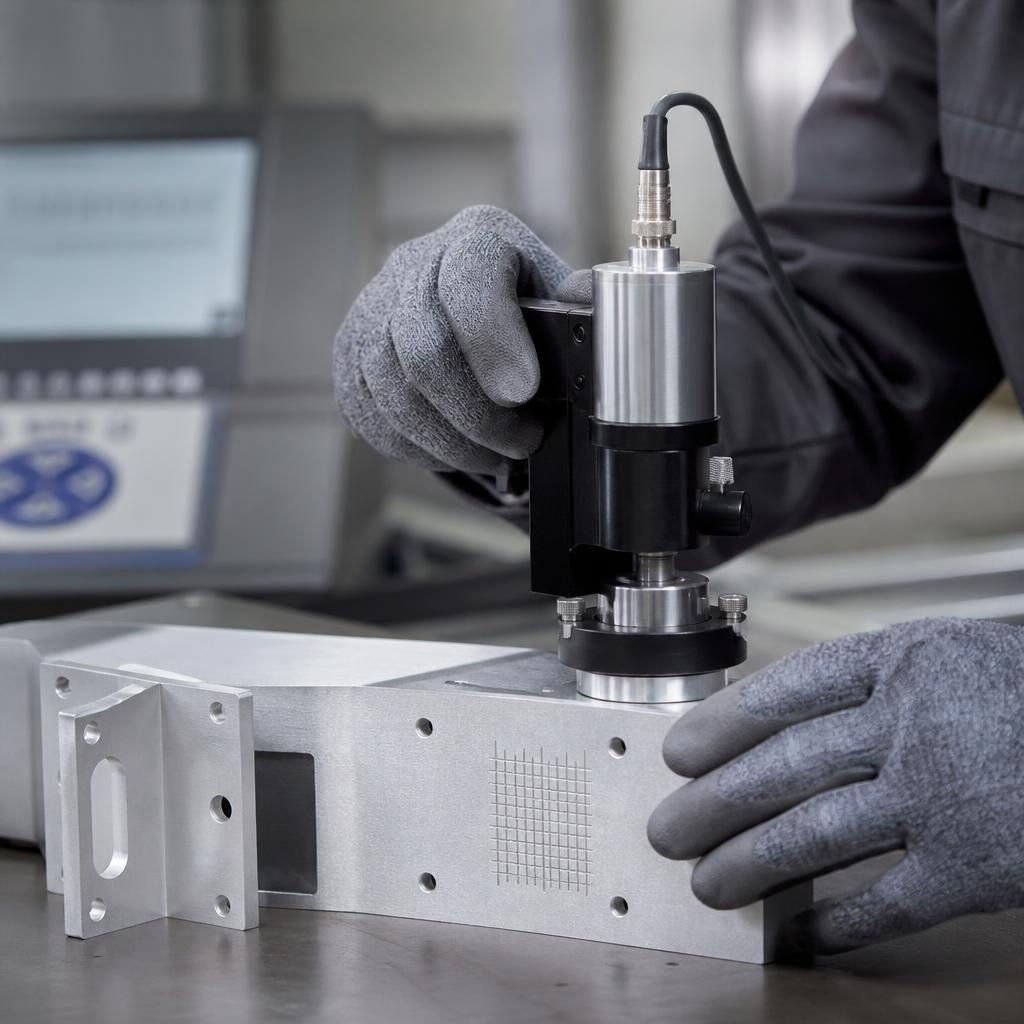
Adhesion should be verified on representative aluminium components rather than judged from the blasted appearance alone. A trial piece can be prepared using the proposed abrasive, pressure and nozzle technique, then powder coated and cured using the intended specification. This shows whether the blast profile and coating thickness work together without obscuring fine details or producing an uneven finish.
After curing, adhesion checks such as a cross-cut assessment or a suitable pull-off test can help identify weaknesses at the aluminium–coating interface. Testing should reflect the alloy, component geometry and service requirements, because a result on a flat sample may not represent recessed areas, edges or machined features. Where results are inconsistent, the blasting parameters, cleaning stage or coating system should be reviewed before batch production begins.