

What advanced features should be present in the powder coating plant to ensure superior aluminium coating quality?
A powder coating plant should combine controlled aluminium pretreatment, precise electrostatic application, monitored curing, and reliable inspection equipment to produce a consistent, well-adhered finish. Automated process controls, clean powder recovery, accurate oven temperature management and thorough quality checks help maintain coating uniformity across individual components and production batches.
Superior aluminium coating quality depends on more than the spray booth and curing oven. An advanced powder coating plant should provide controlled material handling, stable booth conditions, accurate component positioning, disciplined powder management, measurable quality testing and complete process traceability. These features reduce variation between parts and help the coating perform consistently on different aluminium shapes and batch sizes.
Purpose-designed loading and racking
Aluminium components should be loaded onto fixtures that provide reliable electrical contact without damaging visible surfaces. Well-designed jigs keep parts correctly spaced, prevent contact between components and expose faces, edges and recesses to the coating equipment. The plant should also allow operators to manage contact marks in planned, non-critical areas rather than leaving them to chance.
Adjustable racks and conveyor settings are particularly useful where the work includes extrusions, fabricated assemblies, panels and irregular components. Suitable handling equipment should support the weight and dimensions of the work while minimising movement, impact and contamination before and after coating.
Controlled booth airflow and filtration
The spray area should have balanced airflow, effective filtration and a clean internal environment. Excessive turbulence can disturb the powder cloud, while poor extraction may allow overspray to settle on equipment or on freshly coated surfaces. Air movement should therefore be stable and appropriate to the booth design, component geometry and application method.
A well-engineered booth also supports orderly colour changes and cleaning. Powder residues from a previous job must not contaminate a different colour or finish. Dedicated equipment, efficient booth cleaning and controlled separation of powder materials are valuable features where a plant processes varied production schedules.
Reliable powder storage and feed equipment
Powder should be stored in clean, sealed conditions that protect it from moisture, heat and accidental contamination. The plant should have controlled transfer and feed systems capable of maintaining a consistent supply to the application equipment. Sieving or screening can help remove unwanted agglomerates before the powder reaches the guns.
Where reclaimed powder is used, the system should identify, separate and manage it according to the coating specification. Mixing incompatible powders or combining materials with different colours, gloss levels or performance characteristics can produce an unpredictable finish. Advanced powder management therefore includes clear material identification, segregated storage and defined rules for reclaiming or disposing of overspray.
Automated movement and repeatable positioning
Programmable conveyor movement, reciprocating equipment and recipe-based settings can improve repeatability when the same type of aluminium component is coated repeatedly. The important feature is not automation in isolation, but the ability to reproduce the approved arrangement, speed and equipment settings for subsequent batches.
For complex profiles, the plant should allow adjustment of gun position, angle and distance so that recesses and edges receive suitable coverage without creating excessive build-up on corners. The system should also accommodate different component sizes without forcing every job through identical settings.
Instrumented quality-control facilities
Inspection should be supported by calibrated instruments rather than visual assessment alone. Useful equipment includes dry-film thickness gauges, gloss meters, colour comparison facilities and adhesion-test equipment. These checks can identify problems such as insufficient coverage, excessive build, inconsistent sheen, poor bonding or visible contamination.
Inspection lighting and viewing conditions should be controlled so that visual defects can be assessed consistently. Test panels or representative sample pieces may also be used to confirm the selected finish before a larger batch proceeds. The appropriate tests depend on the specification, end use, profile design and required appearance.
Digital records and traceability
A modern plant should be able to record the key details associated with each production run. This may include the powder identification, component reference, approved settings, operator checks, inspection results and any deviations or corrective actions. Barcode identification or equivalent job-control systems can reduce the risk of applying the wrong material or processing parts under the wrong instruction.
Traceability is especially important where coated aluminium forms part of a manufactured assembly. It enables the processor and customer to link finished components to the relevant specification and inspection record, making recurring issues easier to investigate.
Controlled cooling, handling and packing
Coated parts need suitable support after leaving the process equipment. Cooling areas should prevent freshly finished surfaces from rubbing against racks, conveyor components or other parts. Non-marking contact points, protective separators and appropriate packing materials help preserve the finish during internal movement and delivery.
Handling systems should also reduce unnecessary manual contact. Even a correctly applied coating can be marked by poor stacking, unsuitable straps or premature packing, so the plant layout should protect the surface after processing as well as during it.
Calibration, maintenance and process verification
Advanced equipment only improves quality when it is maintained and checked. The plant should have planned calibration for measurement devices, inspection of electrical contacts and application equipment, cleaning schedules for booths and recovery systems, and records of maintenance activity. Filters, hoses, pumps, guns, fixtures and conveyor components can all affect the result when their condition deteriorates.
When assessing a powder coating plant, ask how it controls component identification, powder segregation, rack design, equipment calibration, inspection records and post-coating handling. These features complement the core coating stages and provide the repeatability, cleanliness and evidence needed for demanding aluminium applications.
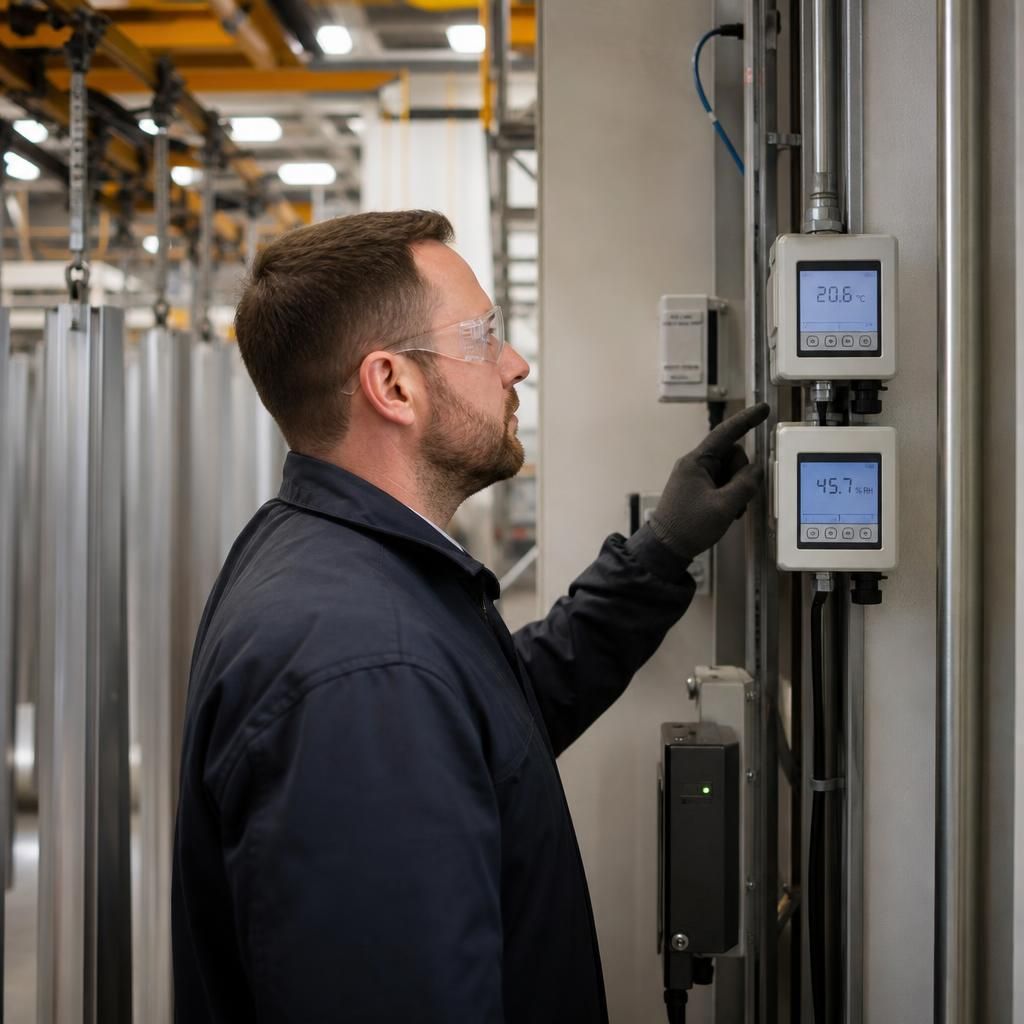
Environmental monitoring is an important advanced feature in a powder coating plant because aluminium can react differently to changes in temperature, humidity and surface condition. Sensors for ambient temperature and relative humidity help identify conditions that may affect powder flow, electrostatic transfer, condensation risk or the behaviour of the coated component before curing.
The plant should also provide a controlled way to check substrate temperature and the interval between pretreatment, coating and curing. Recording these conditions alongside the production details helps operators determine whether a variation in finish is linked to the material, the equipment or the surrounding environment. This is particularly useful when coating aluminium components with demanding appearance or performance requirements.