

How does the curing process enhance the performance and longevity of powder-coated aluminium surfaces?
Curing heats the applied powder coating until it melts, flows and chemically bonds into a continuous protective film on the aluminium surface. This controlled transformation improves adhesion, hardness and resistance to corrosion, chemicals, impact and weathering, helping the finish retain its protective performance for longer.
Curing is the thermal cross-linking stage that converts deposited powder into a stable, functional coating. Once the aluminium reaches the required metal temperature for the specified time, the resin and curing agent react to form a three-dimensional polymer network. This controlled reaction determines whether the finished surface achieves its intended flexibility, toughness, appearance and resistance to service conditions.
The cure schedule must be matched to the powder formulation and the component being coated. Oven air temperature alone is not sufficient, because the coating cures according to the temperature reached by the aluminium itself. A thick casting, a tightly packed batch or a part with significant thermal mass can take longer to reach the target temperature than a thin sheet. Monitoring the part temperature helps prevent a coating from leaving the oven before the reaction is complete.
- Under-curing: an incomplete reaction can leave the film relatively soft or susceptible to marking, reduced solvent resistance and weaker performance during handling or service.
- Correct curing: the coating develops its designed balance of surface hardness, flexibility and resistance to wear and environmental exposure.
- Over-curing: excessive heat or dwell time can affect colour, gloss, flexibility and the appearance of the finish, depending on the powder chemistry.
Correct curing also supports long-term dimensional and mechanical stability. Aluminium components may be exposed to vibration, handling, temperature changes or contact with other parts. A properly developed polymer network helps the film remain cohesive rather than becoming prone to premature cracking, marking or loss of surface integrity. This is particularly important on profiles, enclosures, fabricated assemblies and components with edges, recesses or varying material thicknesses.
Oven uniformity is therefore a significant part of the process. The air temperature should be consistent throughout the working zone, while airflow and loading arrangements should allow each component to receive comparable heat exposure. Parts positioned too close together, shielded from airflow or suspended in an unsuitable orientation may cure differently from parts elsewhere in the batch. Industrial coating processes take account of component size, shape, mass and loading pattern when establishing a repeatable schedule.
The coating film must also be applied at a suitable thickness before curing. Excessive thickness can affect appearance, edge coverage and the way heat reaches the coating, while insufficient coverage may reduce the protective continuity of the finish. Curing improves the properties of the film that has been applied; it cannot correct poor coverage, contamination, inadequate surface preparation or defects introduced during spraying.
Aluminium’s high thermal conductivity can help distribute heat through a component, but it does not remove the need for process control. Complex parts may contain areas that heat at different rates, especially where sections vary in thickness or where components are assembled before coating. Cure validation should consider the coldest or most difficult-to-heat areas rather than relying only on the oven display.
Quality checks can include recording the metal temperature during representative production runs, inspecting the cured appearance and checking film thickness. Depending on the coating system and specification, additional tests may assess adhesion, hardness, flexibility or resistance to a suitable solvent. These checks help identify whether the coating has reached its required state and whether the process remains consistent between batches.
For a long-lasting powder-coated aluminium surface, curing must be considered alongside powder selection, application control and surface preparation. The correct thermal cycle gives the coating the stable structure needed for its specified service performance, while accurate loading and verification reduce the risk of weakly cured or overheated areas. Industrial powder coating specialists can use the component design, coating specification and production requirements to establish an appropriate curing approach for aluminium parts.
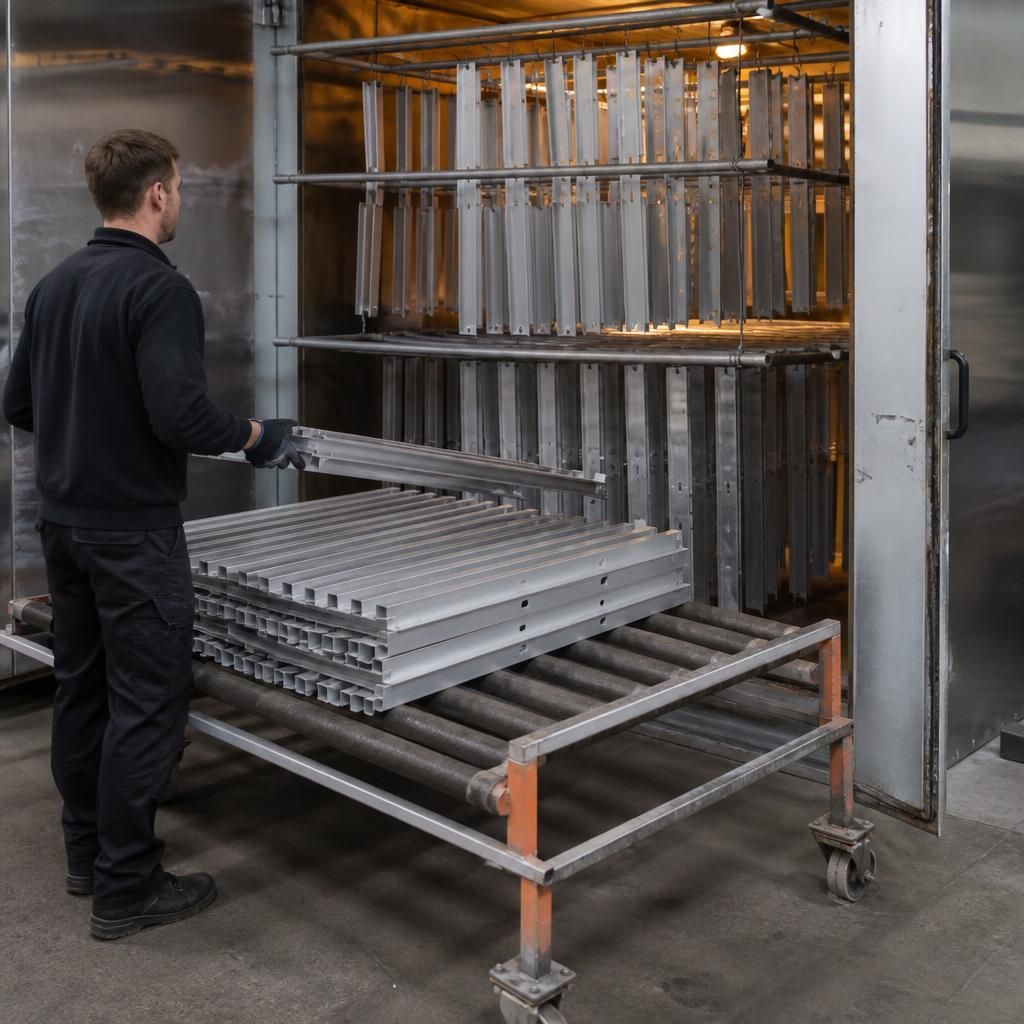
Allowing powder-coated aluminium components to cool before contact, stacking or packing helps preserve the properties developed during curing. A coating may be chemically cured but still vulnerable to pressure marking while it remains hot and relatively soft.
Controlled post-cure handling reduces the risk of imprints, scuffs and local damage that could compromise the protective film. Components should be supported without concentrated contact points, kept separated where necessary and inspected before dispatch or assembly. This protects the continuous finish and helps retain its appearance and service performance after the thermal process is complete.