

How do environmental conditions affect the aluminium powder coating process?
Temperature, humidity and airborne contamination can affect aluminium powder coating by changing powder flow, electrostatic application, adhesion and curing. Controlled, clean conditions help produce a consistent finish, while moisture or contaminants on the metal can cause defects such as poor adhesion, blistering or uneven coverage.
Environmental control is an integral part of aluminium powder coating because the condition of the air, the aluminium, the powder and the processing equipment can influence application, adhesion and final appearance. The most important controls concern substrate temperature, moisture, cleanliness, air movement, powder storage and the consistency of the curing environment.
Substrate and ambient temperature
The aluminium part must be at a suitable temperature before coating begins. If it is significantly colder than the surrounding air, condensation may form even when the workshop itself appears dry. This is particularly relevant when components have been stored in an unheated area or brought in from outside. Moisture on the surface can interfere with pretreatment and coating adhesion, while a warmer component can alter powder flow and the way the film begins to level.
Temperature also affects the behaviour of the coating equipment. Powder must flow consistently through the feed system and spray gun, and the application system must maintain a stable electrostatic charge. Changes in temperature can therefore contribute to variations in transfer efficiency, coverage and film build. The metal temperature should be checked as part of process preparation rather than relying only on the room temperature.
Humidity and condensation risk
Relative humidity is not the only consideration; the relationship between the temperature of the aluminium and the dew point is also important. A surface close to or below the dew point is vulnerable to condensation. This risk can arise after washing, during storage or when components move between areas with different temperatures.
Moisture can also affect the powder itself. Powder that has absorbed moisture may become difficult to fluidise, form lumps or produce an inconsistent spray pattern. Sealed, suitable storage and controlled handling help keep the powder in a usable condition. Open containers should not be left exposed unnecessarily, and powder should be protected from damp floors, walls and sudden temperature changes.
Cleanliness of the work area and equipment
Clean conditions are necessary at every stage, not only inside the spray booth. Dust, fibres, oil mist and residue from other coating materials can settle on prepared aluminium or become trapped in the finish. Booth surfaces, recovery equipment, hangers and contact points should be maintained so that they do not introduce contamination during application.
Compressed air is another potential source of defects. Water or oil carried through the airline can contaminate the substrate, powder or spray equipment. Appropriate filtration, drainage and routine checks help prevent this. Parts should also be handled with clean equipment after pretreatment, since fingerprints, grease and workshop residue can undermine the benefit of an otherwise sound preparation process.
Air movement and electrostatic application
Airflow in and around the booth must be controlled. Excessive turbulence can disturb the powder cloud, reduce deposition on recessed areas and carry overspray onto nearby components. Insufficient or poorly balanced extraction can allow contamination to remain in the application area. Air movement should support containment and operator control without disrupting the electrostatic spray pattern.
The electrical environment matters as well. Reliable earthing of the component and its hanging system is essential for electrostatic attraction. Paint build-up on hooks or contact points can interrupt that path, while poor contact may contribute to weak deposition or uneven coverage. Environmental control therefore includes maintaining the equipment and ensuring that parts are presented consistently to the spray process.
Pretreatment and rinsing conditions
Environmental conditions interact with chemical pretreatment. The condition of the treatment baths, rinse stages and drying area must remain consistent so that the aluminium reaches the booth clean and dry. Changes in bath temperature, concentration or contamination can affect the conversion layer, while inadequate drying can leave moisture in joints, profiles or recessed sections.
After pretreatment, components should be protected from workshop dust and handled in a way that avoids recontamination. Long or hollow sections deserve particular attention because retained water may emerge during spraying or curing. The part should be inspected before powder application, with any visible residue, moisture or damage addressed before coating proceeds.
Conditions during curing and cooling
The curing oven must provide a stable and uniform environment around the loaded components. The relevant condition is the temperature reached by the aluminium itself, not simply the temperature displayed for the oven air. Part thickness, profile design, load arrangement and the thermal mass of a batch can all affect how heat reaches each surface.
Uneven loading or restricted air circulation may leave some areas under-cured while others receive the intended heat exposure. Under-cured powder can have inadequate performance, whereas excessive heat exposure may affect colour, gloss or the coating’s appearance. The powder manufacturer’s curing requirements should be matched to the actual component temperature, with process records and checks used to identify variation.
Cooling also needs consideration. Components should be protected from dust, moisture and physical contact while the coating is still hot or soft. Moving hot aluminium into a damp area can create condensation, and stacking parts before they have cooled sufficiently can mark the finish. Controlled handling after the oven helps preserve the surface achieved during curing.
Practical controls for consistent results
- Check the aluminium for moisture, contamination and suitable surface temperature before spraying.
- Monitor workshop conditions where condensation or powder handling may be affected.
- Keep powder sealed and dry, and avoid mixing material that has become contaminated or physically altered.
- Maintain clean booth surfaces, hangers, spray equipment and compressed-air supplies.
- Use reliable earthing and remove accumulated coating from contact points.
- Protect pretreated components from recontamination before powder application.
- Arrange oven loads so that parts receive comparable heat exposure and airflow.
- Allow coated components to cool in a clean, controlled area before inspection, packing or transport.
For industrial batches, recording environmental observations alongside pretreatment, application and oven checks makes defects easier to trace. If a problem appears only on certain days, profiles, locations in the booth or parts from a particular load, the pattern may indicate a temperature, moisture, airflow or contamination issue rather than a fault in the powder itself.
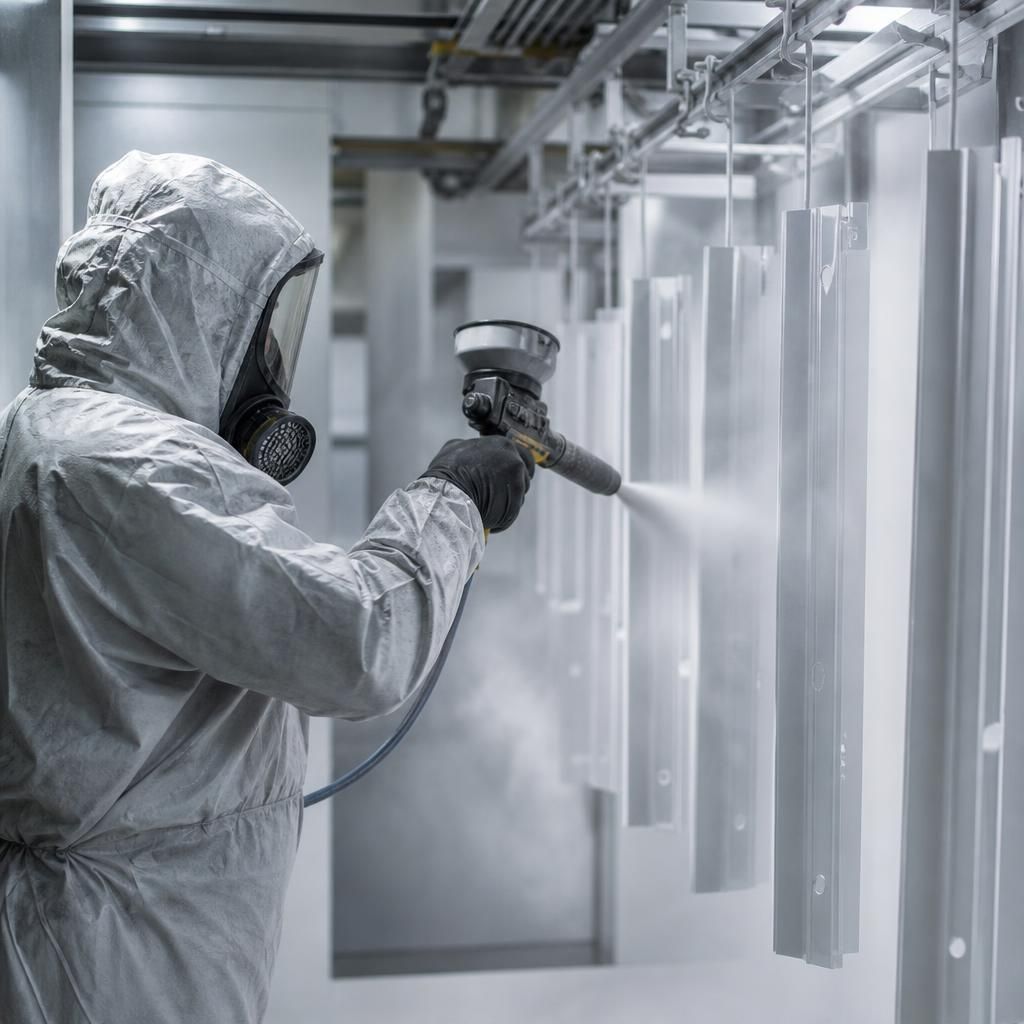
Aluminium component geometry can create local environmental differences during coating. Thin edges, heavy sections, recesses and enclosed profiles may warm, cool or dry at different rates from the surrounding surface. These variations can affect how consistently the powder deposits and how evenly the coating develops during heat exposure.
For this reason, environmental checks should be considered alongside the shape and loading of each component. Consistent spacing and orientation help expose surfaces to comparable air movement and heat, while inspection of recessed areas can identify moisture or coating variation that may not be visible on flat sections.