

How does our aluminium powder coating plant adapt to accommodate diverse coating thickness requirements for different applications?
Our aluminium powder coating plant adapts to different thickness requirements by setting the powder type, application parameters and curing conditions to suit the component, finish and end use. Coating thickness is then checked against the agreed specification, helping maintain consistent coverage across individual parts and production batches.
Our aluminium powder coating plant accommodates different thickness requirements by treating dry-film thickness as a job-specific specification linked to the component’s geometry, dimensional tolerances, operating environment and intended use. This avoids applying the same coating build to every aluminium part and helps ensure that the finish is suitable for both appearance and performance requirements.
The required thickness is established from the technical information supplied for the component and the conditions it will face in service. A decorative enclosure, architectural section or fabricated panel may require a different coating build from an aluminium part exposed to greater abrasion or environmental contact. Where the coating contributes to protection, the specification must provide sufficient coverage without creating unnecessary build-up that could affect fit, assembly or appearance.
Component design is an important part of this assessment. Flat faces, corners, recesses, apertures and narrow sections do not receive powder in exactly the same way. Edges can develop a different film profile from broad faces, while recessed areas may require particular attention to achieve consistent coverage. The plant’s process is therefore adjusted with the part’s shape, hanging position and exposed surfaces in mind rather than relying on a single setting for every item.
Thickness requirements also need to be considered alongside areas that must remain free from coating. Threads, bearing faces, mating surfaces, holes and other close-tolerance features may need suitable masking or defined finishing limits. This prevents excess coating from interfering with assembly and allows the finished aluminium component to retain the dimensions needed for installation or further manufacture.
- Lower-build requirements: these demand careful control to avoid thin spots, particularly around edges, corners and less accessible areas.
- Standard protective or decorative builds: these are assessed for even visual coverage, colour consistency and appropriate adhesion across the accessible surface.
- Higher-build requirements: these require attention to powder flow, surface appearance, cure and dimensional clearance so that additional material does not create defects or affect assembly.
Parts with different thickness requirements may also need separate process instructions, even when they are made from the same aluminium alloy. The instruction can identify the required finish, areas requiring protection or masking, critical dimensions and the points at which the coating should be checked. This creates a clear reference for repeat work and helps reduce variation between components within the same batch.
Inspection is based on the agreed requirement rather than visual appearance alone. Dry-film thickness can be checked at representative locations across the component, including broad faces and areas where geometry may influence the coating build. Results can then be considered alongside coverage, finish quality and dimensional checks. If a part falls outside its specified requirement, the cause can be investigated before the wider batch proceeds, rather than assuming that an apparently smooth finish is acceptable.
For repeat production, the information from an initial or trial run can be used to refine the handling and process approach for subsequent batches. This is particularly useful where aluminium components vary in size, shape or loading arrangement. By linking the thickness requirement to the component design and its end use, the plant can accommodate thin, standard and more substantial coating specifications without treating them as interchangeable.
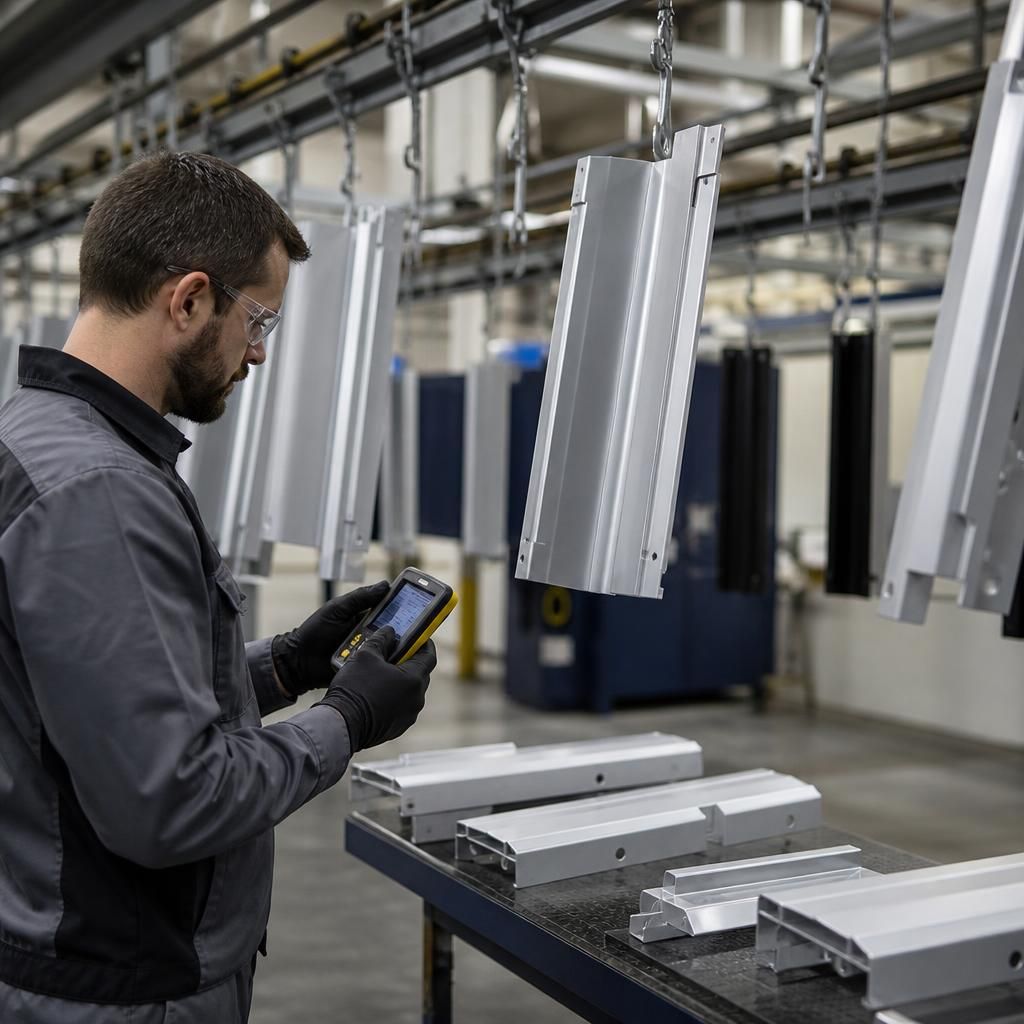
Adapting coating thickness also requires controlled production planning when one order contains components with different build requirements. Parts can be grouped according to their coating specification, finish and dimensional limits so that the appropriate process instruction is followed for each group rather than applying one general setting across the complete order.
This approach is particularly useful for mixed aluminium assemblies, where visible panels may require one coating build while brackets, covers or close-fitting components require another. Separating the requirements helps prevent specification changes being overlooked during production and provides a clearer basis for checking each group before it is released for assembly or further manufacture.