

What are the scalability options for a powder coating setup to accommodate future growth or changes in production demands?
A scalable powder coating setup can accommodate future growth by expanding batch capacity, adding or upgrading pretreatment, spray and curing equipment, and introducing automation where production volumes justify it. Modular planning also allows the setup to support changes in component size, coating specifications and specialist finishes without replacing the entire process line.
A scalable powder coating setup is one that can absorb higher demand, wider product variation or revised coating requirements without creating bottlenecks or requiring a complete replacement. Scalability depends not only on machine capacity, but also on the way the line is laid out, how components are handled, how utilities are sized and how consistently the process can be controlled.
Plan around the likely constraint
Growth is often restricted by the least capable part of the process. For example, a spray area may have adequate capacity while loading, masking, inspection or packing becomes the limiting stage. A scalability review should therefore map the complete route from incoming components to finished goods and identify where queues, handling time or rework are most likely to develop.
- Loading and unloading space should allow work to be staged without obstructing production.
- Racking and hanging systems should accommodate different component shapes and weights.
- Inspection and packing areas should be capable of processing finished parts at the same rate as the coating stages.
- Material movement should be arranged to reduce unnecessary handling as throughput increases.
Allow for product variation
A setup may need to coat small brackets, fabricated assemblies, panels or other metal components as a customer base develops. The useful capacity of a system is therefore determined by its working envelope as well as its nominal output. Consider the maximum component dimensions, available hanging points, permissible load, access for operators and the range of finishes that may be required.
Flexible fixtures and interchangeable hanging arrangements can help the same equipment handle different component families. However, this should be balanced against changeover time, masking requirements and the risk of parts touching during coating. A layout that supports several product formats is generally more adaptable than one designed around a single component type.
Size supporting infrastructure for future demand
Future expansion can be limited by services rather than coating equipment. Electrical supply, ventilation, compressed air, gas where applicable, extraction and fire protection should be assessed at the planning stage. It may be practical to install distribution routes, connection points or floor space that permit later equipment changes, provided the design remains compliant with relevant safety requirements.
Building constraints also matter. Access for moving equipment, floor loading, ceiling height, drainage, ventilation routes and separation between process areas can all affect whether additional capacity can be introduced later. Reviewing these constraints before purchase helps distinguish a genuinely expandable setup from one that would require major building work to change.
Use process control to support higher volumes
As production grows, consistency becomes harder to maintain through informal checks alone. Scalable operation benefits from documented settings, controlled powder storage, traceable job information and repeatable inspection criteria. Recording substrate preparation, powder specification, application settings and cure requirements makes it easier to reproduce an approved finish across larger or more varied production runs.
Process monitoring can also show where capacity is being lost. Useful measures include queue time, changeover time, rework, rejected components, equipment downtime and the proportion of available capacity being used. These records support evidence-based decisions about the next investment rather than relying on estimated demand alone.
Choose staged investment where demand is uncertain
When future orders are difficult to predict, a staged approach can reduce the risk of committing to an unsuitable configuration. The initial setup should meet current production needs while preserving practical routes for later changes. Possible stages may include improving handling and fixturing first, introducing additional process equipment later, or arranging supplementary capacity through an external coating partner while demand is established.
Any staged plan should define the trigger for each change. Triggers might include sustained queueing, repeated subcontracting, insufficient space for work-in-progress, extended changeovers or a rise in product variation. This creates a more controlled investment path than expanding in response to a single temporary order.
Consider colour and material changeovers
Changes in colour, powder type or finish can consume capacity even when equipment is technically large enough for the required volume. A setup intended for a varied production mix should account for cleaning, booth preparation, powder handling, masking and quality checks between jobs. Grouping compatible work, using suitable collection and reclaim arrangements where appropriate, and planning production sequences can protect productive capacity.
Where specialist finishes such as nylon or protective coatings form part of the product range, compatibility between the coating material, application equipment, curing conditions and cleaning method should be confirmed before expansion. Adding a new finish is not simply a matter of increasing throughput; it may introduce different preparation, handling and quality-control requirements.
Review maintenance and resilience
Higher utilisation increases the effect of planned and unplanned stoppages. A scalable setup should have accessible wear parts, clear maintenance procedures and a practical way to isolate equipment for servicing without disrupting the whole operation. Preventive maintenance records can identify recurring faults and indicate whether replacement, duplication or redesign is the more suitable response.
It is also useful to assess dependency on individual operators. Clear work instructions and consistent setup procedures make it easier to maintain output when staffing or product mix changes. Training should cover equipment operation, powder handling, defect recognition, cleaning and the records needed for traceability.
For a business comparing a powder coating setup for sale, scalability should therefore be assessed as a complete operating system rather than as a single machine specification. Reviewing product dimensions, handling, utilities, changeovers, process control, maintenance and available floor space provides a more reliable basis for deciding whether equipment can support future production changes. Powder-coatings.co.uk works with businesses across the Midlands and surrounding areas, with collection and delivery options for industrial coating requirements where using an in-house setup is not the preferred route.
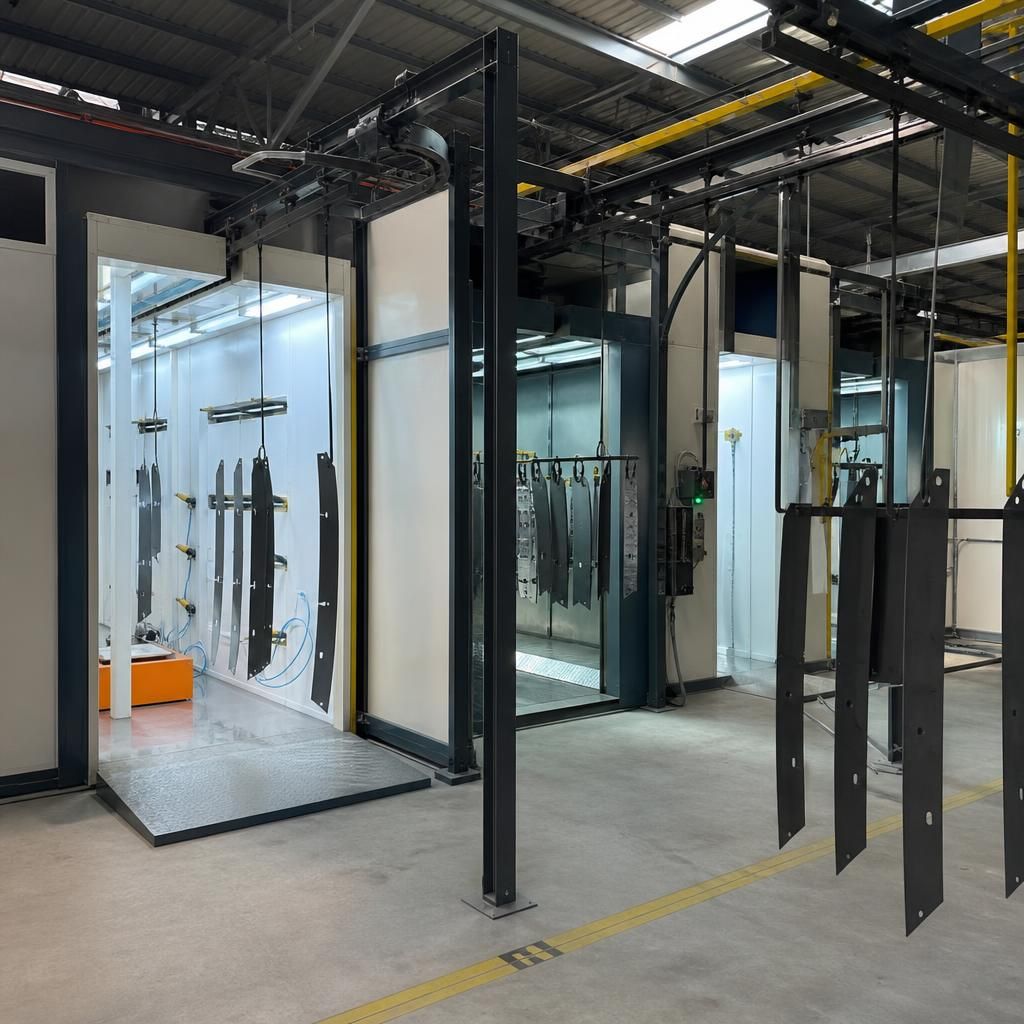
One scalability option is to add parallel process capacity rather than replace the original equipment with a larger line. A second spray area, curing route or preparation station can allow different batches to be processed separately, which may be more practical when production includes varied component sizes, colours or coating specifications.
This approach can also provide operational separation between standard work and specialist requirements, reducing the need to reconfigure one process repeatedly. Before choosing parallel equipment, assess available floor space, extraction, utilities, operator access and the transfer of parts between stages. The additional route should increase usable capacity without creating a new handling or inspection bottleneck.