

What advantages does thermoplastic powder coating offer over traditional liquid coatings in terms of application and performance?
Thermoplastic powder coating is applied as a dry powder and fused with heat, avoiding the solvent evaporation and multiple wet-coat stages often associated with liquid coatings. It can provide a thicker, flexible and highly durable finish with strong resistance to impact, abrasion, chemicals and corrosion, making it suitable for demanding industrial metal components.
Thermoplastic powder coating can offer advantages over traditional liquid coatings through more efficient material transfer, a simpler heating cycle and a finish that remains tough and repairable rather than undergoing an irreversible curing reaction. Its performance depends on the selected polymer, substrate preparation, coating thickness and service environment, so the specification must match the component’s intended use.
Application advantages
- Efficient material use: Powder can be applied electrostatically, allowing charged particles to be attracted to the earthed metal component. Overspray may be collected and, where the material and process allow, reused. This can reduce material waste compared with liquid systems in which solvent content evaporates during application.
- Fewer application stages: The coating is normally heated until the particles melt and form a continuous layer. This avoids the drying intervals associated with successive liquid coats and reduces the risk of defects caused by trapped solvent or inadequate flash-off between layers.
- Consistent film formation: Once melted, the material flows across the prepared surface. Correct control of part temperature, powder deposition and dwell time helps produce an even coating, including coverage around edges and profiles that might be difficult to coat consistently with a brush or spray gun.
- Reduced solvent-related concerns: Thermoplastic powders do not rely on liquid solvent evaporation to form the coating. This can simplify extraction requirements and remove solvent emissions from the coating film, although the overall installation still needs suitable controls for dust, heat and safe powder handling.
- Rework potential: Because thermoplastic materials soften when reheated, some coating systems can be repaired, stripped or reprocessed using suitable controlled methods. This is different from a thermoset or conventional cured film, which cannot simply be melted back into its original state. Rework is not automatically appropriate; contamination, substrate condition and the particular polymer must be assessed.
Performance advantages
- Resistance to mechanical damage: Thermoplastic films can absorb local deformation without cracking as readily as a brittle coating. This is useful for components exposed to handling, vibration, flexing or contact with other parts.
- Barrier protection: A continuous thermoplastic layer can separate the metal from moisture, salts and other contaminants. Its effectiveness depends on complete coverage, sound pretreatment, suitable thickness and protection of cut edges, joints and fixing points.
- Low-temperature flexibility: Many thermoplastic formulations retain useful flexibility across a broad operating range. The appropriate grade should be selected against the temperatures, chemicals and mechanical loads expected in service rather than assumed from the coating category alone.
- Surface functionality: The coating can be specified for properties beyond appearance, such as slip reduction, electrical isolation, noise reduction or resistance to particular chemicals. These properties vary significantly between polymers and should be verified against the required technical specification.
- Ease of local repair: Minor damage may be addressed by cleaning and applying compatible material, or by controlled heating where the coating system permits it. A repair should restore continuity and adhesion; simply covering contamination or loose coating can leave corrosion developing underneath.
Important limitations when comparing systems
Thermoplastic powder coating is not automatically the best option for every component. The process requires the substrate to tolerate the heating cycle, and large, thick or heat-sensitive assemblies may need particular process planning. Surface preparation remains critical: oil, mill scale, rust and residues can prevent adhesion regardless of the coating method. Masking, threaded features, close tolerances and internal cavities also need consideration before production.
Liquid coatings may remain preferable where a component cannot be heated, where on-site application is required, or where a very thin film and exact colour matching are the overriding priorities. A sound comparison should therefore consider the complete duty cycle: preparation, application, handling, exposure conditions, inspection, repair and eventual recoating. For industrial metalwork, the most reliable choice is the system that meets the required protection and processing conditions, not simply the one with the lowest initial application complexity.
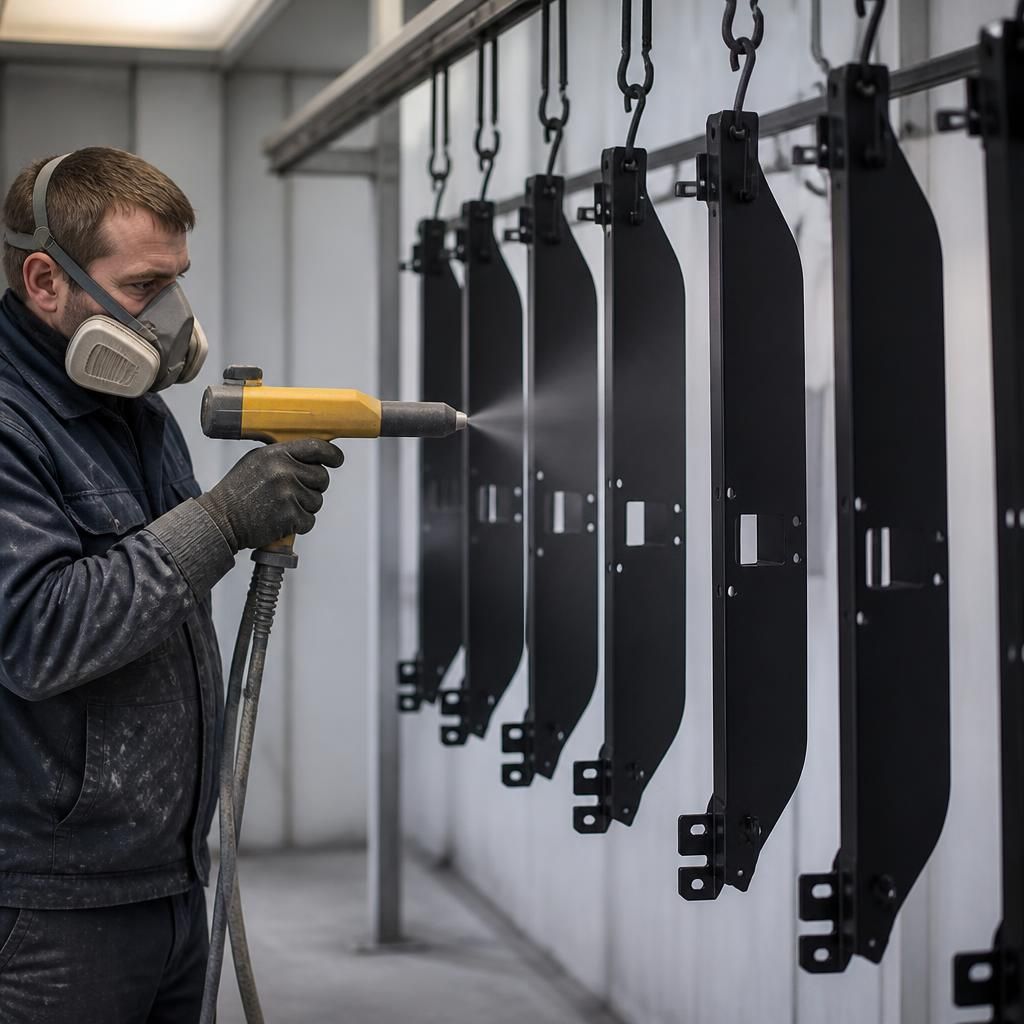
A key advantage of thermoplastic powder coating is that its performance can be matched closely to the component’s operating environment. The selected polymer can be specified for requirements such as chemical contact, repeated handling, electrical insulation or reduced surface noise, rather than treating coating as an appearance-only finish.
This makes the comparison with liquid coatings more technical than simply choosing between powder and wet application. The correct decision should consider the substrate, expected loads, temperature range, exposure and required surface properties. Where the component can tolerate the heating process, a suitably specified thermoplastic coating can combine protective performance with useful functional characteristics in one continuous finish.