

What systems are in place at your powder coating facilities to ensure uniform coverage on varying metal surface textures?
Uniform coverage is managed through controlled surface preparation, consistent powder application and carefully monitored curing, with inspection between stages. These controls help the coating follow smooth, textured and irregular metal surfaces while maintaining a consistent, durable finish across each batch.
Uniform powder coating coverage on different metal textures is achieved by adapting the coating process to the part’s geometry, surface profile and electrical behaviour, rather than using one fixed setting for every component. Smooth sheet, heavily textured steel, castings, welds, edges, recesses and perforated sections can attract and hold powder differently, so each type is assessed and processed with suitable controls.
Job assessment and process planning
Before coating, the component design and surface condition are considered. Important variables include the depth and direction of surface texture, sharp edges, cavities, apertures, weld profiles and areas that may be difficult for the powder cloud to reach. The coating plan can then define suitable hanging points, gun access, application order and any areas requiring particular attention.
This planning is particularly important where a part combines smooth and rough surfaces. A heavily profiled area may need a different application approach from a flat face, while deep recesses can be affected by the electrostatic “Faraday cage” effect. This occurs when charged powder is drawn towards exposed edges and is less readily deposited in an enclosed area. Recognising this risk allows the operator to alter the gun angle, distance or sequence instead of allowing excess powder to build up on the outside while the recess remains lightly covered.
Racking, earthing and component positioning
Consistent racking helps keep each component in a repeatable position as it passes through the coating process. Parts are arranged so that important faces remain accessible and so that one component does not shield another. Suitable contact points also help maintain electrical continuity between the part and the equipment earth. Reliable earthing is essential because the electrostatic charge influences how powder is attracted to the metal surface.
Contact points are selected with the finished area and part geometry in mind. Where practical, they are placed in less visible locations, while still providing a sound electrical connection. Hooks, racks and contact areas also need to remain free from excessive accumulated coating, as build-up can interfere with conductivity and make application less predictable.
Application control for textured and irregular surfaces
Powder delivery and spray equipment are kept consistent so that the coating material reaches the component in a controlled manner. Operators adjust their technique for the shape of the part, maintaining an appropriate gun movement rather than dwelling over edges or moving too quickly across broad surfaces. Angling the spray towards difficult faces and applying powder in a planned sequence helps reduce shadowing caused by corners, folds and adjacent sections.
Edges require particular control. They can attract more powder than a broad flat surface, while sharp profiles may also be more vulnerable to thin coverage if the spray passes across them too quickly. Recesses and internal faces are approached separately where necessary, with the operator avoiding excessive build-up at the entrance to a cavity. These measures help produce a more balanced film across both exposed and sheltered areas.
Checks for repeatability
Uniformity is supported by using consistent settings and documenting relevant process conditions for repeat batches. If the substrate, component design, powder specification or finish requirement changes, the application approach can be reviewed rather than carried forward without adjustment. Trial pieces or representative areas may be used to confirm that the selected technique reaches the required surfaces before a larger batch is processed.
Checks focus on whether the coating has reached corners, recesses, welds and transitions between different textures, as well as on the general appearance of the exposed faces. Visible variation, missed areas, excessive build-up or uneven texture can indicate a problem with positioning, earthing, access or application technique. Identifying the likely cause allows the process to be corrected for the affected component type instead of treating every surface in the same way.
For B2B batches, this combination of part assessment, repeatable racking, electrical control, deliberate gun movement and process records is important because uniformity must be maintained across components that are not identical in shape or surface profile. It provides a structured way to manage variation while preserving the specified appearance and protective function of the coating.
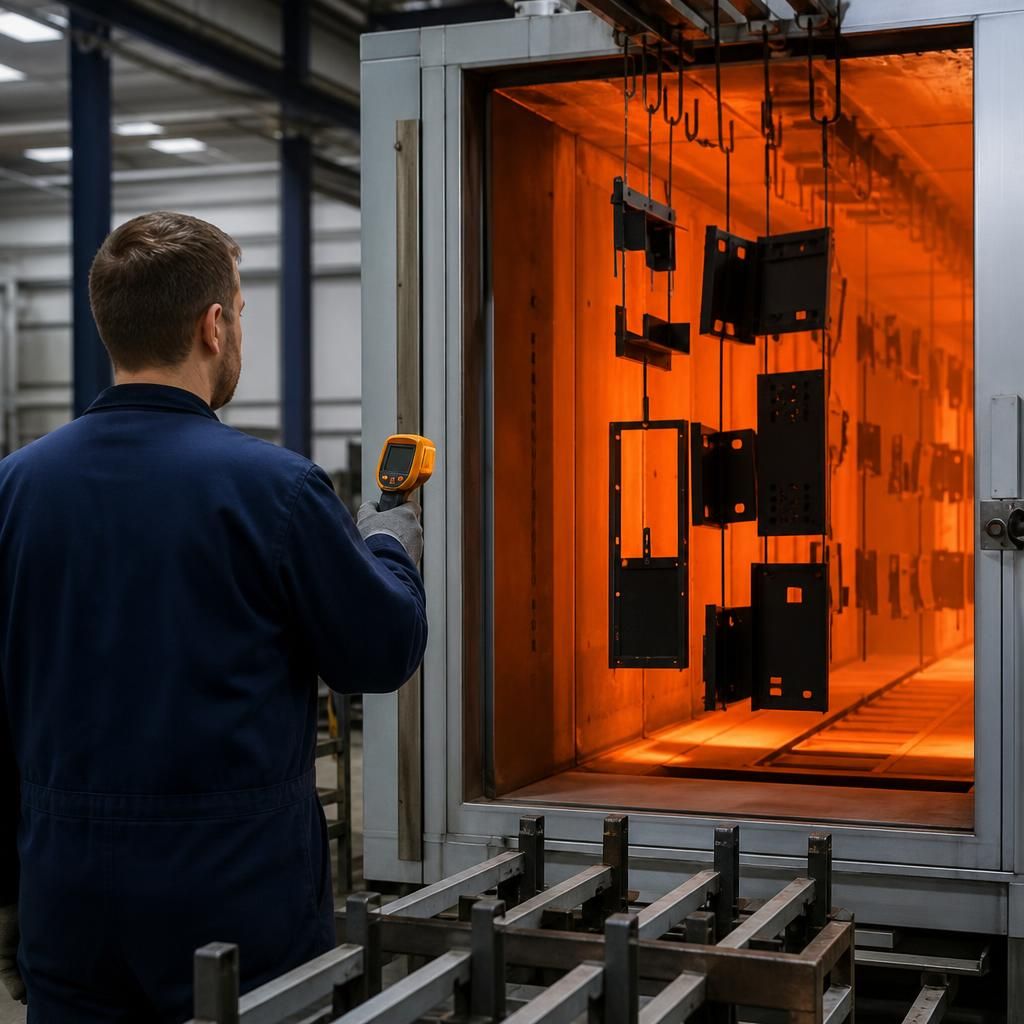
Curing controls help preserve uniform coverage after the powder has been applied. Components with different thicknesses, hollow sections or high thermal mass do not reach curing temperature at the same rate, so an oven setting alone does not confirm that every area has received the required cure.
For mixed or irregular batches, the curing approach is matched to the component design and powder specification. Temperature conditions are monitored at relevant stages, with attention to heavier sections and sheltered areas that may heat more slowly. This reduces the risk of a finish that appears consistent on the surface but has developed uneven protective performance because parts of the coating were under-cured or exposed to excessive heat.