

What factors should be considered when determining the suitability of powder coating materials for specific industrial applications?
The suitability of a powder coating material depends on the component’s substrate, operating environment, expected mechanical and chemical exposure, required corrosion protection, application process and desired appearance. Selection should also account for service temperature, film thickness, curing requirements, dimensional tolerances and whether the finish must meet a particular industry or performance specification.
The most suitable powder coating material is the one whose resin chemistry, film properties and processing requirements match the component’s service conditions and manufacturing process. Selection should therefore begin with the required performance in use, then be checked against substrate compatibility, pretreatment, application equipment, curing capability, regulatory requirements and the cost of maintaining the finish.
Choose the resin family for the exposure. Different powder chemistries provide different balances of weathering resistance, chemical resistance, flexibility and appearance:
- Epoxy powders generally provide strong adhesion, hardness and resistance to many chemicals. They are often considered for components used indoors or where protection from corrosion and chemical contact is more important than long-term colour and gloss retention in direct sunlight.
- Polyester powders are commonly selected for external metalwork because they offer better resistance to ultraviolet exposure and weathering than standard epoxy systems. The exact grade still needs to be matched to the severity of the outdoor environment.
- Hybrid epoxy-polyester powders can provide a balance of properties for indoor applications, but should not automatically be treated as suitable for prolonged external exposure.
- Polyurethane powders may be appropriate where smooth appearance, good weathering performance and resistance to certain contaminants are required. Their suitability depends on the particular formulation and operating conditions.
- Thermoplastic powders, including nylon-based systems, can form thicker, tough and relatively flexible coatings. They may be useful where abrasion, impact, friction, electrical insulation or resistance to particular chemicals is central to the specification.
These descriptions are starting points rather than substitutes for a product specification. Two powders within the same resin family can perform differently because of their formulation, pigment package, additives and intended film build.
Consider the failure mode the coating must prevent. A coating chosen for general corrosion protection may not be suitable where the main risk is repeated impact, sliding contact, abrasion, immersion, staining or aggressive cleaning. Identify how the part is likely to fail and select the material around that risk. For example, a rigid, hard finish may be unsuitable for a component that flexes during assembly, while a flexible coating may not provide the surface hardness required for a wear-prone contact area.
Check compatibility with the metal and the complete coating system. The powder is only one part of the protective system. The substrate, pretreatment and any primer must work together. Galvanised steel, aluminium, mild steel and fabricated assemblies can require different preparation and process controls. Consider adhesion, outgassing from cast or porous parts, trapped residues, weld areas and the risk of contamination from oils or fabrication products. A powder that performs well on one substrate may give inconsistent results if the preparation method or undercoat is unsuitable.
Assess the component’s design and production method. Complex shapes, recesses, internal faces, sharp edges and close-fitting interfaces affect how consistently powder can be deposited and cured. Faraday-cage areas may receive less powder, while corners and edges can experience different film build. Masking may be needed on threads, bearing seats, earth points or mating faces. The selected material should be capable of achieving the required protection without interfering with assembly or exceeding allowable dimensions.
Match the powder to the available curing process. Cure is a chemical reaction, not simply a measure of oven temperature. The part itself must reach the specified metal temperature for the required time, and thick or heavy components heat differently from thin sheet. Powder selection should take account of oven size, loading pattern, heating method and the thermal limits of attached components. Low-temperature or fast-curing products may help with heat-sensitive assemblies, but only where their technical data supports the intended use. Under-cure can reduce performance; excessive heat or time can affect colour, gloss and substrate properties.
Review film-build and tolerance requirements. The coating specification should state an acceptable range rather than relying on visual judgement alone. Excessive build can affect threads, press fits, hinges and electrical contact points, while insufficient build can leave edges and exposed areas inadequately protected. Where a thicker protective layer is required, a material designed for that application may be more suitable than repeatedly applying a standard powder outside its intended range.
Examine appearance requirements alongside performance. Colour, gloss, texture and metallic effect can influence material choice and process control. Textured finishes may disguise minor surface variation but can be harder to clean. Metallic and special-effect powders may require tighter control of application and batch consistency to maintain an even appearance. If components are produced in separate batches or coated by different methods, define how colour and finish will be assessed before production begins.
Use relevant evidence to validate the selection. Technical data sheets should be reviewed for adhesion, hardness, flexibility, impact, abrasion, chemical and weathering performance, but laboratory results must be interpreted in relation to the real application. Where the service is demanding or the cost of failure is high, representative sample panels or trial components can be evaluated after the relevant exposure. Testing should reflect the actual substrate, pretreatment, film build, cure and cleaning regime rather than testing the powder in isolation.
Account for compliance and whole-life requirements. Some applications impose requirements relating to fire behaviour, electrical insulation, contact with particular substances, emissions, restricted chemicals or sector-specific standards. The selected product should have documentation supporting the required use, and traceability should be maintained for the powder batch and process conditions. Also consider repair and recoating: a finish that is difficult to identify, abrade or match may create problems during future maintenance.
For an industrial coating specification, record the substrate, service environment, likely failure modes, resin type, colour and gloss, target film-build range, pretreatment, curing conditions, testing requirements and acceptance criteria. This gives the applicator and component manufacturer a common reference and reduces the risk of choosing a powder based only on colour, price or a general product description.
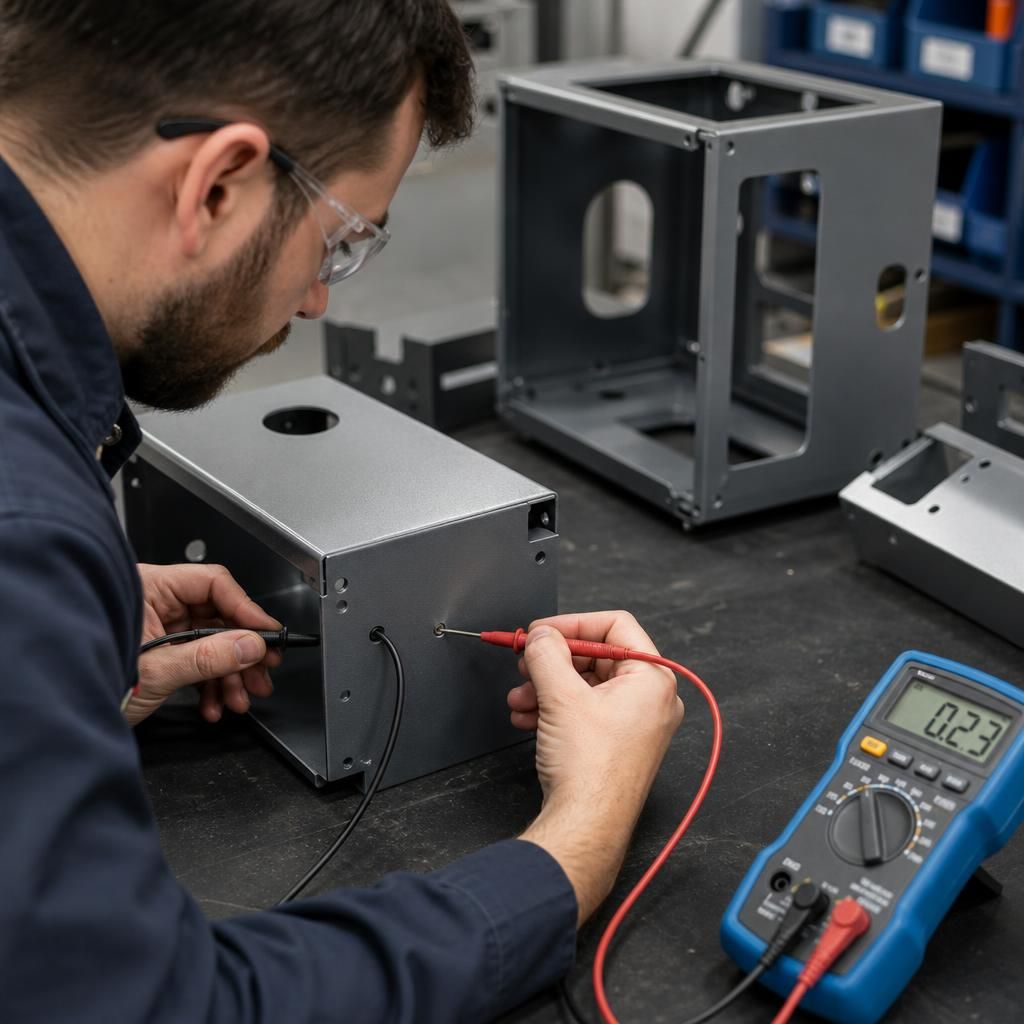
Electrical performance is a separate suitability criterion from corrosion protection and appearance. Most powder coatings form an insulating layer, so the specification should establish whether the finished component must provide electrical insulation, maintain an earth path or control static discharge. This affects the choice of coating, the areas that may be coated and the treatment of bonding points, contact faces and fastener locations.
Where electrical continuity is required, masking and post-coating inspection should be defined before production. Where insulation is required, the coating’s dielectric properties, film build and resistance to the operating environment should be supported by relevant technical information or application-specific testing. A visually satisfactory finish is not sufficient if the coating changes the component’s electrical function.
Discuss Your Powder Coating Material Requirements
Discuss your component’s operating conditions, substrate and performance requirements with the powder-coating.co.uk team before selecting a material. Sharing drawings, specifications or representative parts can help establish a suitable coating approach for your application.