

How does the initial cleaning process impact the effectiveness of subsequent surface treatments for powder coating on steel?
Initial cleaning removes oil, grease, dirt, rust residues and other contaminants that could prevent later treatments from contacting the steel evenly. A properly cleaned surface allows chemical pretreatment, profiling and powder coating to work effectively, supporting stronger adhesion and more reliable corrosion protection.
Initial cleaning determines whether subsequent surface treatments can act on the steel itself rather than on a layer of processing residue. Its effectiveness therefore affects the consistency of pretreatment, the quality of the surface profile, powder film formation and the coating’s resistance to defects during service.
The cleaning stage is more than a visual wash. Steel may carry several different contaminants, including cutting fluids, forming lubricants, handling marks, dust, welding residue, mill scale, storage oils and soluble salts. These materials behave differently during preparation, so one cleaning method may not remove every contaminant. A suitable process is selected according to the steel’s condition, how it has been manufactured and the treatments that will follow.
Why the sequence matters: Cleaning must produce a chemically stable surface for the next operation. If an oily film remains, a chemical pretreatment may react unevenly or fail to reach parts of the substrate. If abrasive dust or loose corrosion products remain, they can become trapped beneath the powder film. Cleaning may also expose defects or residues that were hidden by dirt, allowing the preparation process to address them before coating.
- Degreasing: removes oils, grease and similar organic residues that can interfere with wetting and treatment uniformity.
- Rinsing: removes loosened contamination and cleaning chemicals. Poor rinsing can leave alkaline or detergent residues on the steel.
- Drying: prevents retained water from diluting or disrupting later chemical stages and reduces the risk of flash rusting on susceptible steel.
- Inspection: confirms that the surface is visibly clean and suitable for the next preparation stage rather than assuming that cleaning has been effective.
Residue control is particularly important. A surface can look clean while still carrying a thin film of detergent, dissolved salts or handling contamination. Such residues may alter the behaviour of a conversion treatment, interfere with adhesion at localised areas or contribute to blistering and corrosion beneath the coating. Clean water management, effective drainage and appropriate drying are therefore part of the cleaning process, not separate cosmetic details.
The condition of the steel also influences the result. New steel with mill scale, previously stored components with corrosion, and fabricated parts carrying welding or machining residues require different preparation decisions. Weld spatter, sharp edges and embedded debris are physical issues that cleaning alone will not correct. They may need mechanical preparation or fabrication rectification before chemical treatment and powder application can be considered reliable.
Cleaning also affects the consistency of later surface profiling. Abrasive preparation on a contaminated surface can spread oil across the steel, clog abrasive media or produce an irregular profile. Conversely, cleaning first gives mechanical preparation a more predictable substrate. The aim is not simply to make the steel appear brighter; it is to establish a surface condition that can be treated uniformly across the whole component, including edges, recesses, joints and areas around welds.
Process control should include checks appropriate to the component and its intended coating system. Operators may assess visual cleanliness, water behaviour, remaining residue, dryness and the condition of difficult-to-reach areas. Where contamination is suspected, additional cleaning or testing is preferable to allowing the part to proceed on appearance alone. Components should also be handled in a way that avoids recontamination after cleaning, using clean contact points and minimising unnecessary bare-hand contact.
If initial cleaning is inadequate, later stages may mask rather than correct the problem. A conversion treatment can be applied over contamination, a blasted profile can become fouled, and powder can cure over a weak boundary layer. The resulting defect may not be obvious immediately; it can appear as local loss of adhesion, edge lifting, blistering, underfilm corrosion or an inconsistent finish after the component enters service.
For this reason, cleaning should be treated as the foundation of the preparation sequence. The correct approach is to identify the contaminants, select a compatible cleaning method, remove and rinse residues thoroughly, dry the steel, inspect the result and only then proceed to pretreatment, profiling and powder coating. This sequence gives each later treatment the intended substrate and reduces the risk that an avoidable cleaning fault will determine the performance of the finished coating.
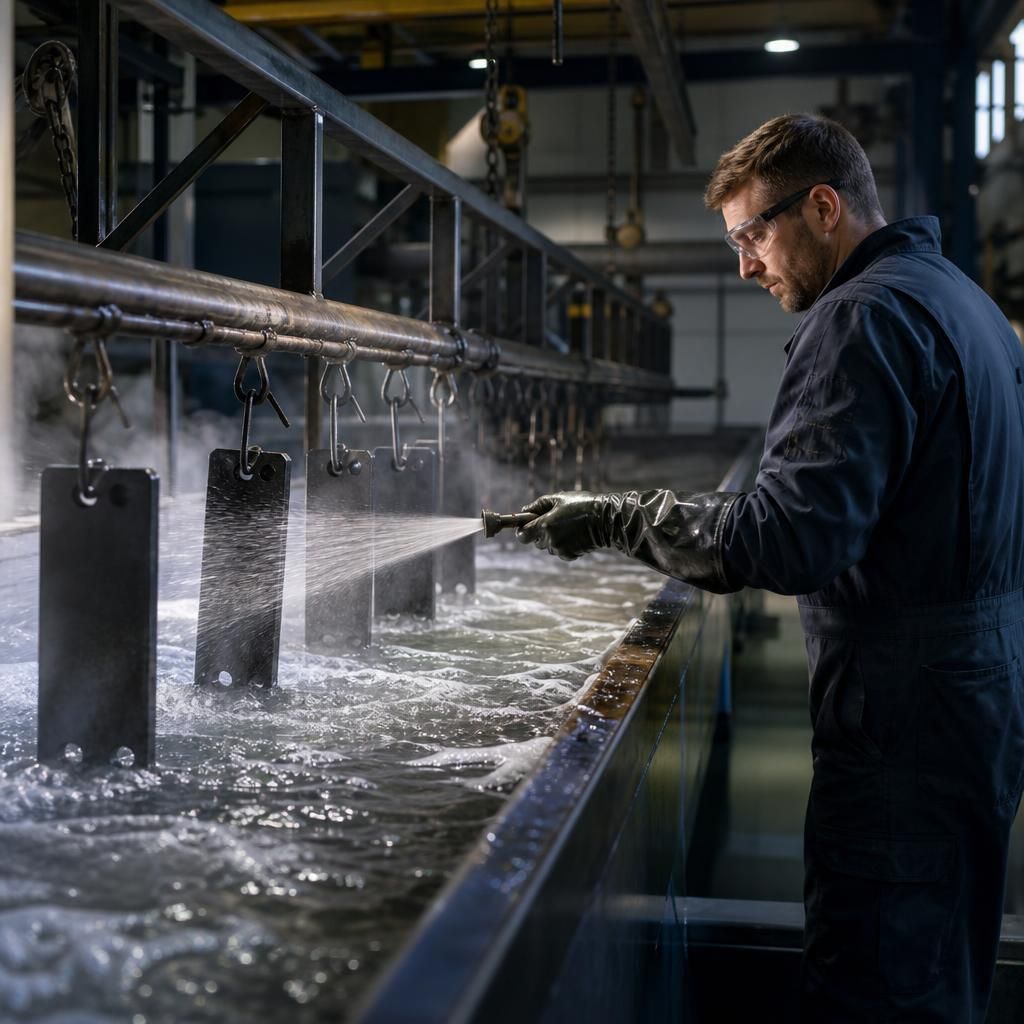
Initial cleaning is most effective when its process conditions are matched to the contamination on the steel. Cleaner concentration, temperature, contact time and agitation all influence whether oils and processing residues are properly displaced. If these conditions vary between batches, the steel may present an inconsistent surface to the next treatment even when the parts appear similar.
For this reason, cleaning should be validated on representative components rather than judged by appearance alone. Parts with different geometries or manufacturing histories may require different exposure or handling to achieve the same result. A controlled, repeatable cleaning stage gives chemical pretreatment and subsequent coating operations a more consistent starting condition, reducing variation across a batch.
Discuss initial cleaning for your steel powder coating project
Discuss your steel components with the powder-coating.co.uk team to identify the cleaning and preparation requirements before coating. Providing details of the steel condition, manufacturing residues and intended application will help establish a suitable preparation route.