

How does the condition of a metal surface influence the choice of pre-treatment methods for electrostatic coating?
The condition of a metal surface determines whether pre-treatment should focus on degreasing, abrasive cleaning, chemical descaling, or a combination of methods. Clean, lightly oxidised metal may need routine cleaning and conversion coating, while heavily contaminated, corroded or previously coated surfaces require more intensive preparation before electrostatic powder application.
The condition of the metal determines the intensity, sequence and chemistry of the pre-treatment needed before electrostatic powder coating. The assessment should identify the substrate, the type and extent of contamination, the presence of corrosion or mill scale, and whether an existing coating must be retained or removed. Pre-treatment is therefore specified for the actual component rather than selected as a single method for every job.
Clean, recently manufactured steel
New steel may appear clean while still carrying drawing compounds, light oil, fingerprints, storage residues or mill scale. These contaminants can interfere with wetting and prevent the powder film from bonding consistently. A suitable alkaline or solvent-based cleaning stage is normally assessed first, followed by rinsing and, where appropriate, a conversion treatment. Light oxidation may require additional preparation, but sound metal does not necessarily need aggressive blasting if its surface is otherwise suitable.
Oily or heavily contaminated surfaces
Oil, grease, wax, cutting fluid and adhesive residues must be removed before any later treatment. If these substances remain, abrasive preparation can spread them across the surface instead of exposing clean metal. The choice of cleaner depends on the type of residue, the metal underneath and the component’s geometry. Parts with recesses, joints or enclosed sections need particular attention because retained cleaner or contamination can later cause cratering, pinholing or poor adhesion.
Rust, mill scale and oxide layers
Loose rust and flaking oxide are unsuitable foundations for a powder film because the coating may bond to unstable material rather than to the substrate. Firm mill scale can also prevent consistent contact between the coating and the steel. Mechanical or abrasive preparation is considered where the surface layer is substantial, while chemical treatment may be appropriate for lighter oxidation or for components whose shape makes blasting difficult. The required level of preparation depends on whether the aim is to expose sound metal, reduce the oxide layer or preserve an existing surface profile.
Deep corrosion presents a separate issue. Pitting can retain moisture, salts and cleaning residues even after the raised rust has been removed. In such cases, preparation may need to include repeated cleaning, more thorough abrasive work and close inspection of the recesses. If corrosion has reduced the section or created sharp irregularities, coating alone will not restore the lost metal or correct the underlying defect.
Welded, fabricated and heat-affected areas
Welds and fabrication zones often contain spatter, heat tint, scale, sharp edges, grinding dust and residues from fabrication products. These areas should be evaluated separately from the main sheet or section. Weld spatter and loosely attached material need removal, while sharp edges may require suitable finishing because powder tends to pull away from very thin edges during application and curing. Weld-cleaning requirements can also differ according to the metal type and the appearance expected from the finished component.
Where fabrication has introduced grinding marks or localised roughness, preparation should produce a consistent surface rather than simply remove visible dirt. Excessively coarse or uneven areas can remain visible through the powder film, while fine dust left in grooves can reduce adhesion. The surface should therefore be inspected after preparation, not judged only by its appearance before cleaning.
Previously coated or repaired metal
Old paint, powder coating, primer and touch-up repairs change the preparation decision. The existing layer must be tested for adhesion, compatibility, thickness and contamination before deciding whether it can remain. A sound, compatible coating may sometimes be prepared for overcoating, but a peeling, brittle or chemically incompatible layer is an unstable base and generally requires removal. Any exposed areas then need treatment appropriate to the underlying steel, aluminium or other substrate.
Previous use can also leave residues that are not obvious visually. Components from industrial, construction or automotive applications may have accumulated road salts, hydraulic fluids, carbon deposits or handling contamination. A surface that looks intact may still require a more rigorous cleaning and inspection regime than unused material.
Galvanised steel, aluminium and other substrates
Substrate condition cannot be separated from substrate type. Galvanised steel has a zinc surface that may include passivation residues, white corrosion products or storage staining. Preparation must remove unsuitable residues without unnecessarily damaging the zinc layer. Aluminium forms a tenacious oxide film and can be vulnerable to aggressive alkaline products or excessive abrasion, so the treatment needs to balance oxide removal with control of the underlying surface.
Different metals also respond differently to conversion coatings and cleaning chemicals. A process suitable for carbon steel should not automatically be transferred to zinc-coated steel or aluminium. The chosen treatment should account for the alloy, the condition of the surface, the intended service environment and the powder system being applied.
Moisture, salts and residues after preparation
Water-soluble salts are especially important on components exposed to outdoor storage, handling or previous service. They may remain in pits, seams and joints and contribute to underfilm corrosion. Rinsing quality, water condition and drainage therefore form part of the pre-treatment assessment. After the final rinse, the component must be dried thoroughly; trapped moisture can cause blistering, pinholing or adhesion loss when the powder is heated.
Cleanliness should be checked at several stages rather than only at the end. Inspection can include visual examination, checks for water-break behaviour, assessment of remaining oxide or old coating, and confirmation that the part is dry and free from visible residue. The exact inspection method depends on the required finish and the consequences of coating failure.
How condition affects the final electrostatic application
Electrostatic powder application relies on the charged powder reaching and remaining on a suitably prepared, electrically connected part. Surface contamination can disrupt the electrical path, encourage uneven deposition and contribute to defects during curing. A weak or unstable surface layer may allow the powder to appear satisfactory initially but fail during impact, handling, moisture exposure or service.
For this reason, pre-treatment selection should consider more than visual cleanliness. It should establish whether the surface is chemically clean, mechanically stable, sufficiently dry, compatible with the conversion stage and properly connected to earth during coating. Difficult areas such as cavities, overlaps and contact points may need separate preparation or masking decisions.
In practice, the assessment follows a logical sequence:
- Identify the base metal and any existing coating or plating.
- Determine whether contamination is oily, particulate, saline, oxidised or chemically persistent.
- Assess corrosion, mill scale, weld residues, pits, sharp edges and previous repairs.
- Select cleaning, mechanical preparation and chemical treatment in an order that does not spread or redeposit contamination.
- Confirm that rinsing, drying and inspection have produced a stable, residue-free surface.
- Check that the prepared component is suitable for consistent electrostatic deposition and subsequent curing.
Where batches contain mixed conditions, the parts may need sorting and different preparation routes rather than one compromise process. Establishing the surface condition before treatment helps avoid over-processing sound metal while ensuring that corrosion, residues or unstable coatings are not concealed beneath the powder.
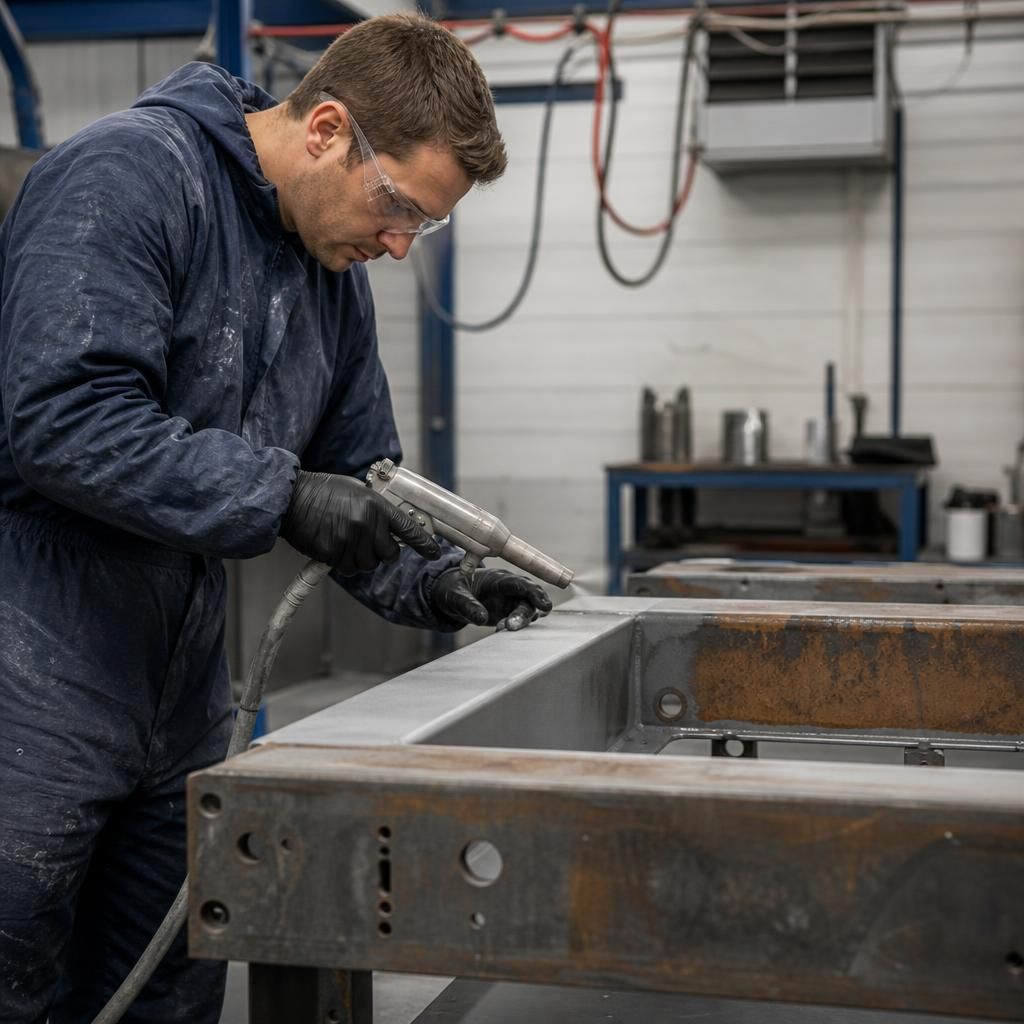
Pre-treatment should be matched to the severity of the defect without unnecessarily attacking sound metal. Excessive abrasion can alter dimensions, expose vulnerable areas or damage a protective zinc layer, while overly strong chemical treatment may etch reactive substrates such as aluminium. The correct method is therefore the least aggressive process that produces a chemically clean, stable surface suitable for the specified powder system.
This balance is particularly important where a component combines different conditions, such as intact metal beside repaired areas or heat-affected zones. A single treatment may clean one area effectively but leave another under-prepared or over-processed. Separating components by substrate and condition, then verifying the result before coating, helps ensure that pre-treatment supports consistent adhesion across the complete part.
Discuss your metal surface pre-treatment requirements
Discuss your metal surface pre-treatment requirements with our team, including the substrate, existing finish, contamination and intended service conditions. This information helps identify a suitable preparation route before electrostatic coating.