

What are the most effective methods for cleaning and degreasing metal surfaces prior to powder coating?
The most effective approach is to identify the contaminants, then use a suitable solvent or alkaline aqueous cleaner to remove oils, grease, dirt and processing residues without damaging the metal. After cleaning, rinse thoroughly where required and dry the surface completely; any remaining residue or moisture can interfere with powder adhesion and finish quality.
The most effective cleaning and degreasing method depends on the metal, the type of contamination, the component’s shape and the finish required. In industrial powder coating, alkaline aqueous cleaning is commonly the most versatile option for removing oils and fabrication residues, while solvent cleaning, abrasive preparation, ultrasonic cleaning or thermal treatment may be appropriate for particular substrates and component designs.
Alkaline aqueous cleaning
Alkaline cleaners use water-based chemistry to break down cutting fluids, drawing compounds, grease and handling deposits. They can be applied by immersion, spray washing or a multi-stage pretreatment line. Spray systems are suited to repeatable production batches, whereas immersion can be more effective for hollow, recessed or irregularly shaped parts when the solution can reach all surfaces.
The cleaner must be selected for the substrate. A formulation that is suitable for mild steel may attack aluminium, zinc-coated steel or other sensitive metals if its concentration, temperature or contact time is unsuitable. Operators should follow the chemical supplier’s technical instructions and control the bath condition, as an exhausted or contaminated solution may redistribute soil instead of removing it.
Solvent degreasing
Solvent cleaning is useful for localised contamination, small batches and components with a light film of oil or grease. Wiping, immersion or vapour-based processes can dissolve organic residues without introducing a water stage. However, a cloth can spread contamination across a surface rather than remove it, particularly if the same section of cloth is reused. Clean, lint-free materials and controlled solvent application are therefore important.
The solvent must evaporate without leaving an oily or silicone-like film. Appropriate ventilation, fire controls, personal protective equipment and waste handling are essential, and solvent choice should comply with current workplace and environmental requirements. Solvent cleaning is not normally a substitute for removing mill scale, weld oxidation or substantial corrosion.
Mechanical preparation
Abrasive blasting is effective where the surface contains rust, mill scale, weld discolouration or firmly attached coatings that chemical cleaning alone cannot remove. It also creates a controlled surface profile that can assist coating adhesion. The abrasive, air pressure, nozzle distance and blast angle need to be matched to the metal; excessive blasting can distort thin sections, round sharp edges or damage softer substrates.
Blasting should follow, rather than replace, degreasing when heavy oil or grease is present. Otherwise, the abrasive may drive contamination into the surface or create an uneven result. After blasting, parts should be protected from handling contamination and assessed for dust, embedded abrasive and flash rust before coating.
Ultrasonic cleaning
Ultrasonic systems are particularly useful for small or intricate components with blind holes, narrow channels, threads and recesses that are difficult to clean by wiping or spraying. High-frequency sound waves create microscopic bubbles in the cleaning liquid; their collapse produces localised agitation that helps dislodge contamination from complex geometry.
Ultrasonic cleaning is usually used with a compatible aqueous or solvent chemistry. It is less suitable for very large fabrications unless specialist equipment is available, and it does not remove every form of corrosion or surface scale. Fixtures should allow the cleaning solution to circulate freely around the component.
Steam and pressure cleaning
Steam or heated pressure washing can remove loose dirt, grease and workshop residues from larger fabrications. These methods are useful as an initial cleaning stage, but pressure alone may not eliminate tightly bonded contamination from pores, welds or textured surfaces. Any detergent used must be compatible with the metal and must not leave a film that interferes with subsequent treatment.
Thermal treatment
Controlled heat treatment, including burn-off, can remove heavy organic coatings, paint residues and some baked-on oils from suitable steel components. It is not a universal degreasing method. Heat can oxidise steel, distort thin parts, alter the properties of heat-sensitive alloys or damage zinc-coated and aluminium components. It must therefore be carried out only where the substrate, construction and downstream pretreatment have been assessed.
How to choose the process
- Identify the substrate, including whether it is bare steel, aluminium, galvanised steel or another alloy.
- Assess the contamination’s composition and severity rather than selecting a cleaner based solely on appearance.
- Consider part geometry, internal cavities, threaded features and areas that may trap cleaning solution.
- Use a process that can be controlled consistently across the full batch, not just on an easily accessible face.
- Check whether the selected chemistry is compatible with later conversion treatment and the powder coating specification.
- Trial the process on representative parts where contamination, weld condition or substrate sensitivity is uncertain.
Checking whether cleaning has worked
Visual inspection should look for smears, discolouration, water marks, particles, rust and residues around welds or edges. A water-break assessment can help identify persistent hydrophobic contamination: if liquid pulls away into separate beads rather than forming an even film, further cleaning may be required. A clean white cloth test can also reveal oil or dirt, although it should be used as a supplementary check rather than the only acceptance test.
Cleaned parts should be handled with suitable gloves or other controls so that skin oils are not reintroduced. The final decision should consider both cleanliness and the condition of the metal itself; a visually bright surface is not necessarily chemically clean, and a degreased surface may still require descaling, abrasion or conversion treatment before powder is applied.
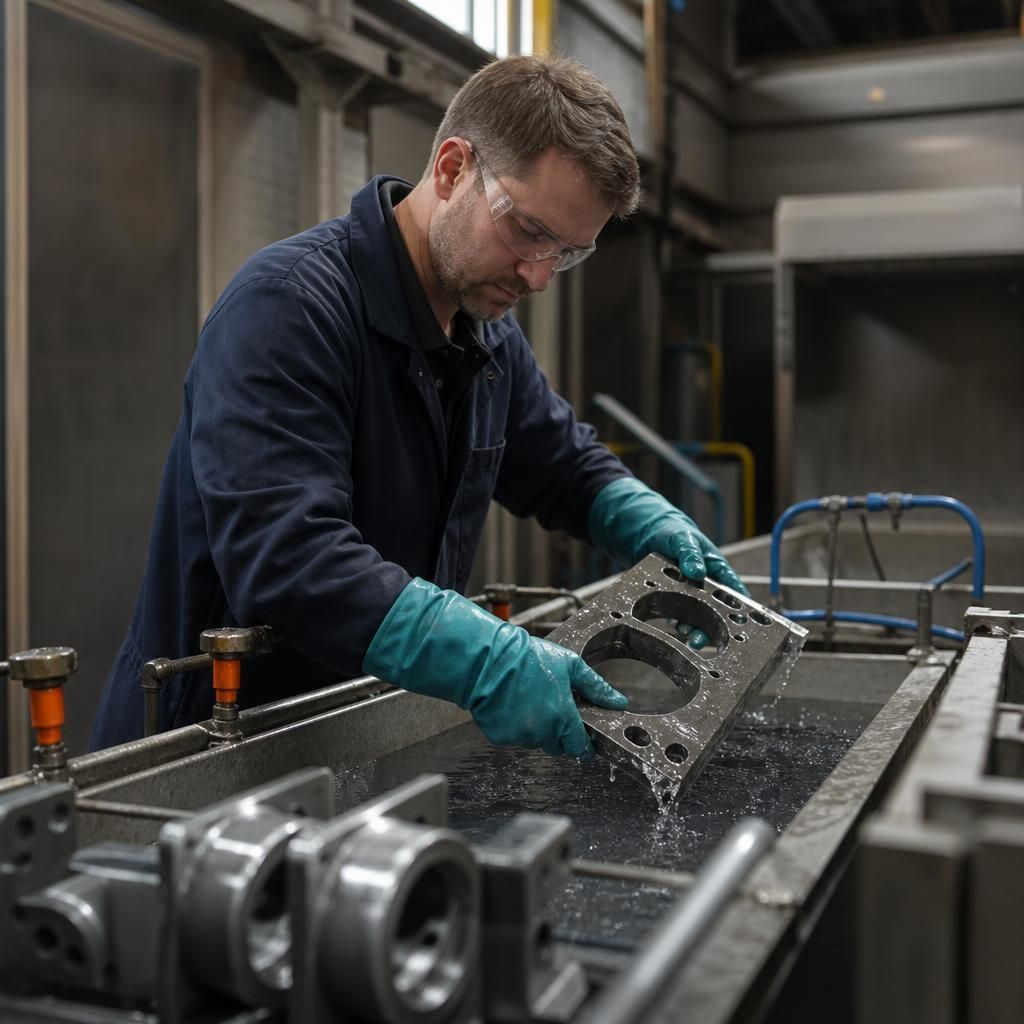
For repeat production, cleaning performance depends on controlling the process rather than simply choosing a powerful degreaser. Concentration, temperature, contact time and spray or immersion coverage should remain within the chemical supplier’s stated operating range. These conditions should be checked as part of batch preparation, particularly when the cleaning solution is handling heavily contaminated components.
- Use representative parts or test pieces to confirm that the chosen process removes the actual oils and fabrication residues present.
- Inspect areas that are difficult to reach, such as welds, recesses and internal faces, rather than relying only on an accessible outer surface.
- Record relevant process checks so that a successful cleaning cycle can be repeated consistently across future batches.
- Investigate changes in finish quality promptly, as they may indicate altered bath condition, inadequate coverage or a change in the incoming contamination.
This approach helps distinguish a problem with degreasing from later issues caused by rinsing, drying, surface preparation or powder application.
Discuss the right cleaning method for your metal components
Discuss your metal components, substrate and contamination with the powder-coating.co.uk team to identify a suitable cleaning and degreasing process before coating. This helps establish the appropriate preparation route for your parts and batch requirements.