

What unique challenges do stainless steel components pose when applying black polyester coating, and how are these challenges effectively addressed in the coating process?
Stainless steel’s smooth, chemically resistant surface can make polyester powder adhesion more difficult, while weld residues, grease, surface contamination and complex component geometry can affect coverage and appearance. The process addresses these risks through thorough cleaning, appropriate surface preparation, careful masking and controlled powder application and curing to produce a consistent black finish.
Stainless steel requires a coating process designed around its alloy, surface condition and thermal behaviour. Black polyester powder can provide a durable, uniform finish, but reliable results depend on selecting a stainless-suitable pretreatment, controlling electrical contact and powder deposition, and validating the curing cycle against the component rather than relying solely on oven settings.
The passive surface is a specific technical consideration. Stainless steel naturally forms a thin chromium-rich oxide layer that protects the metal from corrosion. That layer is beneficial in service, but it means the pretreatment must be compatible with stainless steel and the intended polyester system. A process designed only for mild steel may leave an unsuitable surface or create inconsistent results. The coating specification should therefore identify the stainless grade, existing finish and service conditions before the preparation route is selected.
Different stainless grades and manufacturing histories can behave differently during coating. Sheet, tube, castings and machined parts may have different levels of surface roughness, embedded process residue or heat-affected areas. Welded assemblies can also contain changes in texture and geometry that become more visible beneath a dark, uniform colour. These differences are assessed before production so that the preparation and application method suit the whole component rather than just its largest flat areas.
Black makes small visual variations easier to detect. A dark finish can highlight uneven gloss, orange peel, thin coverage, exposed edges, handling marks and differences between batches. Recesses, internal corners and narrow sections may receive a different powder distribution from broad faces, particularly where the electrostatic field is interrupted. The applicator must therefore consider the hanging arrangement, gun angle, part rotation and access to concealed surfaces. Properly positioned rack contacts are also important because a stable electrical path supports consistent powder transfer and prevents contact points from becoming unpredictable coating defects.
Component design can create further difficulties. Deep cavities, folded sections and close parallel surfaces can produce a Faraday-cage effect, in which powder is attracted preferentially to exposed edges instead of entering the recess. Excessive powder in one area may then contribute to an uneven finish or interfere with dimensional clearances. Application settings are adjusted to suit the geometry, with particular care around apertures, mating faces, threads and areas that must remain free from coating.
Stainless steel also demands careful thermal control. The relevant curing condition is the temperature reached by the metal and the time it remains at that temperature, not simply the temperature displayed by the oven. Part thickness, mass, shape and loading pattern affect heat-up rates. If the component does not reach the polyester manufacturer’s specified cure schedule, the film may not develop its intended mechanical and chemical properties. If it is held at excessive temperature for too long, the finish may suffer from colour or gloss variation and the result may differ from the approved sample.
For this reason, the curing cycle is established with the actual component or a representative load in mind. Temperature checks can confirm that thin and heavy sections are receiving an equivalent cure. This is particularly relevant where one assembly contains brackets, tubes and thick welded areas with markedly different thermal masses. The coating system’s technical data sheet remains the reference for the required metal temperature and dwell time.
Quality control should cover more than appearance. A suitable inspection plan may include:
- checking the stainless grade, incoming finish and areas that must remain uncoated;
- confirming that masking, rack contacts and dimensional interfaces are correctly positioned;
- examining colour, gloss, texture, edge coverage and recessed areas under consistent lighting;
- checking film thickness against the agreed specification without compromising critical fits;
- verifying the cure using a representative component or load profile; and
- recording any approved sample or reference standard used for batch-to-batch comparison.
Where the component is destined for an aggressive industrial environment, coating selection should consider exposure to moisture, chemicals, abrasion, heat and ultraviolet light rather than colour alone. The polyester grade, gloss level and required pretreatment should be agreed with the coating supplier and, where necessary, assessed on a representative sample. This helps separate problems caused by the substrate or design from those caused by application settings.
In practice, the most effective approach is a documented process specific to stainless steel: identify the material and service conditions, use a compatible preparation system, plan masking and electrical contact around the component geometry, apply the powder consistently, and confirm the metal’s curing profile. These controls address the issues that make black polyester coating more demanding on stainless steel and help produce a finish that is both visually consistent and fit for its intended industrial use.
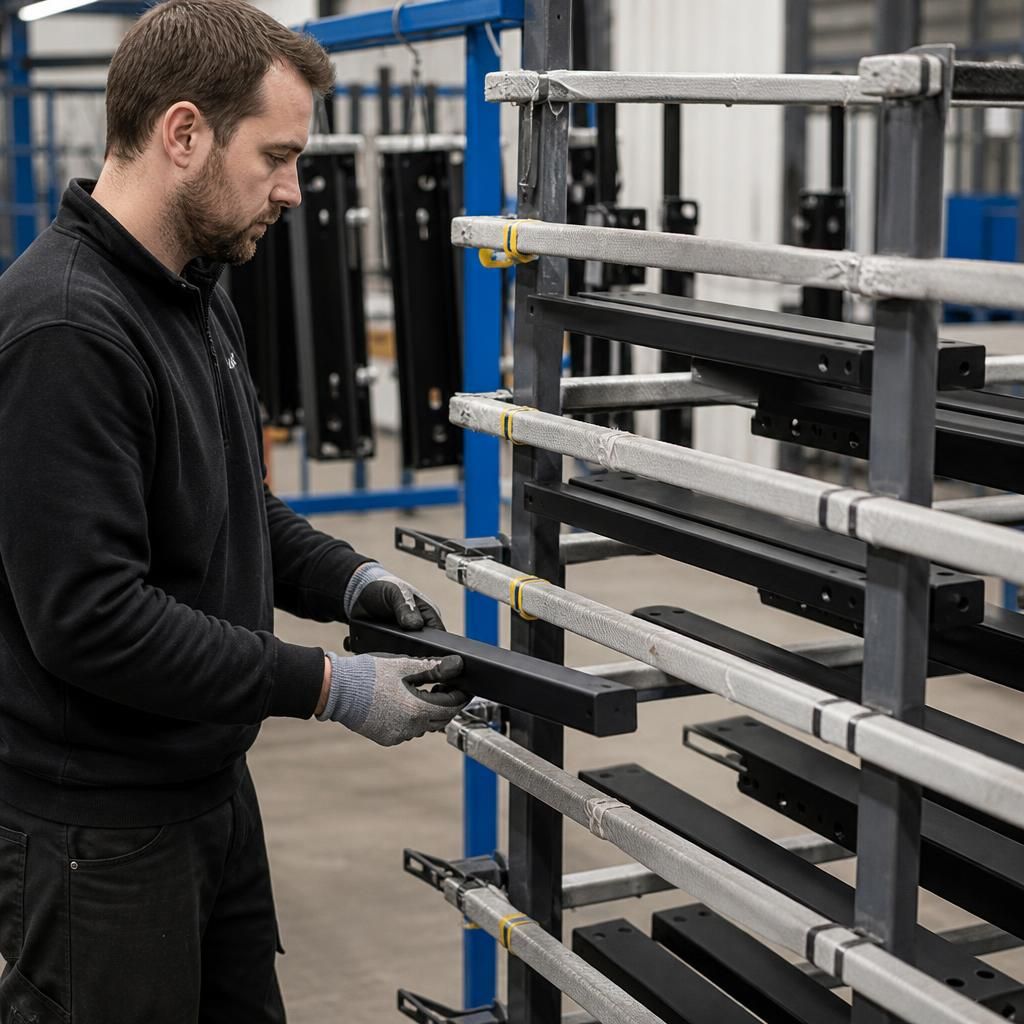
Handling after curing is an important control when applying black polyester to stainless steel. The coating may have reached its required cure, but dragging components across racks, using contaminated supports or stacking parts before they have cooled can mark the dark surface. These defects may appear as scuffs, pressure marks or local changes in sheen rather than as obvious coating failure.
Components should therefore be removed from the line using clean, suitable contact materials and placed so coated faces do not rub against one another. Packaging and separators should also be free from dust, oil and metallic debris. This protects the finished surface during transfer and helps ensure that the appearance inspected at the coating stage is retained when the stainless steel components reach assembly.
Discuss Your Stainless Steel Black Coating Requirements
Discuss your stainless steel components with our coating team, including the material grade, geometry, service environment and required black finish. We can help identify the preparation, application and curing considerations needed for a suitable coating specification.