

How do textured black powder coating services streamline production processes for businesses in the Midlands?
Textured black powder coating services can streamline production by providing consistent batch finishing for metal components, including large-scale and specialist coating requirements. Collection and delivery options also help businesses coordinate coated parts with their wider manufacturing, fabrication or installation schedules.
Textured black powder coating services streamline production by giving metal components a defined finishing stage that can be planned alongside fabrication, assembly and installation. Instead of treating finishing as an unstructured final task, businesses can incorporate coating requirements into their production schedule, part specifications, batch planning and quality checks.
Production planning starts with the component specification. The coating provider needs information such as the metal type, component dimensions, intended use, required texture, areas that must remain uncoated and any performance requirements. Confirming these details before parts are processed helps prevent avoidable interruptions, particularly where components include fixing points, threaded sections, hinges, contact surfaces or areas that need to fit with other parts.
A defined coating workflow also reduces unnecessary movement between different production stages. Parts can be grouped according to their material, dimensions, finish requirement or end use, allowing preparation, coating and curing to be organised in a logical sequence. This is particularly relevant to manufacturers and fabricators handling multiple components for one assembly, because parts can be processed as a planned production group rather than as isolated items.
Part design and racking affect throughput. Components need to be positioned so that the powder can reach the required surfaces and so that the part can be safely supported during application and curing. Suitable racking points should be considered during production planning, since contact marks or inaccessible areas may otherwise require additional finishing work. Designing or identifying these points early helps maintain the intended appearance while reducing handling and rework.
The textured finish itself can support a more controlled finishing specification. Rather than relying on an appearance judged only after liquid paint has dried, the business can define the required colour, texture, coverage and acceptance criteria in advance. This gives production and inspection teams a clearer basis for assessing completed components and helps ensure that coated parts meet the requirements of the wider product or project.
Powder coating can also simplify the transition between coating and later assembly. Once the finish has been properly cured and the component has passed inspection, it can be handled as a finished part rather than requiring further drying or paint-related preparation. Planning should still allow for cooling, protection of the surface and checks on masked or uncoated areas before the part moves to assembly, packaging or installation.
Quality control is most effective when it is built into the process rather than left until the end. Useful checks may include:
- confirming that the correct components and coating specification have been allocated to the batch;
- checking preparation, masking and racking before coating;
- examining coverage, texture and visible defects after curing;
- checking critical dimensions, threads, apertures and contact points;
- separating any parts that need review before they proceed to assembly or dispatch.
These checks help identify issues at the coating stage, when they are easier to address, rather than after coated components have been incorporated into a larger product. For businesses supplying fabricated parts to construction, automotive or manufacturing projects, this can make inspection and handover more structured.
Batch processing is also useful where a product contains several related metal parts. Coating associated brackets, panels, frames, covers or fittings within the same planned workflow can make it easier to track which components belong together. Clear labelling, job records and agreed acceptance criteria support traceability without requiring the wider production team to create a separate finishing system for every component.
To obtain the greatest production benefit, businesses should provide complete drawings or part information, identify surfaces that must not be coated, confirm the required textured black finish and explain how the parts will be used. They should also consider whether components can be safely handled after coating and whether packaging needs to protect edges, corners or visible faces. Good preparation at this stage enables the coating process to fit more predictably into the overall manufacturing sequence.
In practice, textured black powder coating streamlines production through coordinated specification, planned batch handling, suitable racking, defined inspection points and controlled movement into assembly or installation. The service is therefore most effective when treated as an integrated production operation rather than a cosmetic treatment added after all other decisions have been made.
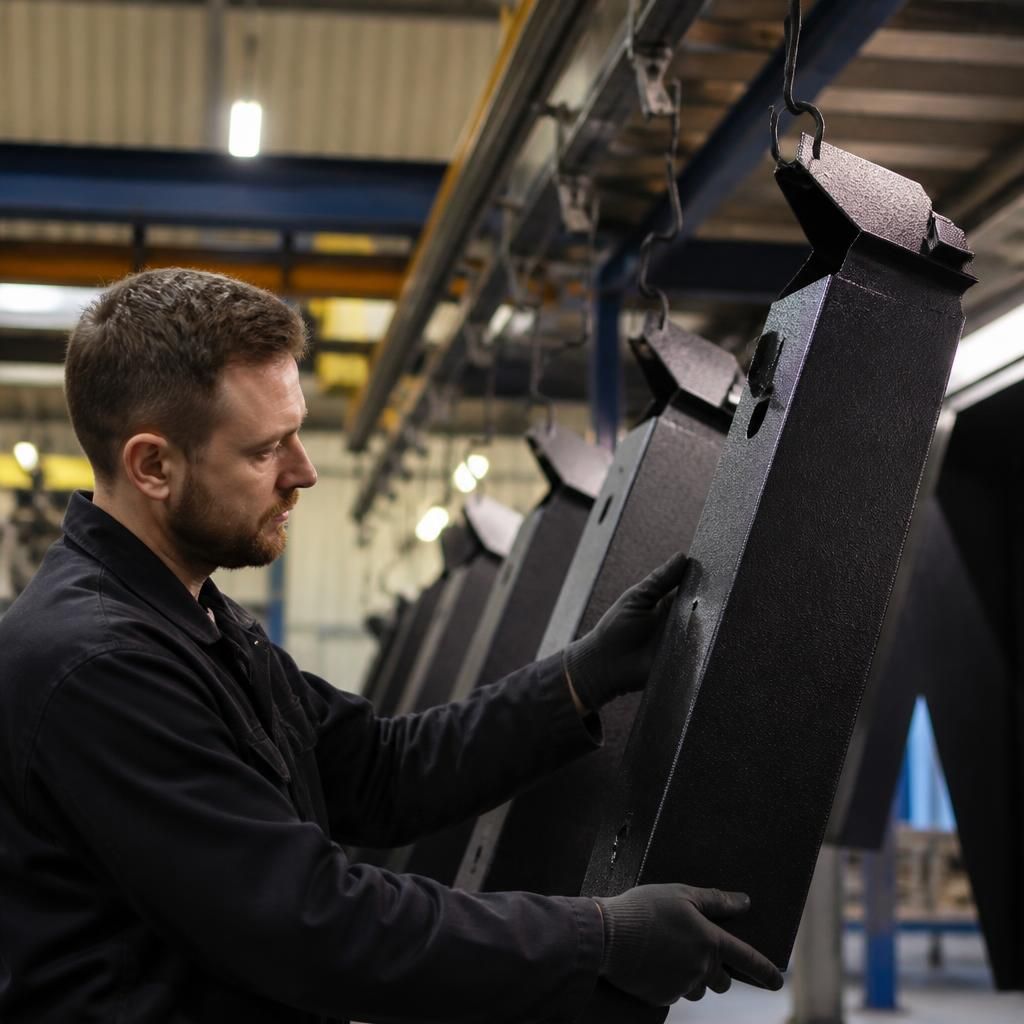
A key production benefit of using a specialist textured black powder coating service is that it allows a business to keep coating separate from its main fabrication or assembly operation. The internal team does not need to reorganise production around the equipment, preparation work and curing requirements associated with finishing metal parts.
This separation can help manufacturers and fabricators allocate workshop capacity more effectively. Fabrication staff can concentrate on cutting, forming and welding, while the coating provider handles the specialist finishing stage. It is particularly useful when a business requires a textured black finish but does not regularly process enough coated components to justify creating a dedicated in-house coating workflow. The finished parts can then return to the production sequence as a defined external operation, with the coating specification agreed in advance.