

How does a shiny black powder coat finish compare in terms of environmental impact and sustainability to other coating methods?
A shiny black powder coat finish generally has a lower environmental impact than solvent-based paint because it uses little or no liquid solvent, produces fewer volatile organic compound emissions and may allow unused powder to be recovered. Its sustainability still depends on the energy used for curing, pretreatment and application, as well as the coating’s service life; a durable finish can reduce the need for repeated recoating compared with less resilient alternatives.
A shiny black powder coat finish can be a more sustainable choice than many liquid coating systems, but the result depends on the complete coating lifecycle rather than the colour or gloss level alone. The relevant factors include raw materials, surface preparation, application efficiency, curing requirements, expected service life, repairability and end-of-life treatment.
Compared with liquid paint, powder coating avoids the need to transport and store a liquid carrier and can generate less coating waste when application equipment is correctly set up. Liquid paint may also require solvents for thinning, cleaning or equipment maintenance, creating additional handling and waste considerations. However, powder coating is not impact-free: its resin, pigments, additives and packaging still require materials and energy to manufacture.
One important distinction is how overspray is managed. Powder that does not adhere to the component may be collected in suitable systems and, depending on the equipment and colour-change requirements, reused or recycled. Recovery is less straightforward where powder has become contaminated, mixed with another formulation or collected with other waste. A coating specification that reduces unnecessary colour changes and uses an appropriate application method can therefore support better material efficiency.
Surface preparation can materially affect the comparison. Degreasing, abrasive preparation and chemical pretreatment may involve water, detergents, acids, phosphates or other treatment chemicals. These substances require controlled handling, and any rinse water or spent preparation media must be managed correctly. A powder finish should not be judged in isolation from the preparation system used to make it adhere to the metal and resist corrosion.
Curing is another part of the assessment. The coated component must reach the required temperature for the powder to form a continuous film, so oven operation contributes to the process footprint. Efficient loading, suitable batch planning and a cure schedule matched to the component can avoid treating empty oven space or applying more heat than the coating requires. Components that need a lower-temperature or alternative curing system may have different energy implications, although the correct technical specification must come first.
Durability is central to sustainability. A finish that remains intact in its intended environment can extend the useful life of the metal component and reduce the need for stripping, preparation and recoating. This benefit is conditional: the powder type, film build, pretreatment, edge coverage and curing quality must suit the exposure to moisture, chemicals, abrasion, ultraviolet light and temperature. A coating that is unsuitable for its operating conditions may require early remedial work, reducing its lifecycle advantage.
Other coating methods have different environmental trade-offs:
- Liquid paint: may be useful where on-site application, very large structures or particular repair requirements make it practical, but solvent management and paint waste can add to its environmental burden.
- Hot-dip galvanising: provides a zinc-based corrosion protection system and can offer a long service life, but it uses a different set of raw materials, processing energy and bath-management requirements. Its appearance and dimensional effects may also make it unsuitable where a smooth shiny black decorative finish is required.
- Anodising: is primarily used for aluminium and creates an integral oxide layer rather than a separate powder film. Its suitability depends on the alloy, appearance required and exposure conditions, with chemical treatment and rinsing forming part of the process assessment.
- Electroplated or specialist protective finishes: can provide particular wear, conductivity or corrosion properties, but may involve several process stages and controlled chemical waste streams. They should be compared against the actual performance requirement rather than against appearance alone.
End-of-life considerations also differ. A thermoset powder coating cross-links during curing and cannot simply be melted and recoated as the original powder. This does not automatically make it less sustainable, because the metal part may remain in service for a long period, but it is relevant when assessing separation, refurbishment and recycling. Thermoplastic powder systems behave differently because they can soften again under heat, although the practical recycling route still depends on the coated product and the materials attached to it.
For a meaningful comparison, request information about the complete specification rather than selecting a finish solely on the basis of colour. Useful questions include:
- Is the coating suitable for the component’s moisture, chemical, abrasion and temperature exposure?
- What pretreatment and rinse stages are required?
- How will overspray, contaminated powder and preparation waste be controlled?
- What curing conditions are needed for the selected formulation and component size?
- Can damaged areas be repaired without stripping an otherwise serviceable component?
- What happens to the metal and coating when the component reaches the end of its working life?
For B2B projects, the most defensible choice is usually the coating that meets the required performance with the least unnecessary processing and the longest practical service life. A shiny black powder coat finish can perform well against that test, but its sustainability should be established from the full preparation, application, use and end-of-life process rather than from the finish description alone.
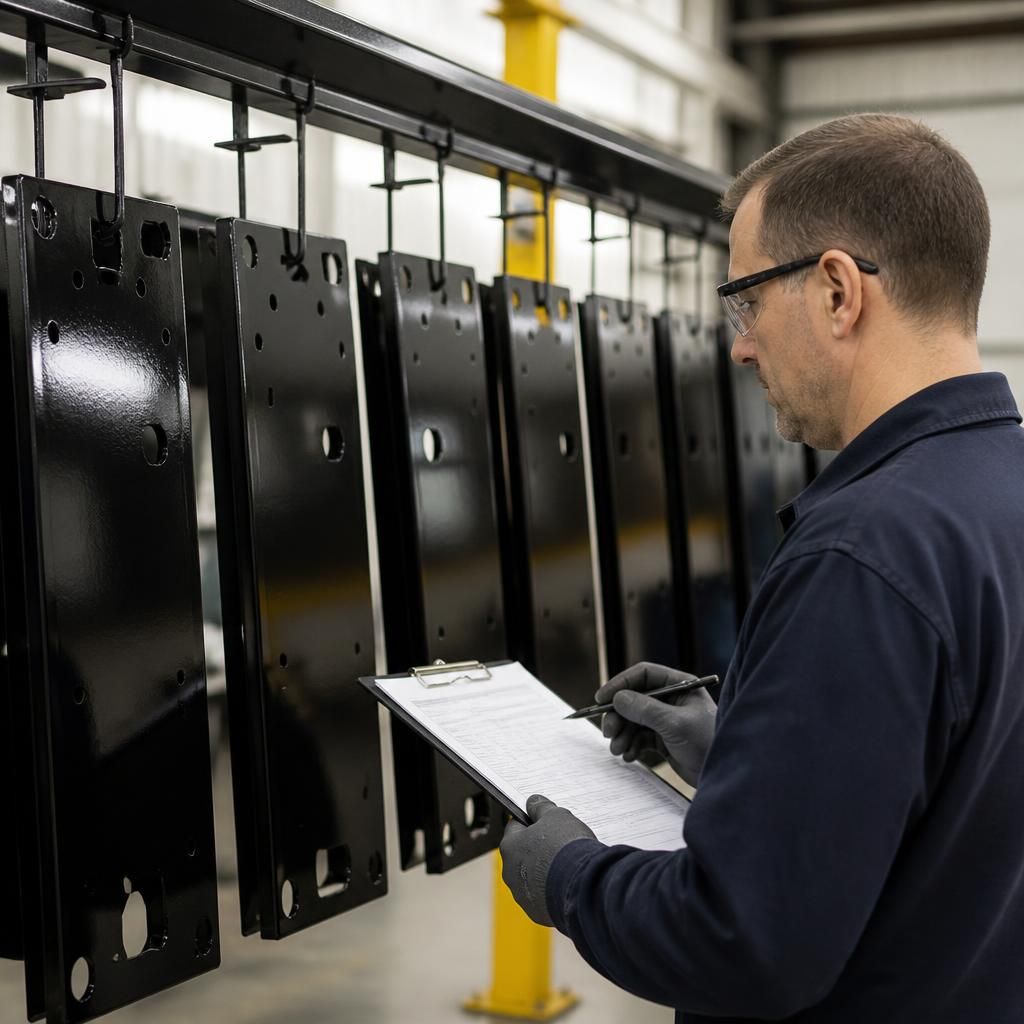
The environmental impact of a shiny black powder coat finish should be assessed on a like-for-like basis against the performance it provides. A coating that meets the required corrosion, abrasion and appearance specification in a single suitable system may avoid additional treatment stages, but this should be confirmed from the technical specification rather than assumed from its colour or gloss.
For a more reliable comparison, review the product’s technical data sheet, safety data sheet and any available lifecycle information alongside details of pretreatment, curing and waste controls. These documents can clarify the formulation, handling requirements and operating limits, helping to distinguish a genuinely lower-impact option from one that appears sustainable only because it produces fewer solvent emissions during application.
Assess the environmental impact of your shiny black powder coat finish
Share your component details and operating conditions with Powder-coatings.co.uk for a project-specific assessment of whether a shiny black powder coat finish is an appropriate lower-impact option. The comparison can consider the required performance, pretreatment, curing and end-of-life requirements together.