

What are the crucial steps involved in achieving a consistent and high-quality electrostatic powder coating finish?
A consistent, high-quality electrostatic powder coating finish depends on thorough surface preparation, correct powder application, controlled curing and final inspection. Each stage must be matched to the metal substrate, component design and required performance so the coating bonds evenly and cures to the specified finish.
A consistent electrostatic powder coating finish is achieved by controlling the complete coating sequence: define the required performance, prepare and handle the component correctly, establish reliable electrical contact, apply powder under controlled conditions, follow the specified thermal profile and verify the finished coating against agreed requirements.
- Define the coating specification. Before processing begins, identify the substrate, component geometry, service environment and required appearance. The specification should cover the powder type, colour, gloss level, texture, corrosion resistance, film build, masking requirements and any areas that must remain uncoated. Clarifying these points prevents a visually acceptable finish from being supplied when it does not meet the component’s functional requirements.
- Assess the component design and condition. Corners, recesses, holes, folded sections and overlapping joints affect how powder behaves during application. Deep recesses can create Faraday-cage effects, where the electrostatic field makes it difficult for powder to reach the required area. Sharp edges may also receive a different coating build from broad, accessible faces. These characteristics should be considered when deciding how the part will be positioned, racked and coated.
- Prepare a clean, chemically suitable surface. Oil, grease, mill scale, rust, weld residue, moisture and previous coatings can interfere with adhesion or cause defects such as pinholes and blistering. The preparation route must suit the metal and the required coating system. Cleaning, chemical treatment, abrasive preparation or a combination of methods may be appropriate, but the important control is that the surface is free from contamination and compatible with the powder system before coating starts. Parts should then be protected from handling contamination.
- Plan masking and racking carefully. Plugs, caps and masking materials protect threads, bearing seats, electrical contact points and other areas that must remain free of powder. Racking must support the component securely without creating avoidable contact marks or shielding faces from the powder cloud. Each part also needs a dependable earth path; poor contact caused by coating build-up on hooks or dirty contact points can reduce transfer efficiency and produce uneven coverage.
- Control the application variables. Gun-to-part distance, gun movement, voltage, current, powder flow, air pressure and the position of the component all influence the deposited layer. Operators should use a repeatable technique rather than relying on visual build alone. Recesses may require a different gun angle or sequence, while edges and exposed faces may need careful control to prevent excessive build. Powder should be stored, sieved or reclaimed in accordance with the product’s requirements so that moisture, contamination and mixed colours do not affect the finish.
- Manage the surrounding conditions and handling. Temperature, humidity, ventilation and cleanliness can affect powder behaviour and surface appearance. Components should be handled with suitable gloves or equipment after preparation, and the spray area should be kept free from incompatible powder residues. Colour changes and equipment cleaning need particular control where different powders are processed, as small traces of another colour or chemistry can be visible in the final finish.
- Use the correct curing profile for the actual part. The relevant temperature is the metal’s temperature, not simply the temperature shown by the oven controller. Part thickness, mass, loading pattern and metal type affect how quickly the component reaches the required condition. Cure verification should therefore reflect the heaviest or most thermally demanding components in the batch. Under-cure can reduce performance, while excessive heat or time can alter colour, gloss or the properties of the coating.
- Inspect against measurable acceptance criteria. Examination should cover colour, gloss, texture, coverage, visible defects, masking lines and contact marks. Where required, coating thickness, adhesion and cure should be checked using appropriate methods rather than judged solely by appearance. Any issue should be traced back to the relevant process variable, such as contamination, earthing, application technique or oven performance.
- Record and repeat the proven process. Batch records can include the powder identification, substrate, preparation route, rack arrangement, application settings, oven conditions and inspection results. This information makes it easier to reproduce an approved finish and investigate variation between batches. A controlled sample or approved reference panel can also help compare future work for colour, gloss and texture without relying on memory.
For industrial components, consistency depends less on one isolated operation than on the interaction between these controls. A coating system should therefore be assessed as a complete process, with the component design, powder specification, equipment settings and thermal cycle all aligned before production work is repeated at scale.
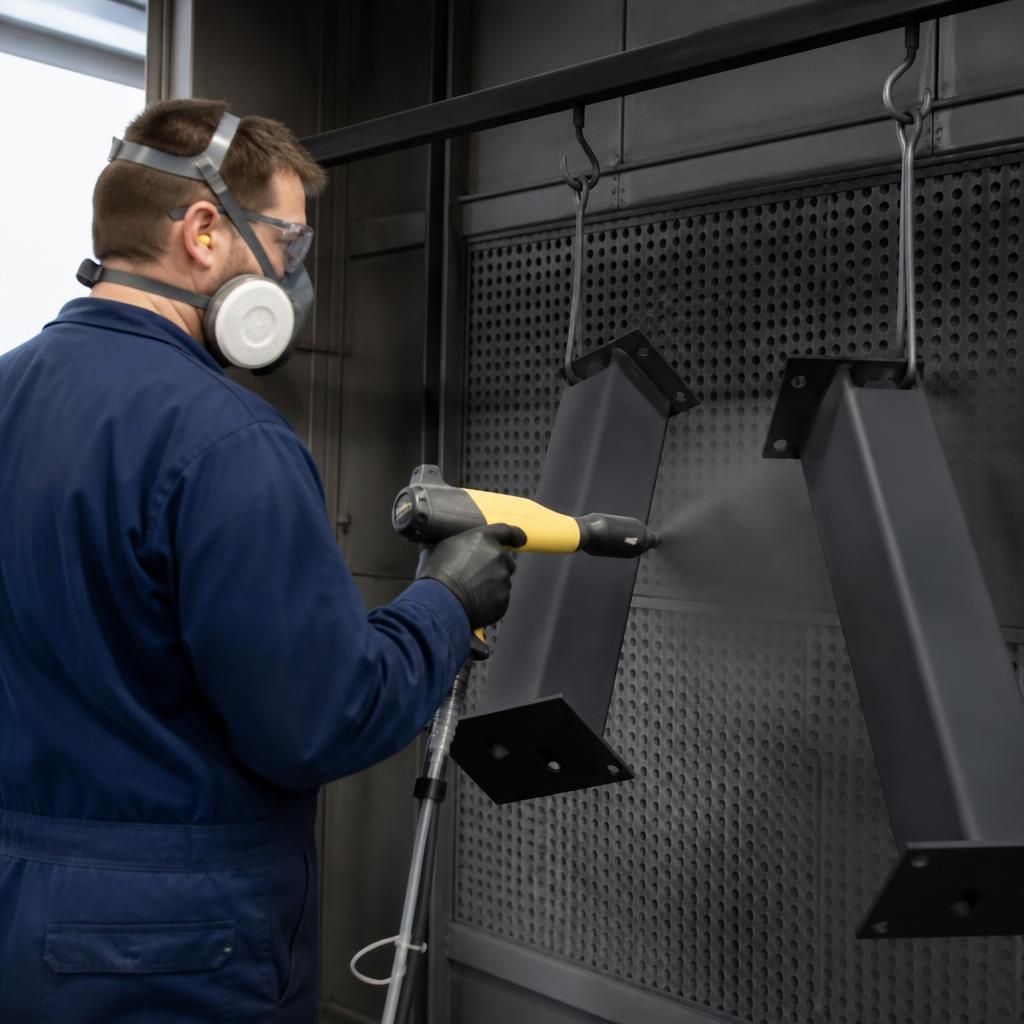
Substrate-specific preparation is a crucial step in achieving a consistent electrostatic powder coating finish. Different metals and fabrication methods can introduce different risks, so the preparation process must be selected for the actual component rather than applied as a universal routine.
Galvanised steel may carry passivation residues or surface oils that require compatible cleaning and chemical treatment. Cast metal can contain pores that release trapped gas during heating, potentially causing pinholes or blistering. Welded areas may also retain residues or have sharp transitions that affect the finished film. Identifying these conditions before coating allows the preparation method and powder system to be adjusted accordingly.
Where the substrate presents a known outgassing or adhesion risk, a trial component or representative section can confirm that the selected process produces the required appearance before larger batches are processed. This is particularly useful when different metals, fabrication methods or surface conditions are combined within one order.